Slovenčina


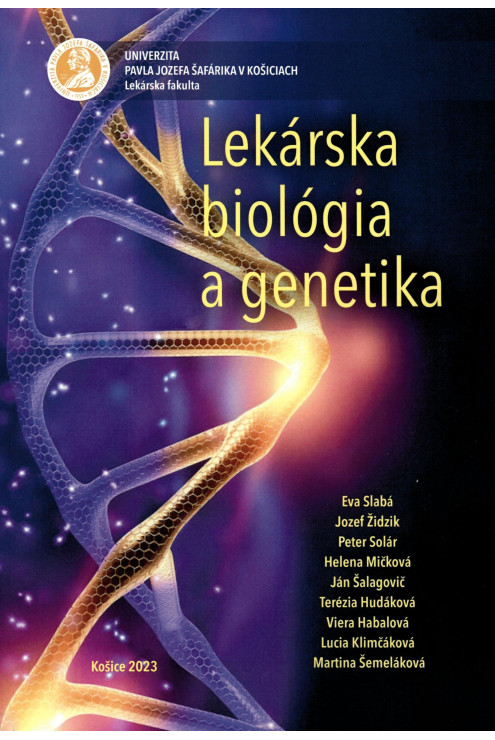
Eva Slabá - Jozef Židzik a kolektív
Vysokoškolská učebnica „Lekárska biológia a genetika“ poskytuje v zrozumiteľnej podobe teoretické základy bunkovej biológie, molekulovej biológie a genetiky. Obsahuje najnovšie poznatky z relevantných odborov doplnené názornými obrázkami, tabuľkami a grafmi. Prehľadne členené kapitoly zoznámia študentov s problematikou bunkovej biológie, procesov molekulovej biológie a zákonitosťami genetiky. Vysokoškolská učebnica je určená predovšetkým pre slovenských študentov I. ročníka lekárskych fakúlt. Jej obsah je podkladom pre úspešné zvládnutie obsahovej náplne predmetu biológia. Učebnica je vhodná aj ako hlavný zdroj informácií pre študentov prírodovedeckých fakúlt. Okrem základných údajov obsahujú niektoré kapitoly aj doplňujúce informácie pre lepšie pochopenie jednotlivých tematických okruhov. Tieto podrobnejšie údaje sú odlíšené veľkosťou písma a nie sú nevyhnutné pre zvládnutie skúšky z biológie. Príslušné informácie však môžu využiť i študenti vyšších ročníkov lekárskych fakúlt či študenti postgraduálneho štúdia.

Data sheet
Specific References
Tradícia organizovania kolokvií na Slovensku už štandardne prináleží vždy inému akademickému slovakistickému pracovisku. Jeho XXXI. ročník sa realizoval pod organizačnou taktovkou Katedry slovakistiky, slovanských filológií a komunikácie Filozofickej fakulty UPJŠ v Košiciach, ako aj košickej pobočky Slovenskej jazykovednej spoločnosti a Slovenskej jazykovednej spoločnosti pri Jazykovednom ústave Ľ. Štúra SAV, v. v.i. V univerzitných priestoroch Učebno-výcvikového zariadenia Danišovce sa počasdvojdňového podujatia stretli nádejní mladí jazykovedci nielen zo Slovenska, ale aj z Českej republiky. Výstupom kolokvia mladých jazykovedcov býva najprv zborník abstraktov, publikovaný už v čase realizovania podujatia, a neskôr zborník príspevkov ako pripomienka tejto udalosti a tiež ako odraz vedeckých záujmov mladých lingvistov. Kolokvialisti prezentovali svoje príspevky venované výskumným problémom z rôznych oblastí jazykovedy, a to z oblasti korpusovej lingvistiky, onomastiky, morfológie, dialektológie, syntaxe, štylistiky, lexikológie, frazeológie aj didaktiky, niektorí dokonca s presahom do literárnych textov.
Tento učebný text je určený poslucháčom medziodborového štúdia v kombináciách s matematikou, jednoodborového štúdia matematiky ako aj rozširujúceho štúdia matematiky. Je za-meraný na kvadratické kongruencie a niektoré diofantovské rovnice.
Autor
E-book
Adriana Boleková (ed.)
Proceedings of Scientific Works
The Košice Morphological Day is an annual May meeting of morphologists, primarily attended by Košice morphological workplaces. On this occasion, a collection of scientific works is regularly published.
This year's collection was published on the occasion of the 23rd Košice Morphological Day, which did not take place due to the poor epidemiological situation.
In the collection, the authors present the results of their scientific-research and pedagogical activities, which are in the form of theoretical overview studies and research works.
E-book
Iveta Domoráková - Štefan Tóth - Zuzana Fagová - Eva Mechírová - Alexandra Kunová - Kristína Čurgali - Viera Eliášová - Monika Holodová - Marianna Danková
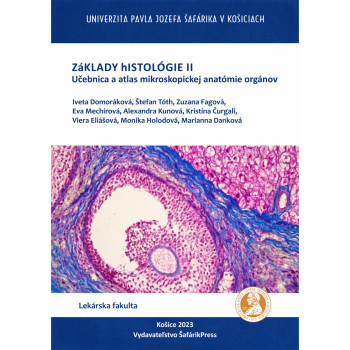
In our new electronic textbook, FUNDAMENTALS OF HISTOLOGY II – Textbook and Atlas of Microscopic Anatomy of Organs, we present students and the professional public with essential information about the microscopic structure of organs, accompanied by extensive visual documentation of organ structures and clear legends for the microphotographs.
All histological specimens come from the archive of the Institute of Histology and Embryology, are used in practical exercises, and are also included in teaching presentations. The electronic textbook is intended for undergraduate and postgraduate students of general medicine and dentistry at medical faculties, as well as for students of veterinary medicine and pharmacy, and biology students at faculties of natural sciences.
The textbook is designed so that students can find clear explanations of most medical terms and also reinforce their knowledge of professional terminology in Latin. An advantage of the electronic textbook is the ability to enlarge microscopic photographs, allowing detailed observation of structures without any qualitative loss of the viewed image. The microphotographs used in the atlas were taken with the following equipment: Zeiss Promicra and Olympus BX50 with a Canon EOS 2000D digital camera and QP Industrial 3.2 software.
Download e-book for free (pdf)