• New
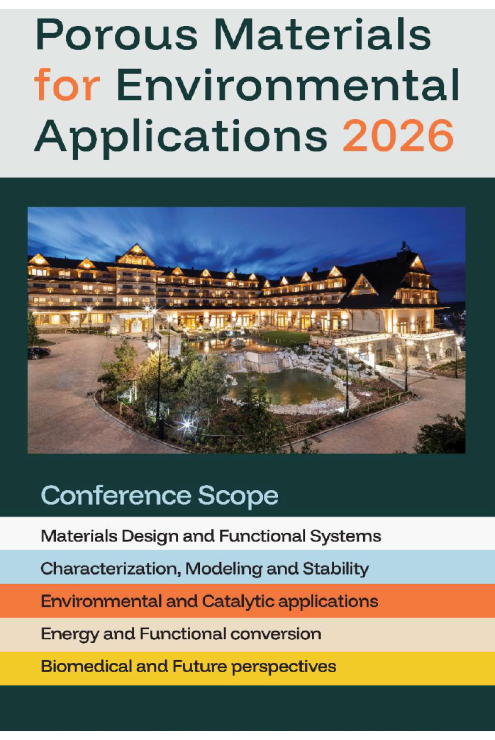
    Porous Materials for Environmental Applications 2026

Porous Materials for Environmental Applications 2026

E-book

Miroslav Almáši  Nikolas Király   eds.

The conference proceedings of Porous Materials for Environmental Applications 2026 represent a collection of scientific and professional contributions presented at the international scientific conference held on 15–19 March 2026 in Białka Tatrzańska (Poland). The conference focused on current trends in the research of porous materials and their applications in environmental, catalytic, energy-related, and biomedical fields. The event provided an interdisciplinary platform for the exchange of the latest scientific knowledge in the design, synthesis, characterization, and practical utilization of porous materials.

Particular attention was devoted to their application in adsorption and separation processes, heterogeneous catalysis, photocatalysis, energy storage and conversion, as well as in biological and medical applications. The published abstracts reflect current challenges related to sustainable development, green technologies, and advanced materials solutions. The proceedings offer a comprehensive overview of the current state of porous materials research at the international level and document the dynamic development of this field with significant overlap into environmental chemistry, materials science, and chemical engineering.

Download the e-book for free (pdf)

Quantity

978-80-574-0507-8

Data sheet

Method of publication:
E-book (pdf)
Editors:
Miroslav Almáši, Nikolas Király
Document type:
Proceedings
Number of pages:
140
Available from:
04. 03. 2026
Year of publication:
2026
Edition:
1st edition
Publication language:
English
Faculty:
Prírodovedecká fakulta
License:
CC BY NC ND (Uveďte autora - Nepoužívajte komerčne - Nespracovávajte)
DOI:
https://doi.org/10.33542/PMEA-0507-8
- Free for download

16 other products in the same category:

Vybrané experimentálne úlohy z koloidiky

E-book

E-book

Daniela Kladeková

This university text is intended for students of chemical and ecological sciences at the Faculty of Natural Sciences of the P. J. Šafárik University in Košice and is intended to serve as a tool for experimental exercises in colloid chemistry. Colloid chemistry is an important part of the theoretical basis of the chemical sciences and belongs to the newer interdisciplinary fields of natural sciences.

It combines knowledge from physical chemistry, physics and biology, while also drawing on a solid knowledge of mathematics and other scientific disciplines. Experiments are often essential in understanding the problems of colloid chemistry, modelling ideas about the phenomena and laws involved in the discipline. This is why active participation in experimental exercises is so important and essential to mastering the material in colloid chemistry.

In selecting the tasks for these scripts, it was also necessary to respect the considerable limitations imposed by the possibilities of the laboratory instrumentation and material equipment of our department. Despite this limitation, however, they can illustrate to students the basic theoretical physicochemical principles of colloid dispersion systems and, importantly, their understanding can contribute to the understanding of some of the more important peculiarities of colloidal phenomena.

Download the e-book for free (pdf)

DidSci+ Conference 2022 - PROCEEDINGS −...

E-book

E-book

Mária Ganajová - Jozef Hanč - Ivana Sotáková - Petra Letošníková (eds.)

The International Conference on Research in Didactics of the Science – DidSci+ 2022, continues in the educational legacy of the successful series of the previous DidSci conferences held from 2004 in Krakow, Prague, Brno, or Trnava. The DidSci+ conferences present a platform for enduring international cooperation, focusing on the frontiers and current challenges in science education research. This special edition of DidSci conferences, celebrating its 10th anniversary, was held in Košice, at the Faculty of Science of Pavol Jozef Šafárik University, from June 26 to 29, 2022. The careful double-blind review process has led to two major publications offering a comprehensive look at the latest advances in STEM and science subjects education. The first volume of selected papers is published as the IOP Conference Series proceedings, Vol. 3037 with open access at https://iopscience.iop.org/issue/1742-6596/3037/1, and is primarily devoted to STEM education, assessment, evaluation, feedback strategies, and teacher development. The second volume of selected papers, published by ŠafárikPress, focuses more on curriculum development, educational innovation, and digital technologies, primarily in chemistry and biology. Both publications are intended for a wide audience, including in-service and pre-service teachers of science subjects, university students in scientific disciplines, researchers in science education, professionals in pedagogical and methodological centers, curriculum developers, and textbook authors.

Download the e-book for free (pdf)

Laboratórny potkan a jeho využitie v...

E-book

E-book

Terézia KiskováStanislav MatéffyFrantiška Horváthová

The laboratory rat (Rattus norvegicus) is one of the most commonly used experimental animals. It serves as a model organism for analyzing numerous biological processes and pathological mechanisms, such as cardiovascular diseases, metabolic disorders (e.g., lipid metabolism, diabetes mellitus), neurological and neuropsychiatric conditions (e.g., stroke, epilepsy, or Alzheimer's disease), neurobehavioral research, autoimmune diseases (e.g., arthritis), cancer, and renal diseases. It offers many unique advantages for modeling human diseases, testing drugs and natural substances, and studying responses to environmental factors. The size of the laboratory rat, compared to the mouse, creates ideal conditions for physiological manipulations. Additionally, rats are used in clinical toxicology to test chemical substances (Hedrich, 2000).

Download the e-book for free (pdf)

14.česko-slovenská študentská vedecká...

E-book

E-book

Adriana Zeleňáková - Zuzana Ješková - Adela Kravčáková - Gabriela Fabriciová - Erik Čižmár - Róbert Tarasenko - Jaroslava Szűcsová - Ľuboš Nagy (eds.)

Zborník obsahuje abstrakty príspevkov účastníkov 14. česko - slovenskej študentskej vedeckej konferencie vo fyzike, ktorá sa konala 2.-3.mája 2024 na PF UPJŠ v Košiciach.

Download the e-book for free (pdf)

Praktikum z molekulového modelingu

E-book

E-book

Ladislav Janovec

An enormous progress in computer technology, closely linked with advances in computational chemistry, has enabled the user to exploit the principles of quantum chemistry to elucidate the chemical phenomena.

Computational chemistry is the branch of science that requires, except an academic knowledge, software skills to fully exploit a potential of theoretical methods. The aim of this textbook is to help the user take the legendary first step in the field of computational chemistry to opening a new horizon of knowledge.

Download the e-book for free (pdf)

Študentská vedecká konferencia PF UPJŠ 2016

E-book

E-book

Vladimír Zeleňák (ed.)

Proceedings of Abstracts of the Student Scientific Conference of the Faculty of Science, Pavol Jozef Šafárik University in Košice

A characteristic feature of education at high-quality universities — among which the Faculty of Science at Pavol Jozef Šafárik University (UPJŠ) in Košice proudly belongs — is the close connection between education and scientific research. Students gain knowledge in their field of study not only through theoretical coursework in individual disciplines, but also through active involvement in solving specific scientific tasks as part of research teams. This can occur during the development of final theses or through participation in the Student Research Assistant Program (ŠPVS), which was revitalized at the faculty in 2015.

The Student Scientific Conference (ŠVK) is one of the faculty’s traditional events, organized during the Faculty’s Science Days as part of Sciencefest. By its very nature, it fits seamlessly into the aforementioned framework of combining education with research, and it has long enjoyed great popularity and student interest. In 2016, the conference featured presentations by 125 students of the Faculty of Science at UPJŠ in Košice, across 16 thematic sections. This collection of abstracts provides an overview of the focus and goals of the student projects. We believe it will serve as inspiration for other potential participants of future conferences and will also be of interest to the broader public, offering additional insight into the faculty's activities.

Download the e-book for free (pdf)

Vybrané úlohy a výpočty z biochémie – metabolizmus

E-book

E-book

Nataša Tomášková

Selected tasks and problems from biochemistry – metabolism follow biochemistry lectures on metabolism and individual metabolic pathways for students of the second and third year of the bachelor’s degree in the fields of chemistry, biology and their combinations with other fields. Scripts provide an opportunity to better understand the lectured subject matter of metabolism through the solution of tasks and problems as serve as a basis for one-hour exercises. The scripts are divided thematically into eleven chapters, and each chapter contains 10 tasks and 7 problems. At the beginning of the chapters there is a short description and explanation of the given metabolic pathway. However, when solving the tasks, the student must focus mainly on the curriculum that was presented on the given topic in the lecture. Subsequently, at the end of chapter, answers to problems are also presented. These scripts are intentionally accessible only in electronic form. The reason is the effort to continuously update and modernize individual tasks.

Download e-book for free (pdf)

Základné fyzikálne praktikum II.
  • On sale!
  • -€9.55

Základné fyzikálne praktikum II.

€10.55 €1.00 -€9.55
Availability: 21 In Stock

Peter Kollár a kol. 

Skriptá Základné fyzikálne praktikum II. sú určené pre študentov Prírodovedeckej fakulty UPJŠ v Košiciach študujúcich na študijných programoch fyzika a medziodborových programoch v kombinácii s fyzikou. Obsahom skrípt sú úlohy z elektriny, magnetizmu a optiky. Podľa študijných programov sú zaradené do 3.semestra bakalárskeho štúdia, v ktorom by už študenti mali mať absolvovaný predmet všeobecná fyzika II. (elektrina a magnetizmus). Súčasťou každej úlohy sú základné poznatky venované javom, ktoré sú obsahom samotnej úlohy.

Autori

Zborník abstraktov z X. medzinárodného...

E-book

E-book

Marián Kulla – Ladislav Novotný – Petra Dávidová – Anton Uhrin (eds.)

Danišovce 16. – 18. 10. 2024

Zborník abstraktov, ktorý máte pred sebou, obsahuje príspevky prezentované na X. Medzinárodnom geografickom kolokviu v Danišovciach. Ústav geografie na Prírodovedeckej fakulte UPJŠ v Košiciach toto podujatie organizuje už od svojho vzniku ako platformu na výmenu vedeckých poznatkov, primárne medzi geografmi zo Slovenska a Česka. Aktuálny jubilejný ročník spoluorganizovali Prírodovedecká fakulta UPJŠ v Košiciach, Slovenská geografická spoločnosť pri SAV v Bratislave v zastúpení jej Košickej pobočky a spoločnosť UMBRA Solutions Košice.

Download the e-book for free (pdf)

Matematika pre nematematické odbory
  • On sale!
  • -€7.96

Matematika pre nematematické odbory

€8.96 €1.00 -€7.96
Availability: 135 In Stock

Danica StudenovskáTomáš Madaras 

Táto publikácia je určená pre študentov nematematických odborov na Prírodovedeckej fakulte UPJŠ v Košiciach. Jej obsahom je látka preberaná v prvom semestri v rámci predmetu Matematika I..

Publikácia nadväzuje na učivo stredných škôl a nevyžaduje žiadne predbežné špeciálne znalosti. Môže slúžiť ako základ na ďalšie samostatné štúdium a môže byť užitočná aj pre iných záujemcov o matematiku a jej aplikácie.

Vyriešené príklady v jednotlivých kapitolách majú pomôcť čitateľovi pri zvládnutí štúdia. Tomu napomáhajú aj ilustratívne obrázky.

Autori

BIOLÓGIA LIŠAJNÍKOV. Časť C: Identifikácia...

E-book

E-book

Mária VilkováMonika GarberováMichal Goga

Nuclear Magnetic Resonance (NMR) is currently a widely used analytical tool that finds application in many fields of science and technology. The broadening of its practical use brings with it the necessity to create educational texts appropriate to the given scientific discipline.

This university textbook is intended for students of biology and serves as a supplement to the study materials for the advanced master's course "Biology of Lichens." At the same time, it represents a useful resource for master's and doctoral students involved in research, helping them interpret NMR spectra and present basic theoretical concepts.

The textbook briefly describes the important aspects of each NMR spectroscopic technique without delving excessively into the physical principles of individual methods or complex mathematical analyses. In this edition, the structures of lichen metabolites have been included, which students will isolate, purify, and identify using various analytical methods during practical exercises. An entire chapter is dedicated to a detailed description of solving the NMR spectra of isolated metabolites, with each step in elucidating the structures of both known and unknown metabolites explained in detail. The solved tasks are followed by numerous unsolved examples, including high-resolution 1D and 2D NMR spectra of metabolites, intended to further develop the acquired knowledge and skills of students and doctoral candidates in structure elucidation using NMR spectroscopy.

Download e-book for free (pdf)

Základy astronómie a astrofyziky

E-book

E-book

Rudolf Gális

The presented work provides basic knowledge of astronomy and astrophysics in a completely new multimedia format. The scope of the knowledge presented is mainly focused on stellar astrophysics and supplemented by cosmology beyond the title of the work.

A new approach in this work is the large proportion of visual materials, graphs, and video clips, contrasted with the brevity of the accompanying text. Such a form of presenting knowledge in this field is unprecedented in Slovakia, and therefore this work can be considered a completely innovative piece. It should be emphasized that the engaging form of the presented knowledge does not come at the expense of its content. The work contains all the necessary information that a physics student, especially one with a pedagogical focus, should master. The work can also be an invaluable aid to teachers in secondary and even primary schools, as well as professional astronomers in popularizing astronomical knowledge.

This suggests that the work covers a relatively wide range of needs at various institutions dealing with astronomy, from universities, through faculties of education and grammar schools, to observatories, planetariums, and astronomy clubs.

Download the e-book for free (pdf)

School of XFEL and Synchrotron Radiation Users...

E-book

E-book

Jozef Bednarčík (ed.)

The SFEL school is continuation of the Winter Schools of Synchrotron radiation held in 2011, 2013, 2014 and SFEL 2017, 2018 and 2019. All schools of the series were held here, in Liptovský Ján, where our conference venue offers conditions for friendly and creative atmosphere.

The aim of the SFEL 2022 school is to facilitate the growth of a new Slovak research community with high expertise in the area of high-efficiency RTG laser, synchrotron and neutron sources. The SFEL school is designed for efficient transfer of the rapidly developing know-howin these areas to young generation – researchers and university students. The next aim of the SFEL2022 is strengthening of personal connections between the local Slovak research community and actually forming scientific teams of XFEL users, scientific teams of synchrotron or neutron sources users, respectively.

Slovak research community thus can take advantage of the fact that Slovakia is a shareholder of the European XFEL GmbH company in Hamburg, but also makes more efficient use of other closely related scientific facilities, including ILL and ESRF in Grenoble and DESY in Hamburg.

Download the e-book for free (pdf)

Základy geografie obyvateľstva a demografie I....

E-book

E-book

Janetta Nestorová Dická

The university handbook Elementals of Population Geography and Demography - Part I, as an introduction to population studies, is primary study material for students of the geography study program, as well as for students of the Information Systems in Public Administration study program at the Pavel Jozef Šafárik University in Košice, but also for the wider public interested in about population phenomena and their spatiality. Among other things, the handbook offers the latest population reports in the world and its regions.

The aim of the handbook is to introduce young geographers to the basics of population research, which includes the most frequently used tools and methods in geographic analysis. The first part of the handbook contains an introduction to the scientific disciplines of population geography and demography with an overview of basic sources of demographic data.

The next part discusses the issue of anthropogenesis, i.e. the development of humans from our ancestors and the spatial spread of humans across our Earth. Part of this part is the recent development of the world population and changes in the size and distribution of the global population over time. The last part analyses how the population is distributed in the world and in relation to the geographical components of the space.

Download the e-book for free  (pdf)

Počítačová fyzika I

E-book

E-book

Milan Žukovič

The textbook Computational Physics I covers the topics taught in the course of the same name at the bachelor's level of the Physics study program, as well as in the course Application of Numerical Methods at the bachelor's level of the Applied Informatics study program.

The text builds upon the basic course in numerical methods, focusing on explaining the fundamental principles of computer-based solutions to some typical physics problems. It includes both the area of deterministic methods for solving problems modeled by ordinary and partial differential equations, as well as the area of stochastic Monte Carlo simulations. The course Computational Physics I lays the foundation for further study of more advanced computational methods taught at the master's level in the subject Computational Physics II. Nowadays, the use of computers as a tool for solving real physics problems, and for students as a tool for preparing their final bachelor's or master's theses, is almost indispensable.

This has led to the creation of numerous user-oriented software packages in various environments for solving a wide range of problems. However, without a thorough understanding of how individual computational techniques work, these programs become black boxes with many pitfalls and risks in their use. Therefore, this text emphasizes understanding both the strengths and weaknesses of individual methods and the assumptions for their successful application.

Download the e-book for free (pdf)

This website uses cookies to ensure you get the best experience on our website