- New

Zavolajte nám:
+421 55 234 1635Kolektív autorov
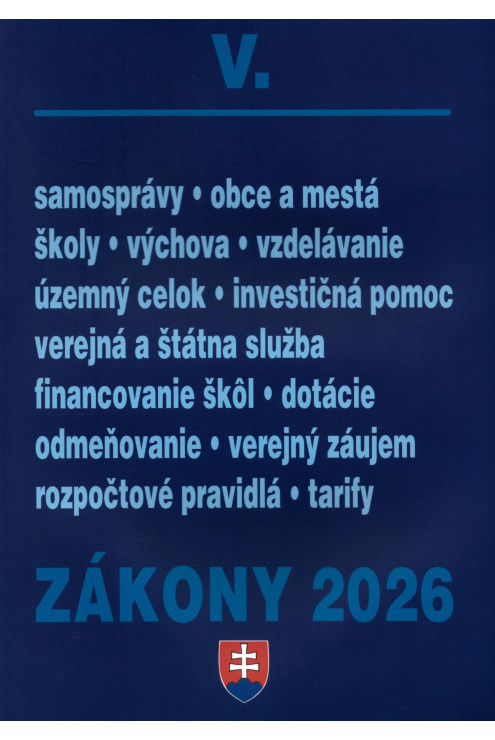
Titul obsahuje úplné znenie zákonov z oblastí rozpočtových pravidiel, štátnej a verejnej služby, zákonov z oblasti školstva, samosprávy, miest a obcí po novelách k 1. 1. 2026. . Zmeny v zákonoch sú v texte prehľadne vyznačené. Publikácia sa venuje rozpočtovým pravidlám, poskytovaniu dotácií, výkonu práce vo verejnom záujme, elektronickej komunikácii, výchove a vzdelávaniu, financovaniu škôl, majetku obcí, verejným prácam, regionálnemu rozvoju, investičnej pomoci...
Titul Štátna a verejná správa, školy a obce obsahuje:
1. Rozpočtové pravidlá
ZÁKON č. 523/2004 Z. z. o rozpočtových pravidlách verejnej správy
ZÁKON č. 70/2025 Z. z. o poskytovaní dotácií pre Plán obnovy...
ZÁKON č. 583/2004 Z. z. o rozpočtových pravidlách územnej samosprávy
2. Štátna a verejná služba
ZÁKON č. 552/2003 Z. z. o výkone práce vo verejnom záujme
ZÁKON č. 553/2003 Z. z. o odmeňovaní niektorých zamest. pri výkone práce vo verejnom záujme
ZÁKON č. 55/2017 Z. z. o štátnej službe
ZÁKON č. 452/2021 Z. z. o elektronických komunikáciách
3. Školy
ZÁKON č. 245/2008 Z. z. o výchove a vzdelávaní (školský zákon)
ZÁKON č. 131/2002 o vysokých školách
ZÁKON č. 321/2005 Z. z. o školskej správe a o zmene a doplnení niektorých zákonov
VYHLÁŠKA č. 541/2021 Z. z. o materskej škole
VYHLÁŠKA č. 223/2022 Z. z. o základnej škole
VYHLÁŠKA č. 224/2022 Z. z. o stredných školách
ZÁKON č. 322/2025 Z. z. o financovaní škôl a školských zariadení
4. Obce a mestá
ZÁKON č. 369/1990 Zb. o obecnom zriadení
ZÁKON č. 138/1991 Zb. o majetku obcí
ZÁKON č. 500/1991 Zb. o pôsobnosti obcí vo veciach nájmu a podnájmu nebyt. priestorov
ZÁKON č. 254/1998 Z. z. o verejných prácach
VYHLÁŠKA č. 83/2008 Z. z., ktorou sa vykonáva zákon č. 254/1998 Z. z. o verejných prácach
NARIADENIE VLÁDY Č. 341/2004 Z. z., ktorým sa ustanovujú katalógy pracovných činností pri výkone práce vo verejnom záujme
NARIADENIE č. 296/2022 Z. z., VLÁDY, ktorým sa ustanovujú zvýšené stupnice platových taríf zamestnancov pri výkone práce vo verejnom záujme
ZÁKON č. 564/1991 Zb. o obecnej polícii
ZÁKON č. 302/2001 Z. z. o samospráve vyšších územných celkov (zákon o samospr.krajoch)
ZÁKON č. 416/2001 Z. z. o prechode niektorých pôsobností z orgánov štátnej správy na obce a na vyššie územné celky
ZÁKON č. 514/2003 Z. z. o zodpovednosti za škodu spôsobenú pri výkone verejnej moci
ZÁKON č. 180/2013 Z. z. o organizácii miestnej štátnej správy
ZÁKON č. 525/2003 Z. z. o štátnej správe starostlivosti o životné prostredie
ZÁKON č. 539/2008 Z. z. o podpore regionálneho rozvoja
ZÁKON č. 57/2018 Z. z. o regionálnej investičnej pomoci
ZÁKON č. 305/2013 Z. z. o elektronickej podobe výkonu pôsobnosti orgánov verejnej moci
Data sheet
Specific References
E-book
Jozef Suchoža - Ján Husár - Regina Hučková
In 2020 and 2021, the tradition of holding the Law – Business – Economics conference was exceptionally interrupted due to the unprecedented situation associated with the spread of Covid-19. This year, the situation allows us to restore the tradition of our Tatra conference and, after two years, to once again meet in person with our traditional domestic and international participants. At the same time, we look forward to welcoming participants who are attending our conference for the first time (and we hope it will not be the last).
You are holding in your hands the proceedings of scientific papers, published in connection with the implementation of scientific projects at the scientific workplace – the Department of Commercial and Economic Law, as the main organizer of the scientific conference, as well as at other departments of the Faculty of Law at UPJŠ and at many academic institutions both at home and abroad. The proceedings are published with the support of the Slovak Research and Development Agency. The editors would like to thank everyone who contributed their scientific articles, as well as the reviewers for their valuable comments and recommendations.
E-book
Žofia Šuleková (ed.)
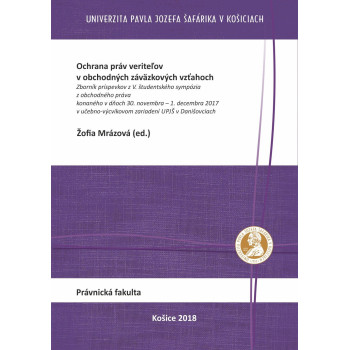
Proceedings of the Contributions from the IV. Student Symposium on Corporate Law held on November 24-25, 2016, at the Training Facility of Pavol Jozef Šafárik University in Danišovce.
The Department of Commercial Law and Economic Law at the Faculty of Law of Pavol Jozef Šafárik University in Košice organized the fourth edition of the student symposium, this time focusing on corporate law.
The event took place on November 24-25, 2016, at the training facility of Pavol Jozef Šafárik University in Danišovce. The aim of the annually organized symposiums is to create a discussion platform for students with the participation of mentors from the department, including teachers, researchers, and doctoral students. This year’s symposium focused on problematic issues related to the legal status of a partner in a commercial company. The topics were assigned to allow students to demonstrate and develop their analytical and argumentative skills while improving their ability to present and formulate their own views and perspectives.
The presented proceedings are the outcome of the students' work from this event.
E-book
Dominika Zavadová(ed.)
Proceedings from the 3rd Student Symposium on Commercial Law
In November 2015, the third annual Student Symposium on Commercial Law took place at the university facility in Danišovce.
After two years of symposia focused on company law, the main topic of the third edition was the general part of commercial obligations law. This year as well, the goal of the student symposium remained to provide more space for students to formulate their own perspectives on current legal issues and to present the results of their own work.
The overarching topic made it possible to assign several current issues, allowing students to tackle problems they are likely to encounter in their future practice. The selected topics are not among those unanimously accepted by legal doctrine or established case law. On the contrary, the topics were deliberately chosen for the lack of sufficient domestic literary sources. As a result, processing the individual topics required more than just standard textbook or commentary knowledge.
The participating members of the department, both teachers and doctoral candidates, acted this year primarily as contact persons, rather than as consultants or supervisors of the students’ work. The primary purpose of the symposium at the faculty is to enable students interested in commercial law to develop their analytical and argumentative skills, as well as to express their personalities. We aim for students to develop not only professional knowledge but also personal skills-so-called soft skills-the art of presenting their own opinions and arguing persuasively.
E-book
Dominika Becková - Adam Giertl (eds.)
Collection of Papers of PhD. students and young researchers
Institute of International Law and European Law offered a place to PhD. students and young researchers to publish scientific outputs of their research. Submited collection of scientific contributions is the result of that initiative. Papers deal with the implementation of international law and law of the EU into the domestic legal system.
Thematically is the collection of contributions divided into several parts, that are dedicated to contributions dealing with the issues of legal theory and international and european law.
Contributions are addressing issues of human rights protection, they aim to the roles of international and supranational judiciary, environment, criminal and public law. Collection of contributions includes also chosen problems of private law and it also dedicates space for contributions focused on foreign investments.
E-book
Vladimíra Žofčinová (ed.)
Reviewed Proceedings of the 3rd Annual International Doctoral Student Conference, February 15, 2018
On February 15, 2018, the Faculty of Public Administration at Pavol Jozef Šafárik University in Košice hosted the second annual doctoral student conference on the theme of "Theory and Practice of Public Administration." For the first time, this academic event took on an international dimension, with participants from partner universities (faculties) in the Czech Republic and Poland, alongside representatives from six Slovak faculties.
The conference, following a brief opening session addressed by the Dean of the Faculty, Assoc. Prof. JUDr. Mária Hencovská, CSc., PhD, was organized into three sections: political science, legal, and socio-economic. Each presenter shared the results of their research, aligning with the title and content of their contribution. The event maintained a scientific-discussion format, with moderated discussions following each presentation or group of thematically related presentations.
E-book
Žofia Mrázová - Natália Kalinák (eds.)
The Department of Commercial Law and Economic Law in cooperation with the Department of Labour Law and Social Security Law and the Department of International Law and European Law of the Faculty of Law of the University of Applied Sciences in Košice organized the IXth annual student symposium, this time on commercial, labour and private international law. The student symposium under the title Decision-making practice of judicial authorities in private law took place on 29 November 2024 at the premises of the Faculty of Law of UPJŠ in Košice. The symposium was prepared within the framework of the scientific projects APVV-23-0331 “Integration of the Capital Markets Union: change of corporate financing and rescue of companies in financial difficulties” and APVV-21-0336 “Analysis of judicial decisions by artificial intelligence methods.”
This year was exceptional in that the organizers of the event decided to change the usual concept of preparing and presenting a professional article on a chosen topic. This time the students chose interesting decisions of the Supreme Court, the Constitutional Court or the Court of Justice of the European Union. They concentrated on working with one particular decision, which they analysed in detail and drafted a gloss - an expert explanation or commentary on the chosen decision. Their task consisted of a brief presentation of the facts, identification of the legal questions that the judicial authorities sought to answer, a legal analysis of the problem addressed, and an assessment of the significance of the decision for the practice of application. In their analyses, the students dealt with topical issues such as the joint action of a proxy and a member of the body, the consequences of a breach of the pre-emptive right, or the repugnancy of an agreement on the division of the community of property of the spouses. In employment law, decisions were presented concerning the right of the father of a child to a breastfeeding break or the wearing of symbols at work. In the section on private international law, the case law on cross-border relocation of the seat as well as on the choice of international jurisdiction of the courts was analysed.
The present proceedings consist of written outputs of students from this event. We are delighted that the students again this year approached their task with enthusiasm and conscientiousness. Finally, our sincere thanks go to all those who contributed to the success of the symposium.
E-book
Jozef Suchoža - Ján Husár - Regina Hučková
Proceedings of the International Scientific Symposium
Collection Law-Commerce-Economy X. is a publication containing professional contributions by the authors, especially with regard to commercial law, civil law, labor law, intellectual property law, but also digital technology law. The thematic focus of the international scientific symposium was concentrated in three areas representing open problems of commercial law with regard to the solution of the economic and social crisis caused by the so-called pandemic (corona crisis), current issues of corporate law in the EU and artificial intelligence and law: the influence of artificial intelligence on the normative activity of the state and court decisions. With regard to the content orientation of the outputs, the publication is suitable not only for readers from the academic environment, but also from applied practice.
Download e-book for free (pdf)
E-book
Collection of Papers from the 8th Student Symposium held on April 20–21, 2015 in Danišovce
The capture of the historic Syrian city of Palmyra by fighters of the radical Islamic State caused shock among the global public. The main reason is the barbarism with which this organization proceeds, not only in relation to the treasures of the world’s cultural heritage. The situation in the Middle East, where cultural treasures of inestimable value are under direct threat, demonstrates how fragile the world’s cultural heritage is. The reaction of the international public and world leaders shows how sensitively the destruction of cultural heritage is perceived.
The quoted statement chosen by the editors relates to the threat posed by the Islamic State—however, the spirit of this statement can be applied to any cultural wealth that forms part of the world’s cultural heritage. The destruction or damage of these values primarily represents a loss for humanity as such. Each destroyed artifact of world cultural heritage signifies the disappearance of a unique legacy left by previous generations for the future. At the same time, cultural heritage must be understood as a broad spectrum of assets—both tangible and intangible. Their legal protection was the topic of this year’s symposium. As with any social interest, the protection of cultural heritage can be ensured through various mechanisms and under different forms of social organization.
These diverse approaches are unified by law as a normative system. The question for the 8th year of the symposium on international law was what role international law plays in the protection of cultural heritage. In the context of the European region, the role of the European Union as a regional organization was examined.
E-book
Michal Jesenko - Rastislav Král (eds.)
Peer-reviewed proceedings of contributions from the 7th year of the international scientific conference for doctoral students, February 11, 2022 The work titled "Theory and Practice of Public Administration. Peer-reviewed proceedings of contributions from the 7th year of the international scientific conference for doctoral students held on February 11, 2022" is a comprehensive output of 29 contributions presented at the international scientific conference, which took place online on February 11, 2022. The conference is a traditional activity that is annually organized by the Faculty of Public Administration, P.J. Šafárik University in Košice. It is primarily intended for doctoral students and young researchers to facilitate open discussion, exchange of views, and mutual confrontation of the results of creative scientific activities.
This includes not only colleagues from Slovakia but also participants from abroad. The peer-reviewed articles provide, on one hand, a multidisciplinary perspective on the theoretical definition of public administration in the context of a functioning legal state. On the other hand, they also highlight practical aspects of public administration in everyday societal life. The contributions analyze the issues from the perspective of legal, economic, sociological, and political sciences.
E-book
Monika Halánová (ed.)
On June 4-6, 2024, Stará Lesná will host the 10th year of the university-wide event ‘Spring School of Doctoral Students of Pavol Jozef Šafárik University in Košice’. As part of the professional program, there will be five plenary lectures by prominent experts from Pavol Jozef Šafárik University in Košice and Comenius University, and one workshop will be held. A total of 47 full-time doctoral students will present the results of their scientific research work, of which 23 doctoral students in the section of medical and natural sciences (Faculty of Medicine/Faculty of Science) and 24 doctoral students in the section of social sciences and humanities (Faculty of Law/Faculty of Public Administration/Faculty of Arts). Part of the professional program of the event will be a panel discussion with the Management of Pavol Jozef Šafárik University in Košice.
Vladimír Babčák a kolektív
Vysokoškolská učebnica Základy slovenského finančného práva ponúka čitateľovi v kompaktnej podobe ťažiskové poznatky týkajúce sa problematiky slovenského finančného práva. V práci je spracovaná finančnoprávna problematika komplexne vo vzťahu k všetkým oblastiam ťažiskových finančno-právnych vzťahov na Slovensku. Jej obsah vychádza z autormi akceptovaných poznatkov o štruktúre systému finančného práva, z ktorého sú vyčlenené aspekty týkajúce sa daňového a poplatkového práva. Rozsah a hĺbka spracovania jednotlivých oblastí finančno-právnej regulácie závisí jednak od významu konkrétneho inštitútu finančného práva a jednak od rozsahu a druhu právnej regulácie platnej v príslušnej oblasti. Finančné právo poníma v symbióze postavenia a pôsobenia ako verejnoprávneho odvetvia, vednej a pedagogickej disciplíny, ktorá sa vyučuje na právnických i ekonomických fakultách, resp. fakultách podobného zamerania. Poznať aspoň základy finančného práva na Slovensku, ako aj obsah platných finančno-právnych predpisov by však malo byť samozrejmosťou nielen pre študentov, ale aj pre každého, kto akokoľvek vstupuje do vzťahov, ktorých predmetom sú peniaze.
E-book
Dušan Šlosár - Vladimír Lichner
This university textbook aims to provide readers with knowledge of the philosophical foundations, meaning, and purpose of mediation, based on research and analysis of mediators' activities. In countries where mediation services operate, their staff often include graduates of social work departments.
An individual approach to both the perpetrator and victim of a criminal offense requires knowledge and skills from social work, psychology, sociology, communication, and related fields tied to social work. The principles of social work apply not only in social policy and social care but also in justice. A mediator’s mission is to facilitate alternative resolutions to unlawful acts while preserving the purpose of legal proceedings as defined by valid legal norms. They fulfill this mission through specific methods of individual social work applied in the justice sector. The mediator’s focus extends beyond the current conflict to uncover related issues, activate parties to resolve disputes, and prevent new conflicts.
Special attention is devoted to the philosophical foundations of mediation in Slovakia. We provide an overview of mediators’ core activities and mediation types used to uphold justice in Slovakia. We analyze mediation goals, the roles of parties involved, and procedural steps. In applying mediation, we explore its potential and implementation in both legal and social work contexts.
As indicated, mediation cannot be understood solely as a specialized activity in criminal justice, as it has broader applications in non-judicial dispute resolution, such as family or community work, which are often overlooked by the public. The mediator’s approach to diverse target groups is grounded in theoretical frameworks. From this foundation, we derive activities expected of mediators in the future. Expanded activities arise from concrete situations encountered during mediation.
E-book
The present monograph "Regionalism and its Contribution to General International Law" was written at the Institute of European Law and Department of International Law, Faculty of Law, Pavol Jozef Safarik University in Kosice, as a part of the project (APVV-O823-11) carried out in 2011-2015, representing one of its final publication utputs.
The main reason for choosing the topic was to evaluate regionalism in its various relationships and forms with respect to international law, and also to evaluate the place,importance and duties of international law in respect to the establishment and functioning of various forms of regionalgroups.
It is a fact that even though a lot of attention has been paid to regionalism, a more complex evaluation of the impact it has had on international law, and vice versa, is still lacking. The efforts of the present monograph are to partially eliminate this gap.
After giving a brief insight into how regionalism has developed, its content and terminology, the monograph studies in more details individual types of regionalism in the form of old and new regionalism, as well as treaty and institutional regionalism; its specifications and contributions to the international law.
Marián Peťovský - Miriam Odlerová - Tomáš Škrinár
Publikácia je komplexným zhrnutím doterajších teoretických poznatkov a praktických skúseností z oblasti činností Policajného zboru. Súčasná policajná prax pociťuje absenciu publikácie, ktorá by vo svojom obsahu vysvetlila postupy pri výkone policajných činností v rozsahu súčasného znenia zákona o Policajnom zbore. Publikácia sa preto sústreďuje najmä na praktickú činnosť policajta pri výkone služby, vykonávanie služobných zákrokov, používanie donucovacích prostriedkov, ale aj povinnosti a oprávnenia príslušníkov Policajného zboru. Okrem toho rozoberá úlohy, organizáciu a riadenie Policajného zboru, informačno-technické prostriedky a operatívno-pátraciu činnosť, spracúvanie informácií Policajným zborom, spôsoby a formy kooperácie Policajného zboru s inými subjektmi a náhradu škody. Publikácia má byť praktickou pomôckou policajta vo vzťahu ku kvalitnému a efektívnemu plneniu jeho úloh, povinností a oprávnení v priamom výkone služby. Autori chcú predmetnou publikáciou osloviť čitateľov z odbornej verejnosti, najmä príslušníkov Policajného zboru, zložiek Ministerstva vnútra Slovenskej republiky, bezpečnostných mimorezortných služieb, ale tiež aj laickej verejnosti, ktorá mnohokrát dochádza do bezprostredného kontaktu so zásahmi polície do ich práv a slobôd.
E-book
The topic of our research task of the same name VEGA 1/0757/17 was based on the question – and was likewise defined in its approved project – how public administration as one of the providers of public services can act as efficiently as possible in favour of making these services available from the aspect (place of permanent residence) of the citizen.
This can be done with a certain optimality in the structure of public administration, primarily at the local, but also at the supra-local, e.g. regional, level. If, for example, the settlement structure is too disintegrated, or conversely the regional structure is too aggregated (or even too fragmented), various alternative solutions must be sought that are rational and optimal for satisfying citizens and that will not waste public resources.
In this, it is also questionable how the system of state administration authorities and local government authorities is reflected in this structure (in the case of known differences in their operation in both these regimes, or in a regime of delegated performance of state administration), including the conditions of funding these services as public services.
E-book
The author's ambition is to build on the current and at the same time to stimulate further discussion of the anchoring of labour law in the system of private law sectors and to contribute to the variation of views in relation to freedom of contract and its limits in labour law. The broad contractual freedom of civil law does not apply to the field of labour law, and thus the penetration of standard civil law institutes into labour law relations is not always self-evident.
The above constitutes the main theses of the present monograph. The issue of freedom of contract in labour law can be grasped in several ways. The author has chosen a content structure that is built on three basic pillars. In the first part, the author assesses the position of labour law in the system of law, which is determined primarily by the actual subject of legal regulation - dependent labour and the specific method of legal regulation through cogent and relatively cogent norms. In this context, the author would like to note at the outset that the much-discussed dispositive nature of labour law norms appears to be merely presumptive. Labour law is built on minima and maxima, with relative mandatory norms being the building blocks of fixed boundaries, a fact that distinguishes labour law from other branches of private law. These considerations are followed by the author's view of autonomy of will in labour law. The limits of contractual freedom (not only) in the theoretical sense form the second pillar of the author's ideas.
Finally, the third part of the thesis is to be the one that translates the theoretical-legal considerations of the interconnection of civil law and labour law into the interpretation of selected civil law institutes and the possibility of their application and implementation in labour law relations.
This website uses cookies to ensure you get the best experience on our website