- New

Zavolajte nám:
+421 55 234 1635Kolektív autorov
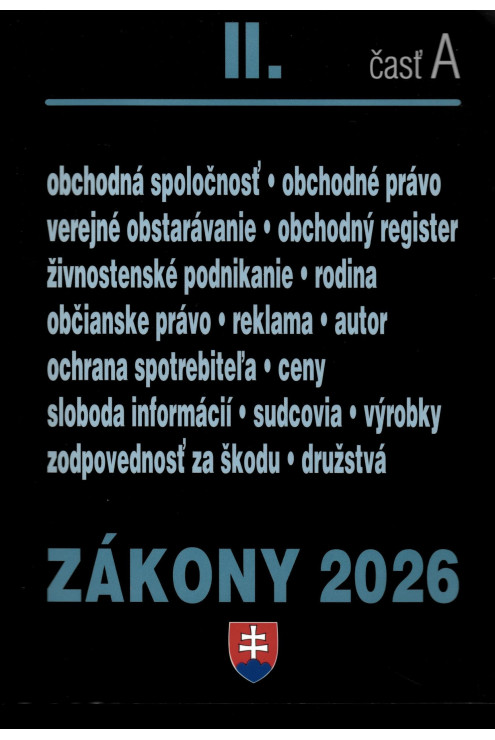
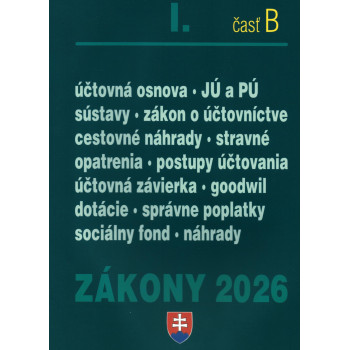
Publikácia obsahujúca právne predpisy z obchodného a občianskeho v úplnom znení. Všetky zmeny v právnych predpisoch sú zapracované k 1. 1. 2026. Zmeny v zákonoch sú prehľadne vyznačené. Súbor právnych predpisov v obchodnom práve upravuje postavenie podnikateľov, obchodné zaväzkové vzťahy, ako aj niektoré vzťahy súvisiace s podnikaním. Občianske právo vo vzťahu k občanovi upravuje predovšetkým rodinné právo, vlastnícke právo, dedičské právo a záväzkové právo.
Titul obsahuje úplné znenie zákonov a súvisiacich predpisov:
Obchodné právo (1. kapitola)
Zákon č. 513/1991 Zb. Obchodný zákonník
Zákon č. 200/2011 Z. z. o Obchodnom vestníku a o zmene a doplnení niektorých zákonov
Zákon č. 309/2023 Z. z. o premenách obchodných spoločností a družstiev
Zákon č. 272/2015 Z. z. o registri právnických osôb, podnikateľov a orgánov verejnej moci
Zákon č. 530/2003 Z. z. o obchodnom registri a o zmene a doplnení niektorých zákonov
Zákon č. 343/2015 Z. z. o verejnom obstarávaní a o zmene a doplnení niektorých zákonov
Zákon Národnej rady Slovenskej republiky č. 18/1996 Z. z. o cenách
Zákon č. 187/2021 Z. z. o ochrane hospodárskej súťaže
Zákon č. 350/2016 Z. z. o niektorých pravidlách uplatňovania nárokov na náhradu škody spôsobenej porušením práva hospodárskej súťaže
Živnostenský zákon (2. kapitola)
Zákon č. 455/1991 Zb. o živnostenskom podnikaní (živnostenský zákon)
Zákon č. 178/1998 Z. z. o podmienkach predaja výrobkov a poskytovania služieb na trhových miestach
Správne právo (3. kapitola)
Zákon č. 147/2001 Z. z. o reklame
Zákon č. 211/2000 Z. z. o slobodnom prístupe k informáciám a o zmene a doplnení niektorých
zákonov (zákon o slobode informácií)
Zákon č. 382/2004 Z. z. o znalcoch, tlmočníkoch a prekladateľoch
Zákon č. 385/2000 Z. z. o sudcoch a prísediacich
Autorské právo (4. kapitola)
Zákon č. 185/2015 Z. z. Autorský zákon
Občianske právo (5. kapitola)
Zákon č. 40/1964 Zb. Občiansky zákonník
Zákon č. 36/2005 Z. Z. o rodine
Zákon č. 108/2024 Z. Z. o ochrane spotrebiteľa
Zákon č. 514/2003 Z. Z. o zodpovednosti za škodu spôsobenú pri výkone verejnej moci
Zákon č. 116/1990 Zb. o nájme a podnájme nebytových priestorov
Zákon č. 504/2003 Z. Z. o nájme poľnohospodárskych pozemkov, poľnohospodárskeho podniku a lesných pozemkov
Občianske právo ako odvetvie súkromného práva v predmete rieši vzťahy medzi troma subjektmi, a to fyzická osoba, právnická osoba a štát. Uvedené právo upravuje majetkové vzťahy, zakladá sa na princípe rovnosti subjektov a na princípe dobrovoľnosti. Vzťahy v premete občianskeho práva majú rôzny charakter. Osobný a majetkový charakter týka sa napr. pozemkov, nemajetkový charakter sa týka napr. autorského práva a ochrana osobnosti sa týka práva na ochranu mena alebo názoru. Najvyšším prameňom obchodného práva na Slovensku je Obchodný zákonník, ktorý upravuje postavenie podnikateľov, obchodno-záväzkové vzťahy a iné vzťahy s podnikaním súvisiace.
Data sheet
Specific References
František Vavera a kolektív
Kriminalistika – tento samostatný vědní obor, který se vyvíjí staletí, je ovšem spíše moderní disciplínou, která je v současném pojetí známa více jak 130 let. Jednotlivé metody kriminalistiky se rozvíjejí zejména v návaznosti na vědeckotechnický rozvoj, ale i právní úpravu a právní myšlení. Záměrem publikace je pojmout celou materii kriminalistiky stručně, přesně a jasně, aby tato publikace byla nejen vhodnou učební pomůckou, ale také vhodným nástrojem pro samotnou praxi. Cílem publikace je popsat jednotlivé druhy kriminalistických metodik, tedy celý úvod do kriminalistiky, metodiky kriminalistické techniky a taktiky a obecnou část kriminalistické metodiky. Navíc se snaží popsat vybrané metodiky vyšetřování některých trestných činů. Její zaměření je právního charakteru, zejména s důrazem na trestí právo (trestní řád). Přáním autorů je poskytnout dostatečnou a vlastně i základní publikaci pro teorii a i praxi, která podá komplexní představu o kriminalistice. Publikace je zejména určena studentům středních, vyšších odborných, a především vysokých škol, jako základní studijní pomůcka, ale i jako příručka pro odbornou i laickou veřejnost.
E-book
Eva Výrostová (ed.)
Proceedings of the International Scientific Seminar "Public Administration as a Provider of Public Services of a Social State - Utilising Foreign Experience for Reforms in the Slovak Republic" held at the Faculty of Public Administration, UPJŠ, Popradská 66 in Košice on 24 November 2017
Public services represent an increasingly expanding segment of the public sector. This growth can be identified primarily horizontally – from services related to general security and other forms of state functionality, through technical infrastructure, postal and telecommunications services, transportation, and information services, to increasingly emphasized healthcare, cultural, educational, and social services. Simultaneously, the entire structure of public services is expanding vertically, particularly in depth: within each area, the range of provided services is broadening.
In this context, the importance of optimizing the structure of service providers is growing, which is the focus of such reform processes as decentralization, deconcentration, privatization, or other forms of structural transformation. The outcome may vary under different conditions, resulting in diverse provider structures for public services of the social state, where the state and its bodies or organizations continue to hold a significant position.
Consequently, the significance of the public administration model as the primary state provider of these services is increasing: due to these processes, countries develop distinct and sometimes incomparable systems of public service providers, even within state bodies or organizations acting on behalf of the state. However, the varying effectiveness of public service delivery systems by public administration bodies remains a persistent reality.
E-book
Terézia Hišemová - Darina Kmecová (eds.)
Reviewed proceedings of scientific papers of Conference of Slovak and Czech law romanists, which take place at May, 10.-11.5.2018, at Faculty of Law, UPJŠ in Košice.
The submitted reviewed proceeding of scientific papers on „The loan or usury? Compulsory enforcement of roman - law basics and problems of application practice.” is prepared within the solution of the grant project VEGA on: „The loan or usury? Compulsory enforcement of historical - law basics and problems of application practice.”, no. p. 1/0198/17.
The authors of papers are important personalities of Roman law working in the Slovak and Czech Republic, as well as PhD students and young scientists from Slovak and foreign universities who are active in the academic environment as well as in legal practice. The main goal of the editors is to help improve the current legal situation, which is assessed as unsatisfactory, and through a historical excursion of the development of the loan institute and then the forced execution of the decision, to create de lege ferenda proposals considering all areas of research.
The Proceedings trace the interrelationships between the substantive law institute in terms of the Roman law of contractus unilaterales - mutuum in its various types, often realized by the attachment of high interest rates, which bordered on the insurrection and the procedural law of individual lawsuits enforced in the legislative, formular and cognitive process. If there was no possibility to impose certain behaviour on the obligated person (the debtor, the sentenced person), then the declared general obligation to enforce the legal norms was only a legal term. It has always been the case that every internally well-organized state, whether antique or present, has to use power tools - often with the use of gross violence - but within the limits of the law, to promote what it has declared valid law. It must protect creditors on the one hand, but it must also prevent self-help and the use of illegal, unjustified and disproportionate violence.
The loan contract as a real contract has often become an integral part and relatively the most frequent reason leading to the compulsory enforcement, especially when contracting parties often agree on the connection of interest - sometimes within the legal limit, sometimes exceeding the legal framework - and in this way the potential future creditor (the plaintiff) significantly increased the insolvency risk of the debtor (the defendant, the sentenced) and of the subsequent execution. The pronounced and deepening social stratification of the Roman population and the secondary depreciation effort, the cancellation of the debts of the poor part of the population logically culminated in social unrest and revolt against the enforcement of the enforcement law.
The proceedings capture not only the rich scientific discussion of Slovak and Czech legal Romanists, but also the opinions, experience and knowledge of experts on contemporary law dealing with this type of issues. As a result, it provides a unique interdisciplinary view of the subject and raises many stimulus points for future research. This work proves that the problems encountered by the various representatives of the Roman jurisprudence and their legal and theoretical bases and solutions are undoubtedly useful and serve as a guideline also for solving legal issues in the field of modern enforcement proceedings.
E-book
Monika Halánová (ed.)
On June 4-6, 2024, Stará Lesná will host the 10th year of the university-wide event ‘Spring School of Doctoral Students of Pavol Jozef Šafárik University in Košice’. As part of the professional program, there will be five plenary lectures by prominent experts from Pavol Jozef Šafárik University in Košice and Comenius University, and one workshop will be held. A total of 47 full-time doctoral students will present the results of their scientific research work, of which 23 doctoral students in the section of medical and natural sciences (Faculty of Medicine/Faculty of Science) and 24 doctoral students in the section of social sciences and humanities (Faculty of Law/Faculty of Public Administration/Faculty of Arts). Part of the professional program of the event will be a panel discussion with the Management of Pavol Jozef Šafárik University in Košice.
E-book
Karin Cakoci et al.
The authors in the monograph focused on describing the genesis and current state of the legal regulation of consumption taxes in the Slovak Republic in interaction with the harmonization process, as well as identifying the mutual dependence of the legal regulation and revenues from consumption taxation on the effect on the state budget of the Slovak Republic.
Given the importance and justification of the researched issue, particularly in relation to the future functioning of the European Union, as well as the impact on the performance of the economies of individual member states, with an emphasis on the development and quality functioning of the single internal market, the authors, through the publication of the monograph, attempt to provoke a broader professional discussion about their own summarized presented results, which were obtained during the entire period of solving the scientific project, concerning current trends as well as perspectives in the field of EU tax policy and its influence on domestic tax legislation in the Slovak Republic in the area of consumption taxes in interaction with budgetary impacts.
The overall goal of the monograph is to present existing and own acquired knowledge related to the issue of consumption taxes in Slovakia, with an emphasis on the development of EU initiatives in this area, as well as a critical evaluation of their impact on the state budget of the Slovak Republic, and presenting possible future developments.
E-book
Renáta Bačárová, Kristián Vassay (eds.)
The proceedings Consumers and Traders Online: Legal and Economic Challenges of Digital Markets present a collection of scientific studies addressing contemporary issues of digital market functioning within the European Union. The contributions analyse legal, economic and technological dimensions of digital services, particularly in the context of the VEGA project 1/0431/23 focused on the conflict of interests between consumers and traders in the delivery of digital content and services. The studies highlight the dynamic growth of the digital economy, bringing new regulatory challenges, issues of data protection and enforcement of consumer rights. The authors examine topics such as geographical indications in the digital environment, the use of artificial intelligence in public enforcement, fintech regulation, liability for damages, and the impacts of the Digital Services Act (DSA) and the Digital Markets Act (DMA). The proceedings also expose increasing fragmentation of responsibility across digital actors and emphasise the need for a harmonised EU regulatory framework. Further attention is given to evolving consumer behaviour, cybersecurity risks, deepfake technologies, the functioning of online marketplaces and digital payment systems. A significant part of the analysis addresses the role of major online platforms, their obligations and influence on transparency in digital markets. The publication offers an interdisciplinary perspective combining law, economics and technology, representing an important contribution to the discourse on modern consumer protection in the digital era.
E-publication
Diana Treščáková - Regina Hučková (eds.)
Publication Law Business Economy XIV. is collection of international scientific works which contains scientific contributions of wide variety of branches of law, as well as related fields of scientific expertise. Among areas of issues which were discussed in this publication are questions of civil, commercial, competition, intellectual property, arbitration and corporate law, as well as other partial areas, including scientific works dealing with business and IT law. Entire publication is significant with richness of scientific contributions from various jurisdictions, because of renowed authors from various countries. Apart from theoretical contribution and expansion of current state of the art in submitted interdisciplinary area, solutions to legal problems were formulated at de lege ferenda level.
Download the e-book for free
E-book
Dominika Becková (ed.)
Proceedings of Contributions from the XIII. Year of the Student Symposium on International and European Law held on March 6, 2020, at the Faculty of Law of UPJŠ in Košice
The Student Symposium on International and European Law has its traditional place in the calendar of events at the Faculty of Law of Pavol Jozef Šafárik University in Košice. In the academic year 2019/2020, the Institute of International Law and European Law decided to continue this tradition and offer students an opportunity to present their professional opinions on selected topics and problematic issues of international and European law.
The XIII. edition of the student symposium continued from its previous year and once again focused students' attention on the institutions of international and European law depicted in films. The films processed by the participants of the symposium offer a wide range of institutions of international and European law.
In their contributions, participants addressed issues related to diplomatic law, terrorism, armed conflicts, the use of robots, environmental protection, and questions regarding the legal regime of outer space.
Novelizovaný správny súdny poriadok s aktualizovanými dôvodovými správami.
ÚSTAVA SLOVENSKEJ REPUBLIKY Č. 460/1992 ZB. V ZNENÍ ÚSTAVNÉHO ZÁKONA Č. 244/1998 Z. Z., ÚSTAVNÉHO ZÁKONA Č. 9/1999 Z. Z., ÚSTAVNÉHO ZÁKONA Č. 90/2001 Z. Z., ÚSTAVNÉHO ZÁKONA Č. 140/2004 Z. Z., ÚSTAVNÉHO ZÁKONA Č. 323/2004 Z. Z., ÚSTAVNÉHO ZÁKONA Č. 463/2005 Z. Z., ÚSTAVNÉHO ZÁKONA Č. 92/2006 Z. Z., ÚSTAVNÉHO ZÁKONA Č. 210/2006 Z. Z., ÚSTAVNÉHO ZÁKONA Č. 100/2010 Z. Z., ÚSTAVNÉHO ZÁKONA Č. 356/2011 Z. Z., ÚSTAVNÉHO ZÁKONA Č. 232/2012 Z. Z., ÚSTAVNÉHO ZÁKONA Č. 161/2014 Z. Z., ÚSTAVNÉHO ZÁKONA Č. 306/2014 Z. Z., ÚSTAVNÉHO ZÁKONA Č. 427/2015 Z. Z., ÚSTAVNÉHO ZÁKONA Č. 44/2017 Z. Z., ÚSTAVNÉHO ZÁKONA Č. 71/2017 Z. Z., ÚSTAVNÉHO ZÁKONA Č. 137/2017 Z. Z., NÁLEZU ÚSTAVNÉHO SÚDU SLOVENSKEJ REPUBLIKY Č. 40/2019 Z. Z., ÚSTAVNÉHO ZÁKONA Č. 99/2019 Z. Z., ÚSTAVNÉHO ZÁKONA Č. 422/2020 Z. Z., ÚSTAVNÉHO ZÁKONA Č. 378/2022 Z. Z., ÚSTAVNÉHO ZÁKONA Č. 24/2023 Z. Z. A ÚSTAVNÉHO ZÁKONA Č. 241/2023 Z. Z.
E-book
Reviewed proceedings from the student symposium organized on the occasion of IV. Slovak-Czech days of tax law.
The International Scientific Conference IV. Slovak-Czech days of tax law was held 16th - 18th June 2021 in Košice (Faculty of Law of Pavol Jozef Šafárik University in Košice). On this occasion, a student symposium on the topic: "Current Challenges of Tax Law" was organized for students of the Pavol Jozef Šafárik University Faculty of Law in Košice on 15th June 2021. The focus of the symposium was chosen due to the content of the grant project APVV-19-0124 entitled "Tax law and new phenomena in the economy (digital services, shared economy, virtual currencies)", which is currently being addressed at the Department of Financial Law, Tax Law and Economy, Faculty of Law, Pavol Jozef Šafárik University in Košice. The output of this symposium is a reviewed proceeding of papers, in which students focus on examining the current challenges of tax law. In this context, students examine not only the current challenges in the field of real estate tax and the introduction of taxation based on their market value of real estate, the decision-making of the Court of Justice of the European Union in the field of direct taxation and indirect taxation, but also new and extremely current taxation issues of cryptoactive (virtual currency) taxation, not only in the Slovak Republic but also in the world. The authors also assess in detail the current situation in the research area, and they also present de lege ferenda proposals that could contribute to the development and improvement of several aspects of taxation, which is a benefit not only for legal science but also for application practice.
Download e-book for free (pdf)
E-book
Kristián Csach - Ľubica Širicová
Private international law has undergone dramatic changes in recent periods. The fully operational process of communitarization of this legal field has not yet – and perhaps could not have been – effectively reflected by domestic legislators. Under the current legal status, it is not uncommon for legal issues to intertwine regulations of community origin and domestic legislation (embodied primarily by Act No. 97/1963 Coll. on Private International Law and Procedure).
Questions about the obsolescence of some provisions of this, until recently, universal codified regulation of private international law arise mainly (but not exclusively) from the conflict rules contained in the so-called "Rome I" Regulation on the law applicable to contractual obligations, the "Rome II" Regulation on the law applicable to non-contractual obligations, and most recently in Council Regulation (EC) No. 4/2009 of 18 December 2008 on jurisdiction, applicable law, recognition, and enforcement of decisions and cooperation in matters relating to maintenance obligations.
Respecting the principle of the primacy of generally binding acts of the Community over domestic law, the correct application of normative texts cannot be achieved without the ability to quickly navigate through the norms and subsequently compare them.
Students and anyone else are therefore confronted with a multitude of legal regulations of substantial scope and detailed regulation. Currently, apart from systematically arranged references on the websites of the Ministry of Justice, we do not find a comprehensive material that would offer an overview of legal regulations in the field of private international law and procedure.
E-book
Milena Barinková (ed.)
Proceedings from the IV Annual Student Symposium on Labor Law held on April 5–6, 2019, in Danišovce
The term "Industrial Revolution 4.0" is currently widely used, yet remains mysterious and its content unfamiliar to many. While we do not claim omniscience, through the educational process at the Faculty of Law of Pavol Jozef Šafárik University in Košice and the scientific research of the Department of Labor Law and Social Security Law, we have delved into examining the accompanying features and anticipated phenomena of this modern industrial revolution.
It can be stated with great certainty that this revolution already affects—and will continue to affect—production processes, including radical changes in their structure, the emergence of groundbreaking technological and communication tools, and, undoubtedly, labor relations. The rise of new forms and methods of work based on automation and digitalization, applied within new models of labor relations, is beginning to threaten jobs in certain sectors of the economy. There is an increasing demand for specialized qualifications and skills, particularly in information technology, with an emphasis on process digitalization, data processing, and the creation of communication networks connecting objects and people. This intelligent industry inevitably disqualifies many existing jobs from their current structures, leading to job losses for numerous employees. Analysts openly predict that by 2030, robots will replace up to 20 million industrial jobs worldwide.
The vision of which occupations or working conditions will be impacted is becoming increasingly concrete. Radical changes will require radical solutions as well as previously unknown movements and new elements or measures in the labor market.
E-book
Žofia Mrázová(ed.)
Proceedings from the VI. Student Symposium on Commercial Law Held on November 28, 2018, at the Faculty of Law, Pavol Jozef Šafárik University in Košice
The Department of Commercial and Economic Law at the Faculty of Law, Pavol Jozef Šafárik University in Košice, organized the sixth annual Student Symposium on Commercial Law on November 28, 2018. The event was part of the research project VEGA 1/0917/16 titled "Atypical and De Facto Relationships in Commercial Law." The symposium aims to provide a platform for discussion among students with the guidance of mentors from the department, including professors, researchers, and doctoral candidates.
This year’s symposium focused on protection against anti-competitive practices. Unchecked anti-competitive behavior could grant economic advantages to violators at the expense of other competitors and threaten the free-market system. Students explored various challenges related to competition law, analyzing Slovak and European legal frameworks as well as court rulings and decisions by other authorities. Through their research, students honed their analytical thinking, argumentation skills, and critical reasoning. The discussions generated new perspectives and encouraged active engagement among participants.
This proceedings volume presents the outcomes of students' work from this event.
E-book
Jana Žuľová(ed.)
Proceedings from the 1st Annual Student Symposium on Labor Law held on April 8–9, 2016 in Danišovce
Discussions on the topic of privacy are currently very topical and interesting. The advancement and progress of technology have added a new dimension to individual privacy. With the use of modern electronic devices, terms such as precious commodity, chimera, or illusion are increasingly associated with privacy. Workplaces have not remained immune to modernization either. Machines are replacing human labor, programming and planning the production process, but also controlling, monitoring, and recording the fulfillment of assigned work tasks.
The availability of technology and its implementation in employers’ operations intrude upon the personal and private sphere of employees, which is an inherent part of every person’s life and does not remain left behind the doors of the workplace. Proper and correct use of monitoring mechanisms by employers means not only mastering their technical installation at the workplace and covering the associated financial costs, but also respecting the privacy of employees.
It cannot be overlooked that the right to privacy is among the fundamental human rights and freedoms, enjoying the corresponding characteristics (inalienability, non-transferability, irrevocability, etc.) and appropriate legal protection. And even though it is not absolute and may be suspended in favor of another right (especially the employer’s right to protect their property), every intervention—such as comprehensive camera surveillance, monitoring of phone calls, email correspondence, blocking certain websites, etc.—always has adverse consequences for the privacy of the employee.
Miloš Večeřa a kolektív
Všeobecná teória práva poukazuje v teórií práva ako sa robí tvorba práva, v aplikácií právnych vzťahoch, taktiež právo europeizácie a globalizácie, obsahuje príklady aplikácie pre podmienky SR legislatívy. Publikácia sa snaží poskytnúť teóriu práva vo všeobecnej rovine ako sa interpretuje v praxi v právnej vede.
E-book
Ján Klučka a kol.
The presented monograph, “Regionalism and Its Contribution to General International Law,” was prepared at the Institute of European Law and the Department of International Law of the Faculty of Law at Pavol Jozef Šafárik University in Košice as part of a project of the same name (APVV-0823-11) carried out in the years 2011–2015, and represents one of its final publication outputs.
The main reason for choosing this topic was the effort to evaluate regionalism in its various forms in relation to international law, and, conversely, to assess the place, significance, and role of international law in the creation and functioning of different forms of regional groupings. In fact, although regionalism is receiving increasing attention in doctrine, a more comprehensive assessment of its impact on international law and vice versa has so far been lacking.
This monograph attempts to partially fill this gap. Against the background of a brief historical development of regionalism, as well as its substantive and terminological components, the monograph examines in greater detail the individual types of regionalism—such as old and new regionalism, as well as contractual and institutional regionalism—their specific features, and their contribution to general international law.
Attention is also devoted to a specific phenomenon of contemporary regionalism, namely the influence of the European Union on its stabilization and development, both through practical measures and through a set of measures regulated by international treaties.
This website uses cookies to ensure you get the best experience on our website