Slovenčina


- New
E-book
Ingrid Madárová - Oksana Humenna - Beáta Jurečková - Veronika Pálová - Lucia Tóthová - Lívia Vašková
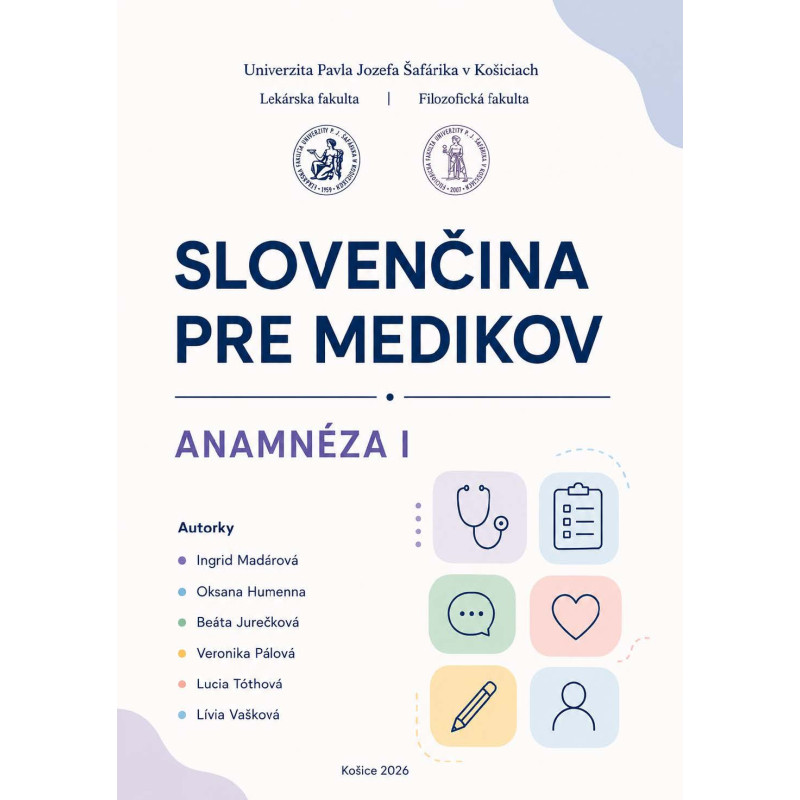
Slovak for Medical Students – Medical History Taking I is a Slovak language textbook designed for international medical students. It focuses on developing the language and communication skills required for medical history taking and professional communication with patients in the Slovak healthcare environment. The textbook contains thematically organized lessons related to clinical medicine, authentic dialogues, medical terminology, grammar and vocabulary exercises, communication tasks, and activities that promote the practical use of Slovak in medical practice. The electronic version of the textbook also includes audio recordings of the dialogues, supporting the development of listening comprehension, correct pronunciation, and spoken language understanding. The publication integrates Slovak language learning with medical content and prepares students for effective communication with patients during clinical training and future medical practice.

Data sheet
E-book
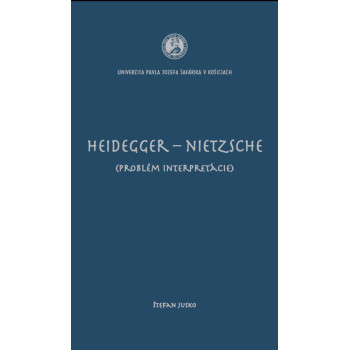
The stimulus for this monograph was my two studies on Heidegger’s interpretation of Nietzsche’s ideas of the will to power and eternal return of the same, published in Heidegger and Modern Metaphysics (supported by the Slovak Research and Development Agency, APVV-14-0706, under the leadership of V. Leška and M. Sobotka). In the submitted monograph, I present both studies in expanded (particularly “Will to Power as Art”) and refined versions (“Eternal Return of the Same”) and add a third chapter addressing the question of the meaning of interpreting philosophical texts, which themselves are interpretations of other texts.
In seeking an appropriate approach to the meaning of interpretation, I conclude that—generally—the purpose of interpretation is to uncover the productive dimension of the interpreted text, which can only be revealed if the interpreter enters the text openly and as neutrally as possible. If the interpreter does not open themselves to the text, allowing it to interpret them in turn, interpretation remains trapped. I believe that without mutual openness between interpreter and interpreted, interpretation has no meaning and typically becomes either rejection or misinterpretation—a form of violence.
In the third chapter, which I consider foundational, I attempt to “balance” the interpretive context of “Heidegger–Nietzsche” from the first two chapters through a reversible context of “Nietzsche–Heidegger,” albeit with the risk that my interpretation of Nietzsche’s thought—specifically his ideas of eternal return and will to power—may remain subjective, even if unintended as misinterpretation. Ultimately, the ambition of the third chapter is to explore intersections between the two philosophers, one of which—a rudimentary yet significant overlap—I identify as Heidegger’s concept of being-in-the-world, reinterpreted through Nietzsche’s lens. It is Nietzsche who challenges us to adopt a self-defined stance toward the world, to confront what it means to be in the world.
The challenge for me—and perhaps the reader—is to remain faithful to oneself, which is only possible by persisting in the context of mutual interpretation between interpreter and interpreted, regardless of who/what is interpreting or being interpreted. For the context of being-in-the-world is always co-created by both sides.
E-book
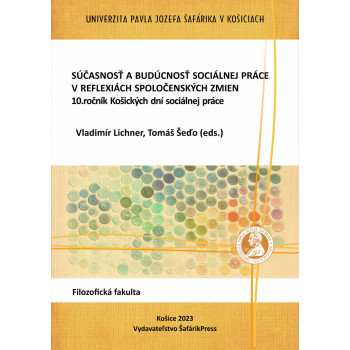
Peer-Reviewed Collection of Contributions from a Scientific Conference with International Participation Held on November 25, 2022 in Košice
"The presented peer-reviewed collection of contributions titled "Present and Future of Social Work in the Reflection of Social Changes" is the output of a scientific conference with international participation, marking the 10th anniversary of the Košické dni sociálnej práce, held on November 25, 2022.
The conference was dedicated to the vision of social work, its methods, and techniques in the context of societal changes. With the changing times come new challenges to which social work must be prepared to respond. The central focus of the collection is the search for answers to pre-defined questions: "Is the current social work system adequately configured for current societal problems? Can social work promptly respond to new and unknown challenges? Are the known methods of social work effective in dealing with contemporary negative phenomena? Do we need additional methods?
If so, what are they?" Individual contributions touch on theoretical concepts in the search for answers, but they also include empirically based contributions that reflect research results from various areas of society and problematic situations, with a view to providing recommendations for both the theory and practice of social work.
Download e-book for free (pdf)
E-book
Katarína Šiňanská - Dušan Šlosár
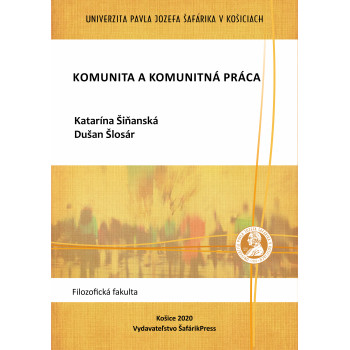
The presented monograph deals with various views on of the community issue and community work, with which area of social work or other helping professions is closely connected. It offers theoretical analysis as a basic theoretical framework of the issue, which is necessary to know in the study and in the performance of the practice in the helping profession. The authors consider community work to be one of the possibilities for fully involving the inhabitants in co-responsible decision-making on things that fundamentally affect their lives.
The monograph characterizes in fifteen chapters the community and the processes that takes place in it, outlines a brief history and approaches in community work. It offers theoretical background, which is used in community work as a necessary prerequisite for a professional approach practice. The monograph also points to the important position of professional help in community.
E-book
Eva Žiaková (ed.)
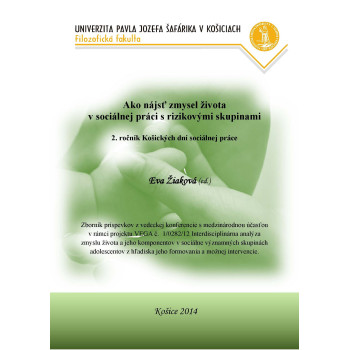
Proceedings of the Scientific Conference with International Participation within the VEGA Project No. 1/0282/12 Interdisciplinary Analysis of the Meaning of Life and Its Components in Socially Significant Groups of Adolescents in Terms of Its Formation and Possible Intervention.
The introductory word is a very good opportunity for us to jointly evaluate what we have managed to achieve in addressing our common scientific research task focused on the study of the meaning of life in socially at-risk groups of adolescents. First and foremost, we asked ourselves what we have discovered about the meaning of life so far, that is, what we know about it.
The second question we asked was: what surprised us about the results we have obtained so far. The third question was about what we want to do to resolve the discrepancy between what we have discovered and what we want to achieve.
The final question in evaluating the solution of the scientific research task was: what do we (not) know about the meaning of life of adolescents and want to know in the future, or what should we focus on to develop the most effective logotherapeutic and sociotherapeutic methods for social workers working with socially at-risk groups of adolescents.