- New

Zavolajte nám:
+421 55 234 1635E-book
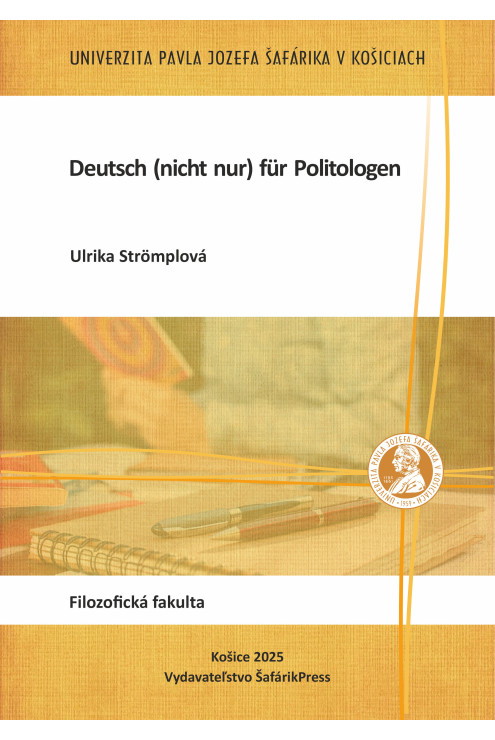
The publication Deutsch (nicht nur) für Politologen addresses selected contemporary topics that can be effectively employed in the teaching of German as a foreign language and specialised German for students of political science, international relations, European public administration, and law.
The publication is designed as a teaching and study resource in the form of course materials that complement formal instruction. It offers a thematically structured core vocabulary, a systematic and clearly organised presentation of key thematic areas and problem domains, and a wide range of task types aimed not only at the acquisition of subject-specific knowledge but also at the development of professional and linguistic competences. Each thematic chapter is structured into three logically interconnected sections and is further supplemented by appendices containing additional materials, including games, case studies, and other practice-oriented tasks.
Data sheet
E-book
The aim of the monograph was to analyze and address the issue of educational systems within children's and youth organizations, with an emphasis on those focused on the age category of children up to 15 years.
The starting point was an analysis of the current state of the educational environment in terms of the systemic nature of education and the basic categories of the educational system. The collected available materials on the educational systems of selected (most representative) children's and youth organizations in the Slovak Republic were subsequently processed according to a unified methodology and using generally accepted pedagogical terminology.
E-book
Tatiana Žiaková - Dušan Šlosár
The last decade marks not only the average life expectancy increase in healthy population, but also life expectancy increase in group of people with intellectual disorders/disabilities. Due to their diagnosis that defines and classifies them into specific categories, people with intellectual disability are finding themselves in a constant confrontation with obstacles negatively affecting the saturation of their existential needs. It creates mostly educational, social, cultural, psycho-social and economical disadvantage in the context of their lives. Consequently, their active potential is weakened, making it unable for them to influence public affairs in society from a position of an adult or elderly citizen. Building up on this condition, the focus of this monograph is on understanding and explanation of prevailing concept of social inclusion and related concepts of social exclusion. These concepts influence the way we tend to define and think about the character of society, as such.
Simultaneously, we are examining that the quality of coexistence between dominant population and people with intellectual disabilities is dependent on the development of attitudes and opinions of major population towards this specific minority. These attitudes reflect the extent of social tolerance and at the same time serve as a quantification of moral values and equity in the society, whether it concerns any type of small everyday help or professional and institutionalised long-term support.
This monograph focuses on presenting professional care for people with mental disability in form of social services as a dominant type of support in our local environment. We show that the quality of social services inevitably depends on degree of professional competences social workers possess. The significance of professional competences social workers are capable of using is reflected in the degree of the competence and adequacy of their performance. The primary aim, in relation to which professional competences should be accustomed, is to enhance meaningfulness and dignity in life of mentally disabled receivers of the social services.
Competences of social workers are a dynamic phenomenon that modifies along the development of society and also with the frequently altering needs of people with intellectual disability as receivers of the social service. For this reason we designed the presented research to reflect our goal to reappraise the scope of professional competences and define the required professional functions of social workers working with people with intellectual disability.
This monograph is dedicated not only to professionals working with this group of people but also aims at answering basic questions to practical issues that families with a intellectualy disabled member are coming into contact with.
E-book
Marianna Sedláková a kol.
The worksheets, based on the direct specific needs of teaching medical students in Košice, respect the real situation of teaching Slovak as a foreign language at UPJŠ.
They also reflect the relatively high number of Slavic students, especially from neighboring countries, who, although just beginning with the Slovak language, are at a higher communicative level compared to students from non-Slavic countries. Therefore, a special part of the worksheets with exercises is dedicated to them, which includes special exercises and dictionaries aimed at eliminating Slovak-Polish or Slovak-Ukrainian interference phenomena. Since some non-Slavic students come from the Czech language environment, we also add a glossary of the most common different expressions in Slovak, Czech, and, for the aforementioned reasons, Polish and Ukrainian. In the part intended for all students, both Slavic and non-Slavic, communicatively focused exercises for practicing grammatical phenomena predominantly at the A1 and A2 communication skill levels (according to the Common European Framework of Reference) prevail, and last but not least, exercises thematically focused on medicine and healthcare.
The texts from the thematic area are, of course, supplemented with realia of the city of Košice. As a functional supplement in the working material, we also publish test samples.
E-book
The university textbook Citizenship of the European Union is structured into four parts. The first chapter focuses on the characteristics of citizenship in a historical context (concepts of citizenship in the ancient, medieval and modern periods).
The second chapter deals with a theoretical introduction to citizenship. It comes up with the characteristics of citizenship, introduces the ways of acquiring and losing citizenship and the transformations of citizenship in the context of globalization and multiculturalism.
The third chapter focuses on European Union citizenship itself, its historical development and the process of introducing and strengthening citizenship in the European Union.
The fourth chapter presents the specific rights of citizens deriving from European Union citizenship - the right to free movement, the right to vote and stand as a candidate in municipal and European Parliament elections, the right to diplomatic and consular protection in the territory of a third country, the right to petition the institutions of the European Union, the right of access to documents of the institutions and bodies of the Union, and the right of initiative of the citizens of the European Union.
Download e-book for free (pdf)
E-book
Scholars whose works constitute medieval philosophy were active as theologians, jurists, physicians, and sometimes even poets. Among them, there is hardly anyone who could be described exclusively as a philosopher.
For theologians and (religious) jurists, the primary source of their philosophical reflection was the Bible or the Qur’an. The second source was the philosophical heritage of the preceding antiquity, in which the figure of Aristotle and his commentators dominated. The Peripatetic legacy was complemented by followers of Plato in the long line of so-called Neoplatonic philosophy (e.g., Plotinus, Iamblichus, and Proclus), which in its beginnings developed within the environment of Hellenistic schools.
It is therefore not surprising that the main philosophical problem for medieval scholars was the relationship between theology and philosophy, or faith and reason, and, consequently, the relationship between theology and metaphysics. In the context of Christian thought, this was already discussed in the 2nd century, when some Church Fathers questioned the value of secular learning for those to whom the truth had been revealed by God.
E-book
Eva Žiaková (ed.)
Proceedings of the Scientific Conference with International Participation within the VEGA Project No. 1/0282/12 Interdisciplinary Analysis of the Meaning of Life and Its Components in Socially Significant Groups of Adolescents in Terms of Its Formation and Possible Intervention.
The introductory word is a very good opportunity for us to jointly evaluate what we have managed to achieve in addressing our common scientific research task focused on the study of the meaning of life in socially at-risk groups of adolescents. First and foremost, we asked ourselves what we have discovered about the meaning of life so far, that is, what we know about it.
The second question we asked was: what surprised us about the results we have obtained so far. The third question was about what we want to do to resolve the discrepancy between what we have discovered and what we want to achieve.
The final question in evaluating the solution of the scientific research task was: what do we (not) know about the meaning of life of adolescents and want to know in the future, or what should we focus on to develop the most effective logotherapeutic and sociotherapeutic methods for social workers working with socially at-risk groups of adolescents.
E-book
Marcela Gbúrová - Daniel Dobiaš - Jana Šutajová - Gabriel Eštok - Ján Ruman - Tomáš Dvorský
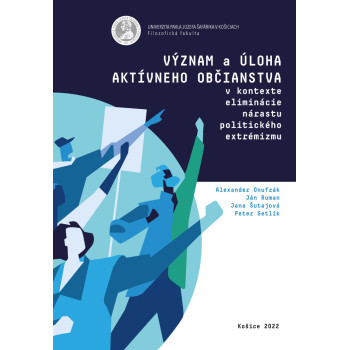
Research Into Correlations Between Deformations of Political Awareness and the Increase of Political Extremism Among Secondary School Students in the Košice Self-governing Region and the Prešov.
Self-governing Region The issue of political extremism has a relatively long research period, and it should be emphasised that, especially in the recent period, it has received increased attention in the political science community not just in Slovakia but also abroad. Given the specifics of this anti-democratic form of political discourse, which has not only explicit forms, but also highly sophisticated manifestations against democracy (extremism of the centre, or centrist extremism), it is also addressed by experts of other humanities and social disciplines: history, psychology, anthropology, sociology, etc.
The common interest of this professional community is both to analyse different forms of extremist discourses and narratives, to search for national specificities of extremism that are anchored in their historical, social and cultural contexts, but at the same time to reveal transnational extremist influences within a globalizing world and to propose evidence-based strategies to counter extremist discourses.
Download e-book for free (pdf)
E-book
Decision-making is an everyday activity for us, whether it involves decisions about routine matters such as what to have for breakfast or more significant choices like selecting a career after finishing school. Due to the far-reaching consequences that a single decision can have on our entire lives, this area has received considerable attention in psychology. After all, the classic goals of psychology—describing, explaining, and predicting human behavior—are essentially attempts to understand decision-making and identify and describe the factors influencing it. Fundamental psychological disciplines such as the psychology of emotions and motivation, cognitive psychology, social psychology, and personality psychology all strive to achieve this understanding.
The presented text primarily adopts a cognitive approach, focusing on the processes of information processing and utilization. Since there are very few events in the future we can be completely certain about, key concepts include terms expressing uncertainty about the future, such as uncertainty, risk, objective probability, and subjective probability.
The central question thus lies in processing information from the environment and utilizing it in the decision-making process.
E-book
The monograph entitled The first Slovak women’s magazines: Dennica, Živena, Slovenská žena (1898–1923) provides a general view of the initial stage of the formation of women’s magazine production in Slovakia, defined by a period of 25 years at the turn of the 19th and 20th centuries between 1898 and 1923, in the context of the historical and social development, to which the Slovak journalistic milieu inevitably responded.
The publication is a result of detailed material research of Slovak historical periodicals, implemented mainly from the perspective of the mediological methods and standards of research work.
E-book
Mikuláš Jančura - Maroš Melichárek (eds.)
The Student Scientific Conference is defined as a compulsory elective subject within the accredited study programs of the Department of History at the Faculty of Arts, UPJŠ. It was organized for the first time at the department in 2011.
The primary goal of this already traditional event is the presentation of partial results of student-authored research, primarily linked to selected factual parts or theoretical foundations of bachelor’s and master’s theses. This also explains the broad thematic spectrum of the internal content of each conference. Besides awarding credits for participation, the conference offers students a range of added values, which can be understood as its secondary objectives.
On this basis, as organizers, we considered it beneficial to qualitatively elevate the “round” anniversary edition of the Student Scientific Conference and give students the opportunity to publish their contributions. Within the submitted proceedings, 7 texts are published, of which 4 are from the bachelor’s level and 3 from the master’s level of study. The contributions cover a wider spectrum, mainly cultural-historical topics spanning from the Early Middle Ages to the second half of the 20th century, which also demonstrates the wide range of thesis topics processed at the department.
As organizers of the event, we have the ambition for publishing the proceedings to become as much a tradition as the Student Scientific Conference itself, as we consider this meaningful in relation to our work with students. Last but not least, we would like to express our gratitude to our colleague and friend Mgr. Henrich Hrehor, PhD., who has been the long-term main organizer and the “spiritual father” of the entire event since 2011. Thanks are also due to the head of the department for annual support and to the colleagues who undertook the reviewing of contributions within the submitted proceedings.
E-book
The presented monograph aims to critically map the understanding of the concept of possible worlds.
The first chapter describes the formation of the semantics of possible worlds, along with indicating some problems it brings, which were incisively revealed primarily by W. V. O. Quine. In the next two chapters, the work focuses on more modern views on the nature of possible worlds, with the main attention given to the dichotomy between the possibilist and actualist approach to the question of modalities, alongside which it is necessary to assess other distinctions (essentialism - anti-essentialism, realism - reductionism (or ersatzism or fictionalism), naturalism - non-naturalism, etc.). Increased attention in the work is specifically devoted to the possibilism of D. Lewis and the actualist concepts of S. Kripke, A. Plantinga, R. M. Adams, N. Rescher, D. Armstrong, and J. Hintikka.
An unconventional approach to the issue of possible worlds is captured in the fourth chapter. It is primarily dedicated to the significant concept of Jaakko Hintikka, which works with the notion of epistemic possible worlds and documents the inclination towards the modification and relativization of modal discourse. The conclusion provides an evaluation of the discussion that touches on the main problems associated with considerations of possible worlds.
In the presented monograph, some representative concepts of possible worlds, or possible individuals, are clarified, and the overall process is indicated from assessing possible worlds as ideal logical constructs through their relativization by separate domains of individuals for individual worlds and further through the relationship of attainability to financial, impossible, and non-standard possible worlds.
E-book
Mária Fedorčáková - Miriama Filčáková
Current publication is dealing with the history of philosophical education in Košice since the beginning to the foundation of the Faculty of Arts at Pavol Jozef Šafárik University in Košice in 2007. Beginnings of philosophical education in Košice are connected to the fundation of the University of Košice in 1657, which was originally founded as Jesuit university with two faculties – Faculty of Theology and Faculy of Arts.
The publication is dealing with the philosophy teaching in the Faculty of Arts and examines the philosophy teachers and students. Another interest is given to decline of philosophy teaching caused by transformation of the University into the Royal Academy and the Academy of Law at the end of the 18 and during 19 century. The second part of the publication is dealing with the history of higher education after the second world war and the foundation of the University of Pavol Jozef Šafárik in Košice.
The authoress focuses on circumstances of the foundation of the Faculty of Arts in Prešov and its history and later development after 1989, which included also division of the university in 1997. The last part of publication presents the history of the university buildings, in which the Faculty of Arts is situated.
E-journal
Juraj Schenk et al.
The scientific journal Sociálne a politické analýzy (Social and Political Analyses) serves as an interactive electronic platform for communication and the presentation (publication) of experts and their work in the fields of basic and applied research and analyses within sociological, psychological, political, and methodological contexts. It is a medium focused on intensively supporting research activities and analyses within an interdisciplinary framework, facilitating the exchange of experiences, fostering collaboration, and revitalizing the production of scientific work in this area.
The publication section of the journal offers space for works such as:
- Original sociological, psychological, and political studies and analyses in any areas of social life
- Methodological studies
- Research reports
- Studies from qualification theses Research and analysis projects
- Reviews
E-book
The population exchange between Czechoslovakia and Hungary was carried out on the basis of the Agreement on the Exchange of Populations between Czechoslovakia and Hungary, which was signed on February 27, 1946. Its adoption was not only part of Czechoslovak solutions to the status of national minorities, but also part of the strategic concept of building a state of Czechs and Slovaks without Germans and Hungarians.
The agreement was part of the postwar resolution of mutual disputes and misunderstandings and was intended to be one of the solutions that, in the postwar period, would eliminate a factor which, according to Czechoslovak political leaders, had caused the war conflict.
The population exchange between Czechoslovakia and Hungary was therefore not an isolated historical event, but part of migratory movements that had begun in Europe already after the First World War, and can be seen as a continuation of previous developments as part of migration patterns in Europe.
Download e-book for free (pdf)
E-book
Miriama Filčáková (ed.)
Proceedings of the 11th Scientific Conference of Young Historians, organized by the Department of History at the Faculty of Arts, Pavol Jozef Šafárik University in Košice, in cooperation with the Slovak Historical Society at the Slovak Academy of Sciences, on October 19-20, 2021.
Currently, these histories are often presented as an extension of the history of science. The history of knowledge not only expands the boundaries of the history of science but also explores the boundaries between different forms of knowledge and ignorance. Just as studies of historical memory have expanded and complemented their interest in researching forgetting, the history of knowledge includes studies of ignorance. They focus on the change that has occurred over the past decades: from the sacralization of science and respect for professional knowledge to the rejection of science and constant questioning of professional knowledge, to which the history of knowledge must also respond. Findings as a product form the basis of human interactions and have their own past. What was the significance of knowledge and cognition in different historical periods? How did state power influence the development of knowledge and cognition? What can be considered knowledge in a particular historical era or culture? Finally, is there any human activity that cannot be considered knowledge?
Currently, in the field of the history of knowledge, a significant surge in research, publishing, and the emergence of new institutions can be observed. The eleventh doctoral conference—Meeting of Young Historians XI, organized by the Department of History at Pavol Jozef Šafárik University in cooperation with the Slovak Historical Society at the Slovak Academy of Sciences—will contribute to expanding the perspective on the past of knowledge and cognition. The conference, intended for Slovak and foreign doctoral students, aims to provide a space for presenting the latest results of scientific research, professional discussion, establishing contacts, developing cooperation, and exchanging experiences among the broader historical community. The starting point for the conference is a peer-reviewed proceedings volume consisting of publication outputs from active participants.
E-book
Renáta Orosová (executive editor)
The scientific and professional journal Edukácia focuses on issues of education and upbringing in primary, secondary, and higher education. It emphasizes the current state and future perspectives of educational practice, the latest aspects of pre-service teacher training, social pedagogy, special pedagogy, as well as pedagogical and psychological aspects of upbringing in basic educational institutions from the perspective of the broader pedagogical community. It is intended for researchers, young university lecturers, doctoral students, as well as professional and pedagogical staff, with the aim of presenting trends in education and sparking discussions on current issues in the areas of education and upbringing covered.
This website uses cookies to ensure you get the best experience on our website