Slovenčina


E-book
Eva Výrostová (ed.)
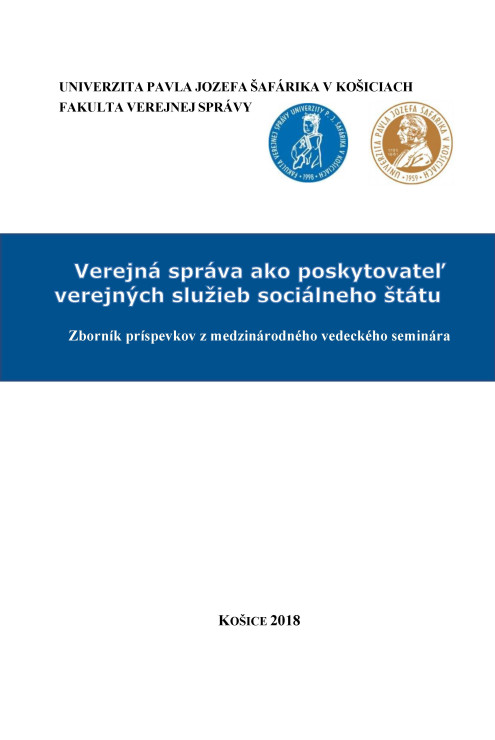
Proceedings of the International Scientific Seminar "Public Administration as a Provider of Public Services of a Social State - Utilising Foreign Experience for Reforms in the Slovak Republic" held at the Faculty of Public Administration, UPJŠ, Popradská 66 in Košice on 24 November 2017
Public services represent an increasingly expanding segment of the public sector. This growth can be identified primarily horizontally – from services related to general security and other forms of state functionality, through technical infrastructure, postal and telecommunications services, transportation, and information services, to increasingly emphasized healthcare, cultural, educational, and social services. Simultaneously, the entire structure of public services is expanding vertically, particularly in depth: within each area, the range of provided services is broadening.
In this context, the importance of optimizing the structure of service providers is growing, which is the focus of such reform processes as decentralization, deconcentration, privatization, or other forms of structural transformation. The outcome may vary under different conditions, resulting in diverse provider structures for public services of the social state, where the state and its bodies or organizations continue to hold a significant position.
Consequently, the significance of the public administration model as the primary state provider of these services is increasing: due to these processes, countries develop distinct and sometimes incomparable systems of public service providers, even within state bodies or organizations acting on behalf of the state. However, the varying effectiveness of public service delivery systems by public administration bodies remains a persistent reality.

Data sheet
E-book
Martin Vernarský - Rastislav Král - Ondrej Mitaľ - Jana Volochová (eds.)
The competences of local self-government units, together with the state's participation in their execution, represent a combination of factors that substantially determine image of contemporary local self-government subsystem in Slovak Republic.
Mentioned combination is not only a model that sets the way for the optimal adjustment of the local self-government functioning, but also represents authentic testimony of the state's attitude to the real importance of local self-government units as decentralized entity of public power.
Conference proceedings have a cross-sectional character. In this sense, the papers are not limited by the views of a single discipline. However, the key contribution of included papers might be a comprehensive view, how to improve actual tensions in local self-government theory and practice, which from the conceptional point of view deals with issues of local self-government units. Moreover, it fulfils the ambition of multidisciplinary scientific analysis focused on the position and competences of the local self-government in the context of an economic, political and legal perspective.
E-book
The non-conference collection of scientific papers "Quality of life of citizens - challenges, determinants and solutions II." presents the current state and possible trends in improving the quality of life of citizens in the post-covid period.
The authors of the papers processed a whole range of information that focuses on the use of smart technologies in the conditions of contemporary society. The published outputs are thematically focused on the following areas: determinants affecting the quality of life of citizens, legislative changes as a solution tool impacts of the pandemic on quality of life, quality of life of citizens and social exclusion, smart technologies as a tool influencing the quality of separate waste collection, use of smart technologies in healthcare provision, use of artificial intelligence in social life.
Download e-book for free (pdf)
E-journal
Michal Jesenko (editor) - Eva Mihalíková - Darina Koreňová
Public Administration and Society is a scientific journal publishing scientific academic articles, contributions to discussion and reviews having the content orientation on the theory and practice of Public Administration. The mission of the Journal is to publish significant results of the scientific scholarly researches regarding the area of public administration and related disciplines which are connected with the study profile and scientific bias of our Faculty. The Scientific Journal is issued in electronic version.
E-book
Franziska Cecon - Belinda Hanner - Dominik Prüller (eds.)
Publikácia je koncipovaná ako interdisciplinárna vedomostná báza zahŕňajúca východiská, spoločné témy a výzvy relevantné pre komunálnu politiku, digitalizáciu na úrovni obcí a miest a témy zelenej transformácie. Hlavnými cieľovými skupinami tejto publikácie sú učitelia a vedeckí pracovníci, študenti vysokých škôl verejnej správy, politických vied a príbuzných odborov a odborníci už pôsobiaci v orgánoch samosprávy obcí alebo miest. Odborníci z rôznych univerzít a výskumných inštitúcií v unikátnom medzinárodnom konzorciu obohacujú vďaka publikácii vedeckú diskusiu, ako aj diskusiu o najnaliehavejších a najrelevantnejších témach týkajúcich sa digitálnej a zelenej transformácie s dôrazom na komunálnu úroveň spravovania.