Slovenčina


- New
E-book
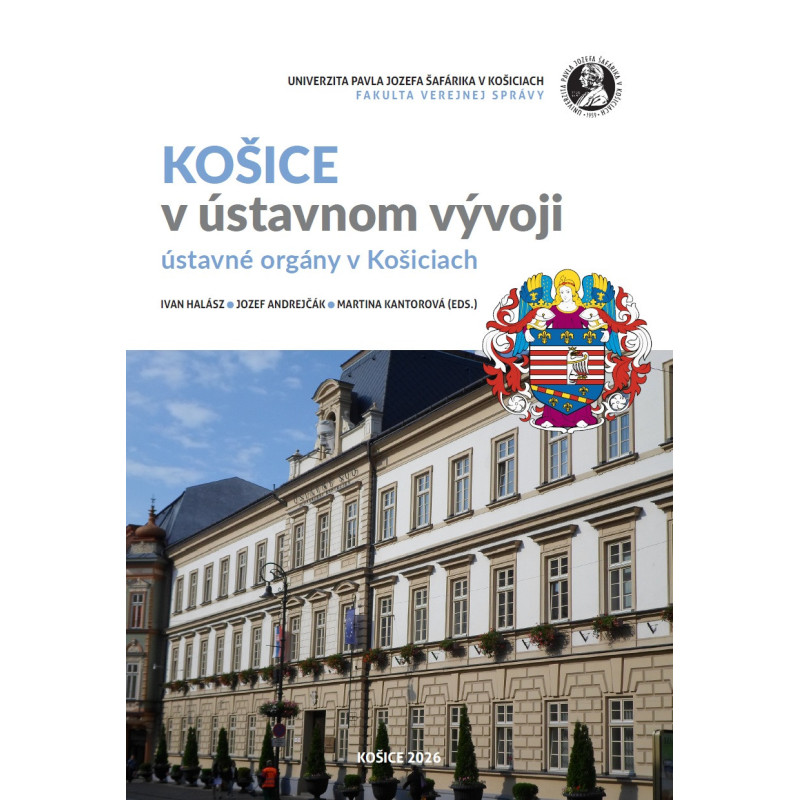
Ivan Halász Jozef Andrejčák Martina Kantorová (eds.)
A peer-reviewed collection of papers from a scientific conference held on 16 March 2026
These conference proceedings comprise studies presented at the scientific conference held on March 16, 2026, commemorating the thirty-third anniversary of the first session of the Constitutional Court of the Slovak Republic in Košice. The event was organized by the Department of Public Law Disciplines of the Faculty of Public Administration of Pavol Jozef Šafárik University in Košice, with the support of the research project VEGA No. 1/0487/24/13 (Strengthening Constitutional Awareness and the Authority of the Constitution in the Central European Context). The scientific event was opened by the Mayor of Košice, Jaroslav Polaček, and the Vice-President of the Constitutional Court of the Slovak Republic, Ľuboš Szigeti. Their contributions serve as the opening texts of this volume. In his address, Jaroslav Polaček expressed his satisfaction that in 1993, the historic city of Košice became the home of such a vital constitutional body. The study by Ľuboš Szigeti, in turn, outlines the position of the Constitutional Court within the system of state authorities of the Slovak Republic, as well as its evolution over the past three decades.
The volume continues with papers by individual speakers representing important academic, university, and constitutional institutions in Košice. Ivan Halász explores the broader context of the symbolism of capital and other major cities in constitutional law, before examining the specific characteristics of Košice within both the Slovak and Central European contexts. In an extensive historical study based on archival research, Štefan Šutaj provides a detailed account of the period in 1945 when Košice temporarily served as the capital of the whole of Czechoslovakia. Writing both as a constitutional law expert and as a witness to the events of that time, Ladislav Orosz addresses the establishment of the regional branch of the Office of the President of the Slovak Republic in Košice, as well as the challenging early years of its existence. In his study, Ján Štiavnický focuses on the circumstances surrounding the establishment of the Constitutional Court in Košice. He situates this issue within both the Czechoslovak and Slovak contexts. Alena Krunková examines the current state of constitutional law education at the Faculty of Law of Pavol Jozef Šafárik University in Košice. Jozef Andrejčák analyzes the distinctive features of the city of Košice within the system of local self-government in the Slovak Republic, alongside specific challenges arising from this status. In their joint study, Gabriel Eštok and Tomáš Dvorský investigate the role of Košice and its municipal bodies within international and regional cooperation. The papers conclude with a study by Patrik Hajdu on the symbolism of judicial buildings in Košice. Finally, the volume includes an annotated list of artifacts, buildings, and other monuments of the city of Košice that can be utilized in the process of fostering constitutional patriotism in Slovakia. Both the individual studies and the overarching conception of the volume demonstrate that Košice is not merely Slovakia's second-largest city and the metropolis of its eastern region, but also a significant historical and political symbol. It symbolizes the modern Slovak constitutional judiciary just as much as the tradition of self-government, which has always played an important role in Slovakia. Furthermore, the traditions of tolerance and civic engagement in this historic city must not be overlooked.
Data sheet
E-journal
Michal Jesenko (vedecký redaktor) Eva Mihaliková Darina Koreňová (výkonné redaktorky)
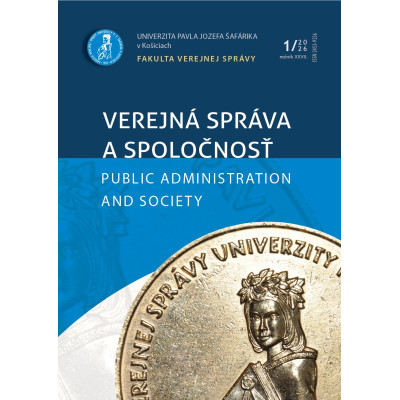
Public Administration and Society is a scientific reviewed Journal of the Faculty of Public Administration University of Pavol Jozef Šafárik in Kosice that publishes scholarly articles, discussion papers, and reviews focusing on theory and practice of Public Administration. The mission of the Journal is to publish significant results of scholarly research in the fields of public policy and administration, social sciences, public law, economics, and public administration management.
E-book
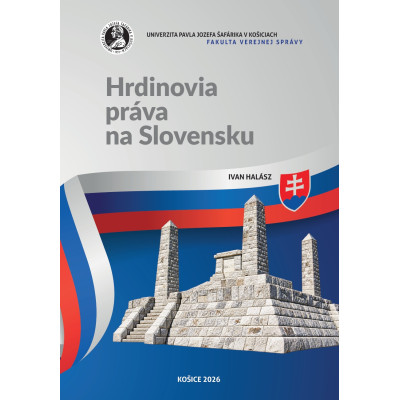
The book, in the context of constitutional patriotism, deals with the individual fates of Slovak lawyers, officials, activists and intellectuals who, during their lives, stood up against injustice or at least tried to improve the legal-political situation of society as a whole, using the platform of law and the existing system. Sometimes they had to face negative consequences for it. It covers figures from the late 18th century to the end of the 20th century. Among them are both people who held top positions in the state and civic activists or independent intellectuals. The book aims for balance in terms of religion, nationality, region, and partly gender. Besides individual stories, it also highlights constitutionally conform attitudes of institutions (like local governments) and groups of people (like human rights initiatives) in efforts to defend or achieve a constitutional system. The book also analyzes the question of which key figures in Slovak history can serve as a role model for constitutional patriotism.
E-book
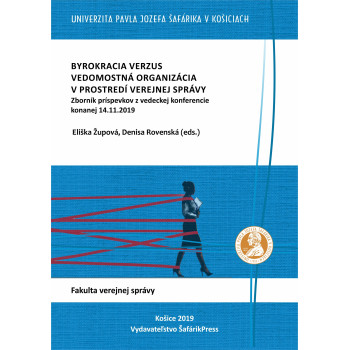
Denisa Rovenská - Eliška Župová (eds.)
Proceedings of the Scientific Conference Held on November 14, 2019
The presented publication contains contributions oriented towards the environment of public administration organizations, which were presented by the authors in the form of lectures. The contributions focused on the issue of bureaucratic rules applied in various organizational and political processes and on the issue of knowledge organization from different perspectives. The information discussed during the scientific conference contributed to emphasizing the need to address this issue primarily from an interdisciplinary framework. It is precisely the integration of diverse knowledge and experiences from many scientific disciplines that ensures the comprehensiveness of understanding the researched topic in both its breadth and depth.
We would like to express sincere gratitude to the entire scientific committee and all reviewers for their time and willingness to participate in the creation and improvement of this publication.
We are honored to offer readers a collection whose content is interesting and informationally rich, and we also hope that it will inspire further research and create an environment for future stimulating discussions.
E-book
Gabriela Kravčáková a kol.
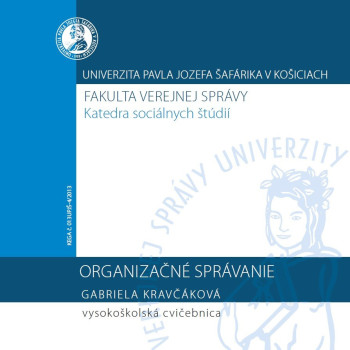
University Exercise Book Organizational Behavior adds content as University Textbook with the same name and completes the overall view of the behavior of people in organizations with respect to the classical approaches and new trends on a subject.
The authors are university teachers, scientific researchers of two Slovak universities and two Czech universities and their texts formed the basis of analysis and comparison of theoretical knowledge of both home and foreign resources, research results, as well as monitoring requirements of practice imposed on the behavior of employees organizations. Submitted publication has 26 separate chapters focusing on work, personality, work groups and teams, team roles, communication organization, social, communication and management skills, social audit, job satisfaction and motivation, loyalty to the organization, organizational culture, social responsibility organization, talent management, performance management, learning and learning organization, negative phenomena at work, unemployment as a social problem, acceptance of risk in the organization, system of strategic tuning of organization and empirical social research. Each chapter contains a brief summary of the information on the chosen theme, theses and questions to replicate the tasks and activities in which there are used innovative and creative teaching methods (case studies, role playing, mental mapping, etc.)
With a view to increase the active participation of students or other participants, actors in addressing current issues and problems in practice. University Exercise Book may therefore serve not only as a teaching material for higher education, but also as a useful tool in various outdoor and indoor training activities in the process of learning in organizations, or. the interaction of academic theory and economic reality.
Download the e-book for free (pdf)
Attachments (zip)