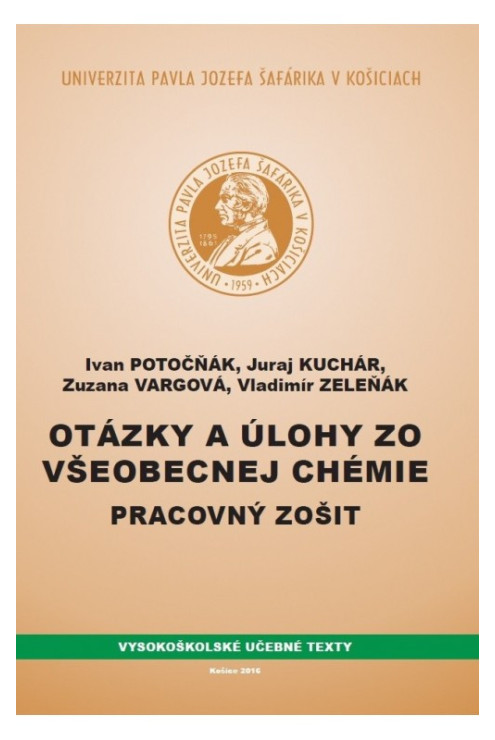
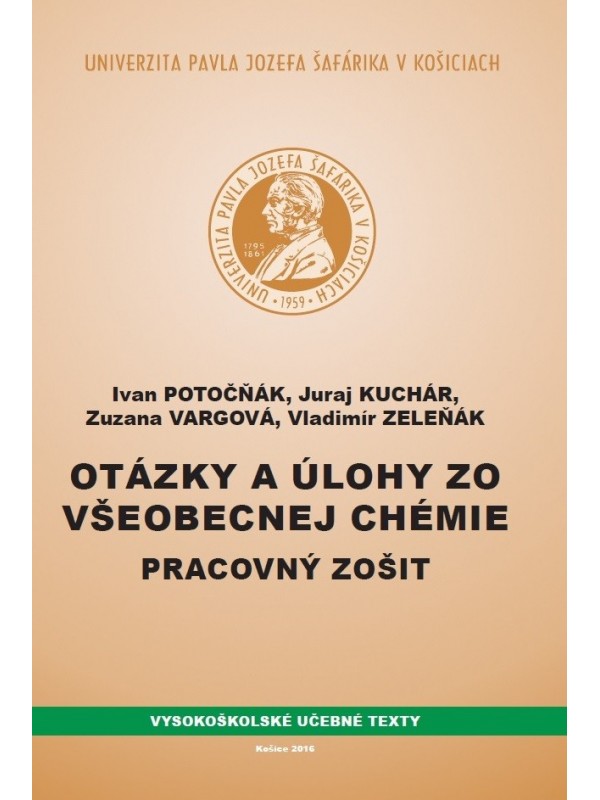
Otázky a úlohy zo všeobecnej chémie

€15.00
Tax included

Ivan Potočňák a kol.

The textbook represents a study literature on the subject of General chemistry, which is a compulsory subject of bachelor courses in Chemistry and Chemistry -  interdisciplinary study, the first year. This textbook contains 15 + 2 chapters in the whole range of 170 pages that follow the content of lectures and by means of examples and theoretical tasks consolidate and extend knowledge gained from lectures.

Quantity

978-80-8152-404-2

Data sheet

Method of publication:
Printed publication
Author:
Ivan Potočňák - Juraj Kuchár - Zuzana Vargová - Vladimír Zeleňák
Document type:
Course Notes
Number of pages:
174
Year of publication:
2016
Edition:
2nd edition
Publication language:
Slovak
Faculty:
Prírodovedecká fakulta
License:
Copyright

16 other products in the same category:

Teória vypočítateľnosti

E-book

E-book

Ľubomír Antoni-Stanislav Krajči

An important part of theoretical computer science is the problem of Turing machines. This computational model has two basic properties: like any other computational program, the software of a Turing machine is composed of instructions, but in its case they are all of a single type. Every other (so far known) computer program can be transformed into a Turing machine program without loss of information. While the second feature reduces the question of what a calculator cannot do to the question of what a Turing machine cannot do, the first feature allows a much simpler investigation of such a question. Using this computational model, we can thus find concrete problems that no automaton can ever deal with (perhaps the most famous is the problem of the Turing machine stopping). Their existence demonstrates the fundamental limitations of (not only ideal) computational means, and thus encourages both criticality and humility in our thinking.

Download e-book for free (pdf)

The 6th International Conference on...

E-book

E-book

Jana Shepa (ed.)

The book of abstracts from 6th International Conference on Nanomaterials: Fundamentals and Applications, NFA 2022 is composed of contributions from the participants of this international conference. The conference consisted of 4 invited lecture and 52 abstracts of participants. The conference is focused on nanotechnology and its application in various research areas. All contributions are professionally processed and inspiring.

Download the e-book for free (pdf)

Laboratórny potkan a jeho využitie v...

E-book

E-book

Terézia KiskováStanislav MatéffyFrantiška Horváthová

The laboratory rat (Rattus norvegicus) is one of the most commonly used experimental animals. It serves as a model organism for analyzing numerous biological processes and pathological mechanisms, such as cardiovascular diseases, metabolic disorders (e.g., lipid metabolism, diabetes mellitus), neurological and neuropsychiatric conditions (e.g., stroke, epilepsy, or Alzheimer's disease), neurobehavioral research, autoimmune diseases (e.g., arthritis), cancer, and renal diseases. It offers many unique advantages for modeling human diseases, testing drugs and natural substances, and studying responses to environmental factors. The size of the laboratory rat, compared to the mouse, creates ideal conditions for physiological manipulations. Additionally, rats are used in clinical toxicology to test chemical substances (Hedrich, 2000).

Download the e-book for free (pdf)

Skenovacia tunelová mikroskopia

E-book

E-book

Tomáš Samuely

Today, scanning probe microscopes are standard tools in materials science, physics, chemistry, biology, and engineering. Thousands of these microscopes are in operation worldwide and are at least as common and popular as scanning electron microscopes.

Despite the vast number of newer scanning probe microscopy techniques, classical STM remains a significant and irreplaceable method, widely used, for example, in solid-state research. In this text, we will focus on both traditional and innovative STM techniques that are available and utilized in the laboratories of the Center for Low Temperature Physics in Košice.

Download e-book for free (pdf)

Cognitive neuroscience of auditory and...

E-book

Norbert Kopčo - Frederick Gallun - Beáta Tomoriová - Ľuboš Hládek(eds.)

Cognitive neuroscience is a fast developing scientific field which aims at uncovering the neural basis of human perception and cognition. To achieve this goal, cognitive neuroscience uses a variety of tools and approaches ranging from non-invasive brain imaging to psychophysics and neural modeling. Mastering such tools requires skills and knowledge from multiple scientific domains, including neurophysiology, cognitive psychology, and several computational fields.

Access on request via email: kogneuro (@) gmail.com

http://pcl.upjs.sk/workshopcd 

https://sites.google.com/site/kogneuro/

Book of Abstracts: International Meeting on...

E-book

E-book

Soňa Király (ed.)

The book of abstracts from International Meeting on Advanced Materials, IMAM 2025, is composed of contributions from participants of this conference. The conference consisted of 16 lectures by mentioned conference participants. The conference is focused on advanced materials and its application in various research areas. All contributions are professionally processed and inspiring.

Download the e-book for free (pdf)

Študentská vedecká konferencia PF UPJŠ 2015

E-book

E-book

Vladimír Zeleňák(ed.)

The proceedings contain abstracts of contributions from participants of the Student Scientific Conference of the Faculty of Science, Pavol Jozef Šafárik University in Košice, which took place on April 22, 2015.

The Student Scientific Conference (SSC) enjoys long-term popularity among the faculty's students and teachers, and we are pleased that this was no different this year, with 128 contributions submitted to the SSC.

The contributions were organized into 19 sections, additionally complemented by an open programming competition and the final of the IHRA contest. For many students, presenting at the SSC is one of the first opportunities to gain experience in presenting their results before a professional audience. Considering the number of submitted contributions, along with the members of the expert juries from the faculty's teaching staff and the audience who came to support their classmates' presentations, the SSC is an event where a large part of the student and academic community of the faculty meets at one place and time. Many abstracts presented in this proceedings were developed as part of students' work on partial tasks that are components of research projects at the departments of the Faculty of Science, Pavol Jozef Šafárik University.

The abstracts represent, in a way, an overview of research topics at the individual workplaces of the faculty. The SSC proceedings thus serve as a useful tool that students and faculty teachers can use to present the faculty externally to partners, employers, and potential collaborators. Partners from practice have shown interest in cooperating in organizing the SSC for a long time. Since 2005, the association of IT companies has awarded a Prize for the Most Original Work and a Prize for the Work with the Best Prospects for Practical Application.

Download the e-book for free (pdf)

Výpočtová a kognitívna neuroveda II (Návody na...

E-book

E-book

Norbert Kopčo

Neuroscience is an interdisciplinary field of science at the interface of biological, psychological and computer sciences, which aims to describe the functioning of the brain and mind. Computational and cognitive neuroscience are subfields of neuroscience focused on the study of information processing in the human and animal nervous systems, and on the theoretical description of the brain and mind. This university textbook contains several assignments that provide an overview of the methods used in computational and cognitive neuroscience, with an emphasis on mathematical modeling and on the behavioral study of cognitive processes. The textbook builds on the author's previous works.

Download e-book for free (pdf)

School of XFEL and Synchrotron Radiation Users...

E-book

E-book

Jozef Bednarčík (ed.)

Pavol Jozef Šafárik University in Košice under the auspices of Ministry of Education, Research, Development and Youth of the Slovak Republic, Ministry of Economy of the Slovak Republic and European X-Ray Free-Electron Laser Facility GmbH in Hamburg organizes School of XFEL and Synchrotron Radiation Users 2024 (SFEL 2024). The school is continuation of the Winter Schools of Synchrotron radiation held in 2011, 2013, 2014 and SFEL 2017, 2018, 2019 and 2022. The aim of the SFEL2024 school is to facilitate the growth of new Slovak research community of high expertise in high-efficiency RTG laser and synchrotron and neutron sources. The SFEL school is designed for efficient transfer of the rapidly developing know-how in these areas to young generation – researchers and university students. The next aim of the SFEL2024 is strengthening of personal connections between the local Slovak research community and forming scientific teams of XFEL users. Slovak research community thus can take advantage of the fact that Slovakia is a shareholder of European XFEL GmbH Company in Hamburg, but also makes more efficient use of other closely related scientific facilities, including ILL and ESRF in Grenoble and DESY in Hamburg.

Download the e-book for free (pdf)

O jaskyniach a krase pre každého – vybrané...

E-book

E-book

Alena Gessert

Caves have always been very specific places throughout history. In some cultures, they served as sites for sacrifices or remembrance, while in others, they were seen as places where one could cross to the "other side of life." People used caves for shelter, as places to leave messages, to wait out bad weather, and in some cases, even lived in them. During wars in our region, entire families or villages would hide from enemies in caves, or they would use them to conceal weapons.

Today, in most countries, caves are destinations for tourists who want to experience something new and unknown: darkness, high humidity, and the fascinating beauty of underground formations. They are also sought after by cavers who long to explore caves, enter worlds where no human has set foot before, find evidence of previous habitation, or conduct research that continually advances our knowledge.

In the publication you are holding, we present both traditional and less conventional topics about the formation of karst and caves, selected ecological aspects, maps and their creation, significant caves of the world, and the life of people in such areas. We also offer an overview of important karst locations that are definitely worth learning more about or visiting in person. This publication is intended for readers among pupils, students, teachers, and the general public, and we believe it will draw you into this mysterious world.

Download e-book for free (pdf)

Anatomické termíny pre štúdium anatómie človeka...

E-book

E-book

Juraj Ševc - Anna Alexovič Matiašová

Among students of single-discipline and interdisciplinary biology studies at faculties with a natural science focus, there often arises a problem in defining the scope of the curriculum when studying the subject of Human Anatomy. The presented study material aims to help students of non-medical scientific fields navigate the extensive anatomical terminology and to limit the amount of required anatomical terms to an optimum, so that alongside mastering Latin nomenclature, students still have sufficient capacity to memorize additional knowledge in the areas of systemic, comparative, developmental, and functional anatomy.

Emphasis on organizing individual anatomical terms into logical units simultaneously supports a hierarchical view of the architecture of the human body. Despite its seemingly self-serving nature, anatomical terminology thus becomes the framework upon which students build knowledge from more or less related scientific disciplines studying the human body and the processes occurring within it throughout their further studies. At the same time, alongside this ambition that goes beyond the scope of the anatomy discipline, the Anatomical Terms follow a long tradition of anatomical handbooks while respecting the valid Latin and Slovak anatomical nomenclature.

This script represents a practical supplement to university textbooks of Anatomy or Neuroanatomy and especially to anatomical atlases, but it certainly does not aim to replace them. Here you will find all the necessary terms gathered in one place, which you can always have at hand on your phone, e-reader, or laptop. The emphasis on organizing individual anatomical terms into logical units supports a hierarchical view of the architecture of the human body, and the inclusion of a brief introduction to each system is intended to encourage you to seek further, more detailed information about the structure and function of the given organ system.

Download the e-book for free (pdf)

Základy prietokovej cytometrie v rastlinnej...

E-book

E-book

Vladislav Kolarčik

Flow cytometry is a diagnostic and research technique that enables rapid analysis of cells, nuclei and organelles of plants and other organisms. In plant biology, it is most often used for DNA content analysis in a wide range of applications. It is the method of first choice and its importance is even increasing compared to competing technologies. It is unrivaled in speed, accuracy, repeatability and low cost. Flow cytometry has become a standard tool in laboratories focused on biological-ecological plant research.

This textbook provides information on the historical development of flow cytometry and its establishment in the analysis of the plant genome. It describes the procedure of sample analysis to determine the nuclear DNA content and presents the basic applications, such as determination of genome size, ploidy level and reproduction modes of plants and determination of endopolyploidy level in plant tissues. These college textbooks are intended for students, teachers and anyone interested in the use of flow cytometry in scientific work with plant cells.

Download e-book for free (pdf)

Študentská vedecká konferencia PF UPJŠ 2019

E-book

E-book

Katarína Cechlárová (ed.)

This year, the Student Scientific Conference was held on April 24, 2019, across 17 sections in disciplines such as biology and ecology, chemistry, physics, geography, mathematics, informatics, and their didactics. Bachelor’s and master’s students presented a total of 124 contributions. The most successful participants advanced to national or traditional Czech-Slovak student scientific showcases in fields like physics, chemistry, mathematics, informatics, and mathematics didactics.

In addition to faculty students, 10 high school students participated outside the competition. They were invited based on their achievements in subject-specific Olympiads or because they were already engaged with the faculty under the guidance of dedicated teachers in laboratory work as part of their preparation for future studies. The day also featured a programming competition with 23 participants, an IHRA contest involving 16 teams of high school students and 15 teams from elementary schools, and a new Puzzle section where 72 high school students from the region competed.

The abstracts from the Student Scientific Conference demonstrate that our faculty's students not only absorb theoretical knowledge delivered in lectures but also actively engage in solving partial scientific problems that align with research objectives at the institutes of PF UPJŠ. This collection serves as both a record of scientific activity at the faculty and a dignified presentation for the broader public.

Prof. RNDr. Katarína Cechlárová, DrSc.

Vice-Dean for Education

Doc. RNDr. Gabriel Semanišin, PhD.

Dean of the Faculty

Download the e-book for free  (pdf)

This website uses cookies to ensure you get the best experience on our website