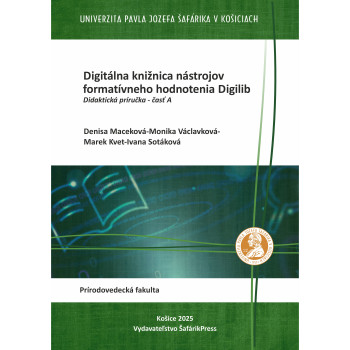
Digitálna knižnica nástrojov formatívneho hodnotenia Digilib

E-publication

Denisa Maceková-Monika Václavková-Marek Kvet-Ivana Sotáková
The Digilib Digital Library of Formative Assessment Tools – User Guide, Part A introduces the Digilib application as the key component of the library, designed to support the implementation of formative assessment in teaching at all levels of education. It explains the structure of the system, its modules, the principles of user roles, and the possibilities for working with the digital formative assessment tools. Particular attention is paid to the possibilities for creating, editing, and assigning the tools to students, as well as to providing personalised real-time feedback. The User Guide also explains how the Digilib application is interconnected with the affiliated applications Digiform and Digilib Images, which expand the possibilities for creating and visualising assessment tools. The guide is intended for teachers at all levels of education, student teachers, school administrators, and digital coordinators who are interested in the systematic use of the Digilib digital library to support the implementation of formative assessment, enhance the quality of the educational process, and foster the development of students’ self-assessment and reflective competences.
Download the e-book for free(pdf)

Quantity

978-80-574-0474-3

Data sheet

Method of publication:
E-book (pdf)
Authors:
Denisa Maceková-Monika Vácvalková-Marek Kvet-Ivana Sotáková
Document type:
Handbook
Number of pages:
136
Available from:
15.12.2025
Year of publication:
2025
Edition:
1st edition
Publication language:
Slovak
Faculty:
Prírodovedecká fakulta
Note:
Publikácia bola vypracovaná v rámci riešenia projektu KEGA č. 001UPJŠ-4/2023 Implementácia formatívneho hodnotenia do výučby na základnej škole so zameraním na digitálnu formu.
Vývoj aplikácie Digilib bol realizovaný na Žilinskej univerzite, Fakulte riadenia a informatiky, Katedre informatiky.
License:
CC BY NC ND (Uveďte autora - Nepoužívajte komerčne - Nespracovávajte)
DOI:
https://doi.org/10.33542/DKN-0474-3

16 other products in the same category:

Novel Trends in Chemistry, Research and...

E-book

E-publication
Soňa Király

The Book of Abstracts of the institutional conference Novel Trends in Chemistry, Research and Education 2025 consists of 88 contributions that reflect the current scientific direction and disciplinary diversity of chemical research at our faculty. The publication is divided into several chapters, including abstracts of 6 invited lectures, 4 plenary lectures, and thematically oriented sessions covering a broad spectrum of chemical disciplines. A total of 78 abstracts are included within the sections.

Download the e-book for free

The 5th International Conference on...

E-book

E-book

Veronika NiščákováIvana Šišoláková (eds.)

Abstracts of the 5th Intemational Conference Nanomaterials: Fundamentals and Applications (NF A) 2021 is the contributions summary of the conference participants. The conference will feature four invited lectures and ten registered lectures. This conference is a tool for creating a dialogue between experts in the field of nanomaterials, their use and overall application in various fields.

Papers in the proceedings are thematically divided into 6 areas. All contributions are highly professional and interesting and can contribute to further creative scientific work.

Download the e-book for free  (pdf)

Praktické cvičenia z fyzikálnej chémie

E-book

E-book

Andrea Morovská TuroňováRenáta OriňakováFrantišek Kaľavský 

The university textbooks "Practical Exercises in Physical Chemistry" are intended as teaching literature for students of the 2nd year of the Chemistry study program and the 3rd year of the interdisciplinary study program at the Faculty of Science of the Pavel Jozef Šafárik University in Košice.

The three chapters summarize the basic knowledge of thermodynamics, electrochemistry and kinetics, the next chapter deals with the measurement of some other physico-chemical quantities. The tasks developed on the basis of cooperation with the Criminalistics and Expertise Institute of the Police in Košice, which also participates in the innovation of practical teaching, are also very attractive and interesting for students. Thematic units are updated and supplemented by new knowledge, principles as well as detailed working procedures using new instrumentation.

The aim of laboratory exercises in physical chemistry is to illustrate and confirm the physicochemical laws and correlations that apply to the quantitative description of chemical phenomena. Students will learn to use instruments and equipment that occur in physico-chemical laboratories, they will learn the principles of accurate and correct quantitative measurement of physical quantities, important from a chemical point of view. They can also develop professional and scientific communication skills, and we want to support their creative approach to making measurement protocols.

Download the e-book for free  (pdf)

Študentská vedecká konferencia PF UPJŠ 2019

E-book

E-book

Katarína Cechlárová (ed.)

This year, the Student Scientific Conference was held on April 24, 2019, across 17 sections in disciplines such as biology and ecology, chemistry, physics, geography, mathematics, informatics, and their didactics. Bachelor’s and master’s students presented a total of 124 contributions. The most successful participants advanced to national or traditional Czech-Slovak student scientific showcases in fields like physics, chemistry, mathematics, informatics, and mathematics didactics.

In addition to faculty students, 10 high school students participated outside the competition. They were invited based on their achievements in subject-specific Olympiads or because they were already engaged with the faculty under the guidance of dedicated teachers in laboratory work as part of their preparation for future studies. The day also featured a programming competition with 23 participants, an IHRA contest involving 16 teams of high school students and 15 teams from elementary schools, and a new Puzzle section where 72 high school students from the region competed.

The abstracts from the Student Scientific Conference demonstrate that our faculty's students not only absorb theoretical knowledge delivered in lectures but also actively engage in solving partial scientific problems that align with research objectives at the institutes of PF UPJŠ. This collection serves as both a record of scientific activity at the faculty and a dignified presentation for the broader public.

Prof. RNDr. Katarína Cechlárová, DrSc.

Vice-Dean for Education

Doc. RNDr. Gabriel Semanišin, PhD.

Dean of the Faculty
Download the e-book for free  (pdf)

Internet vecí a jeho aplikácie

E-book

E-book

Ľubomír Antoni a kol.

In university textbooks, we present the basics of the Internet of Things, its origin and technological development, concept. We classify Internet of Things applications into the areas of healthcare, intelligent environment, personal and social areas, transport and logistics, smart cities.

We present an overview of university subjects in the field of the Internet of Things, which were created and innovated at Slovak universities within the national project IT Academy - Education for the 21st Century. We present extended subject annotations, application examples and case studies using various methods in the field of the Internet of Things.

University textbooks are intended for students of bachelor's, master's, engineering and doctoral study programs in computer science, but also in non-informatics fields.

Download e-book for free(pdf)

Úvod do koordinačnej chémie

E-book

E-book

Juraj Černák

A significant part of inorganic chemistry is coordination chemistry, which deals with coordination compounds. Coordination compounds are numerous because they arise from the combination of central atoms, mostly metals, with ligands, and every organic compound is a potential ligand. This is confirmed by a recent report that American scientists M. Brookhart, C. Schauer, and their colleagues from universities in North Carolina and Washington described the preparation of a rhodium complex with methane as a ligand.

This textbook is based on the long-term experience of the author in teaching and testing this subject. The subject is well-covered in several textbooks of varying difficulty in English; their partial list can be found by readers in the list of used literature at the end of this textbook. On the other hand, in Slovak language, coordination chemistry issues are only marginally covered in several textbooks focused more on general inorganic chemistry but lack a comprehensive view on this topic. From this follows the goal of this proposed textbook - to cover the lack of study literature in this area for Slovak language.

Download the e-book for free  (pdf)

NOVEL TRENDS IN CHEMISTRY, RESEARCH AND...

E-book

Jana Šandrejová - Andrea Gajdošová (eds.)

The scientific book of abstracts from the conference „Novel Trends in Chemistry, Research and Education 2024“ is a summary of the contributions of conference participants, which contain the original results of their scientific and research activities. The contributions published in this volume are divided according to content into the fields of analytical, inorganic, organic, physical chemistry, biochemistry and didactics of chemistry.

Download the e-book for free (pdf)

Základy znalostných systémov

E-book

E-book

Ondrej Krídlo

University textbooks present the basics of knowledge systems, which are divided into two parts. The first part of the publication is devoted to the basis of Formal Concept Analysis, ie the method of data analysis, knowledge representation and information processing, which is based on the formalization of the concept. In the second part we deal with the basics of logic programming, procedural semantics of logic programming, ie programs - theories, questions, SLD-derivation, SLD-tree, search strategies.

University textbooks are intended for students of master's degree programs in computer science.

Download e-book for free (pdf)

Študentská vedecká konferencia PF UPJŠ 2023

E-book

E-book

Marián Kireš  (ed.)

Proceedings of Abstracts from the Student Scientific Conference of the Faculty of Science, Pavol Jozef Šafárik University in Košice

The Student Scientific Conference (SSC) represents the culmination of long-term and intensive work on a selected topic, collaboration with a supervisor, or a broader team at the workplace. In practice, however, it often marks the beginning of scientific research, focusing on a chosen subject, field, or close cooperation with a future supervisor of a bachelor's, master's, or doctoral thesis.

This year, the Student Scientific Conference took place on April 19, 2023, featuring 14 sections, a programming competition, and the IHRA contest. Bachelor’s and master’s students presented 101 contributions. Additionally, 8 high school students participated non-competitively, presenting their SOČ projects; 14 students took part in the programming competition, and 3 students competed in the IHRA contest.

We believe that the proceedings of abstracts and related documents serve not only as an archive but also as a dignified presentation of scientific activities at our faculty for the wider public.

Download the e-book for free  (pdf)

Všeobecná fyzika IV, 1. časť: Atómová fyzika

E-book

E-book

Adela KravčákováStanislav VokálJanka Vrláková 

The presented “General Physics IV, Part 1: Atomic Physics” is intended as a basic study material for lectures from General Physics IV in the second year of bachelor-level study of physics and interdisciplinary study in combination with physics at the Faculty of Science, P. J. Šafárik University in Košice. The content covers the first part of the given course of physics, devoted to atomic physics.

The aim of the course is to obtain basic information about the structure of the atom and the electron shell of the atom.

Download the e-book for free  (pdf)

Určitý integrál

E-book

E-book

Ondrej Hutník

The concept of the integral is one of the most significant concepts in mathematics as a whole. In its most primitive form, it was already used by the ancient Greeks in the creation of Euclidean geometry. However, it was only after Descartes' work on analytical geometry in 1637 that mathematicians could begin to consider the integral as a subject of analysis. Descartes' work laid the groundwork for the discovery of infinitesimal calculus by Leibniz and Newton around 1665. At that time, a great dispute arose over the priority of this discovery, dividing scholars of Germany and England into two opposing camps, each favoring their own champion. Today, we know that Newton's work on fluxions and fluents was somewhat earlier, but Leibniz's notation and approach have gained more acceptance in the mathematical world, and the symbols ∫ ∫ and d d are still used today. A brief overview of the history of the integral will be presented in Chapter 1.

Today, there is a plethora of scripts, textbooks, and books dedicated to explaining the concept of the integral. Therefore, every potential author faces the initial question of whether to write another text on this topic. Our affirmative answer to this question was driven by the students' request to find the subject matter of a part of the winter semester of the second year presented in a coherent form. The second motivation is a slightly different approach to the topic. If we consider the methods typically used in solving problems and gaining routine with a certain integral, it mainly involves the Newton-Leibniz formula, and often there is little time left to compute the definite (Riemann) integral using its definition. Therefore, we included a discussion of the Newton integral in Chapter 2, which reflects this fact and is directly related to the indefinite integral, whose various calculation methods receive relatively much attention in the previous semester. Only after that, in Chapter 3, do we build the theory of the Riemann integral, present criteria for its existence, classes of integrable functions, basic properties, and finally its relationship with the Newton integral. Questions primarily concerning geometric applications are addressed in Chapter 4, and in the final chapter, we focus on extending the Riemann integral to unbounded functions and unbounded intervals.

Download the e-book for free (pdf)

Jarná škola doktorandov 2020

E-book

E-book

Peter Fedoročko (ed.)

Proceedings of the 7th Annual Doctoral Spring School 2020

From November 10 to November 11, 2020, the 7th annual Spring School for Doctoral Students at Pavol Jozef Šafárik University in Košice will take place in Košice in a modified mode in the on-line space. The scientific program of the spring school will comprise 2 plenary lectures by leading scientific experts of Pavol Jozef Šafárik University in Košice. Doctoral students will present their research papers in two sections: 24 doctoral students of Faculty of Public Administration, Faculty of Law and Faculty of Arts, and 22 doctoral students of Faculty of Medicine and Faculty of Science.

The scientific programme of the spring school will also include a panel discussion with the management of Pavol Jozef Šafárik University in Košice.

Download the e-book for free  (pdf)

Štúdium fyzikálnych vlastností tuhých látok

E-book

E-book

Róbert Tarasenko - Vladimír Tkáč

The presented university textbook is intended for all students engaged in the field of condensed matter physics who, while working on their final theses, come into contact with the experimental device known as the Physical Properties Measurement System (PPMS). The main purpose of this textbook is to facilitate, in a certain way, the students' work with the complex manuals provided with this experimental device. At the same time, through this textbook and its clear instructions, students acquire the necessary experimental skills essential in the field of condensed matter physics.

Download the e-book for free (pdf)

This website uses cookies to ensure you get the best experience on our website