Slovenčina


Veronika Králíková a kolektív
Zdravotnické právo ovlivňuje každodenní rozhodování zdravotnických pracovníků více, než si mnozí uvědomují. Každý informovaný souhlas, každý zápis do zdravotnické dokumentace i každé odborné rozhodnutí má svůj právní rozměr. Právě v těchto situacích může neznalost právních pravidel znamenat nejen profesní problém, ale i vážné právní důsledky. Tato publikace přináší srozumitelný a prakticky orientovaný výklad zdravotnického práva určený především zdravotníkům. Čtenář získá přehled o tom, jaká práva má pacient, jaké povinnosti mají poskytovatelé zdravotních služeb a jaké právní dopady mohou mít rozhodnutí učiněná v klinické praxi. Kniha vysvětluje základní právní principy, upozorňuje na nejčastější rizikové situace a nabízí orientaci v právních otázkách, které zdravotníci řeší při své práci. Publikace se věnuje soukromoprávním vztahům mezi pacientem a poskytovatelem zdravotních služeb, odpovědnosti za újmu, informovanému souhlasu, zdravotnické dokumentaci i trestněprávním aspektům zdravotnické praxe. Samostatná pozornost je věnována také znalecké činnosti ve zdravotnictví a specifickým situacím, které vznikají na rozhraní medicíny a práva. Kniha je určena především studentům zdravotnických oborů, lékařům, nelékařským zdravotnickým pracovníkům a dalším profesionálům působícím ve zdravotnictví. Využití však najde i u studentů práva, právníků specializujících se na zdravotnické právo nebo pracovníků veřejné správy. Autorka propojuje zkušenost soudní lékařky a právničky a nabízí tak jedinečný pohled na právní otázky medicínské praxe.

Data sheet
Specific References
E-book
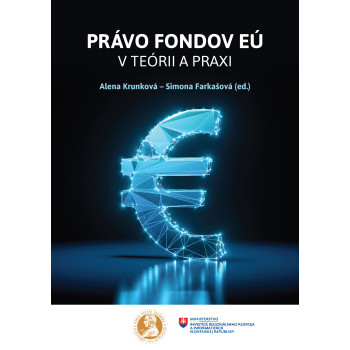
Alena Krunková - Simona Farkašová
Proceedings of the International Scientific Conference on EU Funds Law in Theory and Practice held on October 3, 2019, in Košice.
The conference was attended by representatives from the academic sphere, educators from the Faculty of Law at UPJŠ in Košice, who created the subject and continue to participate in its teaching. The participants included professionals from practice, such as those from the Office of the Deputy Prime Minister of the Slovak Republic for Investments and Informatization, the Office for Public Procurement of the Slovak Republic, the Supreme Audit Office of the Slovak Republic, and the Ministry of Labor, Social Affairs, and Family of the Slovak Republic. Valuable information was also shared at the conference by representatives from the Ministry of Regional Development of the Czech Republic, OECD representatives, and representatives from the European Commission's Representation in Slovakia. The presented contributions reflected current issues in a highly professional manner, identified problematic areas, and outlined suitable solutions for contentious issues.
From the individual presentations of the conference participants, it was possible to compile a work that, while not extensive in scope, is very remarkable in value. It connects theory and practice in an outstanding manner and thus expands knowledge in the still complex issue of the legal regulation of European Union funds.
E-book
Alexander Bröstl - Marta Breichová Lapčáková (eds.)
The presented Collection Volume is dedicated to three framework areas, namely justice, community and freedom. These are the thematic areas of the 30th IVR World Congress, on the occasion of which a meeting of its Slovak section was held. The published contributions focus on the main topic of the congress, which is also the central topic of legal and social sciences. Thus, in the Collection we will find reflections on the freedom of the individual in society, its various shades of meaning and forms. The question of the organization of social relations in the form of the degree of participation of citizens in state power in the context of the democratic form of government and its current challenges should not be neglected either. Thus, the institutions of direct and indirect democracy, the dangers of the lures of the so-called totalitarian democracy, or the question of identities in a postmodern pluralistic society. The question of justice in procedural law is not avoided either.
The collection thus provides the reader with a wide area of research from legal-philosophical questions, through questions of the theory of the constitutional state, to their application in legal practice. Geographically, it maps the events in the Central European and wider European area with an impact on their global dimension. The publication can thus become a useful source of knowledge and current developments in jurisprudence and its main topics with the aim of a better understanding of social reality.
E-book
Milena Barinková (ed.)
The complex of legal norms protecting work, ensuring safety and health protection at work, is very broad in scope, extending beyond the Labour Code to include other specific legal regulations, collective agreements, executive legal regulations, and internal corporate normative acts.
Health protection of employees from hazardous workplace influences is a central requirement stemming from fundamental human rights guaranteed by the Constitution of the Slovak Republic. To ensure its universal enforcement across all employers in both private and public sectors, strict regulation through cogent norms is fully justified. The European Commission’s Communication to the European Parliament, Council, European Economic and Social Committee, and Committee of the Regions on the EU Strategic Framework on Health and Safety at Work 2014–2020 (COM(2014) 332 final) addresses the need to account for labor market changes arising from demographic shifts, aging populations, and technological advancements.
Work pace demands are intensifying, and all age categories of employees must adapt to new technologies, organizational changes, and evolving job structures. This increases requirements for maintaining health fitness throughout entire professional careers. Mental health fitness, which receives insufficient specific attention, is an inherent part of health fitness requirements. Prevention plays a critical role in mental health protection.
E-book
Ján Husár - Kristián Csach (eds.)
The collection contains contributions presented at the international conference held on April 1st - 3rd 2014 in Smolenice, organized by Pavol Jozef Šafárik University in Košice in cooperation with the Institute of State and Law of the Slovak Academy of Sciences and the Institute of State and Law of the Czech Academy of Sciences. Authors are high-profile Slovak and Czech scholars in the field of private law and company law, as well as representatives of new generation of young researchers. Contributions focus on contemporary issues in the field of company law, in particular theoretical basis of corporations, groups of companies, doctrine of abuse of rights, reflective loss and new tendencies in corporate law in foreign legal orders. The first part of the contributions presented at the conference have been already published in the special issue of the theoretical magazine Právny Obzor n. 4/2014.