• New
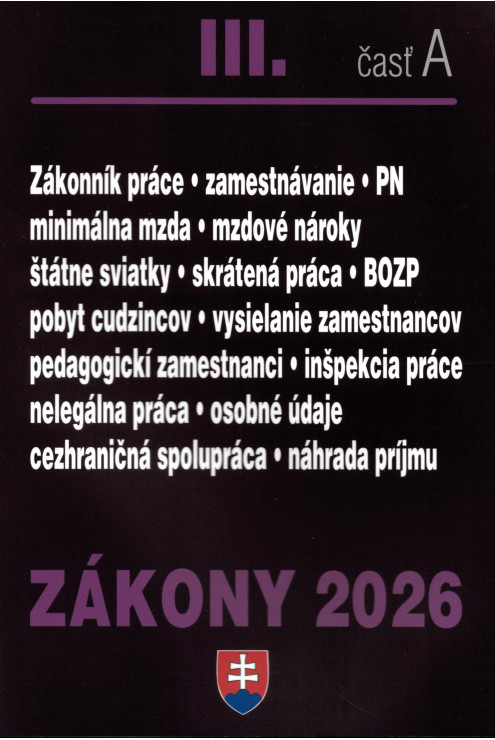
    Zákony III. A / 2026

Zákony III. A / 2026

€17.24
Tax included

Kolektív autorov

Publikácia obsahujúca najdôležitejšie právne predpisy z pracovnoprávnej oblastí, miezd, zamestnanosti, BOZP a správneho práva. Všetky právne predpisy obsahujú zmeny k 1. 1. 2026 a sú uvádzané v úplnom znení. Zmeny v zákonoch sú v texte prehľadne vyznačené. Hlavné témy: Zákonník práce, Minimálna mzda, Služby zamestnanosti, Inšpekcia práce, BOZP, Ochrana osobných údajov.

Titul obsahuje úplné znenie zákonov a súvisiacich predpisov pre rok 2026:
Zákonník práce (1. kapitola)
Zákon č. 311/2001 Z. z. Zákonník práce
Mzdové predpisy (2. kapitola)
Zákon NR č. 663/2007 Z. z. o minimálnej mzde
Zákon č. 462/2003 Z. z. o náhrade príjmu pri dočasnej pracovnej neschopnosti zamestnanca
Zákon NR SR č. 241/1993 Z. z. o štátnych sviatkoch, dňoch pracovného pokoja a pamätných dňoch
Zákon č. 215/2021 Z. z. o podpore v čase skrátenej práce
Oznámenie MPSVaR SR č. 245/2025 Z. z. o sume minimálnej mzdy na rok 2026
Oznámenie MPSVaR SR č. 244/2025 Z. z. o sumách minimálnych mzdových nárokov na rok 2026
Zamestnanosť (3. kapitola)
Zákon č. 5/2004 Z. z. o službách zamestnanosti
Zákon č. 404/2011 Z. z. o pobyte cudzincov
Zákon č. 351/2015 Z. z. o cezhraničnej spolupráci pri vysielaní zamestnancov na výkon prác pri poskytovaní služieb
Pedagogickí zamestnanci (4. kapitola)
Zákon č. 138/2019 Z. z. o pedagogických zamestnancoch a odborných zamestnancoch
Bezpečnosť a ochrana zdravia pri práci (5. kapitola)
Zákon NR SR č. 124/2006 Z. z. o bezpečnosti a ochrane zdravia práci
Zákon č. 82/2005 Z. z. o nelegálnej práci a nelegálnom zamestnávaní
Zákon č. 125/2006 Z. z. o inšpekcii práce
Správne právo (6. kapitola)
Zákon č. 18/2018 Z. z. o ochrane osobných údajov
Zákon č. 54/2019 Z. z. o ochrane oznamovateľov protispoločenskej činnosti

Podľa Zákonníka práce má každý právo na prácu a na slobodnú voľbu zamestnania, na spravodlivé a uspokojivé pracovné podmienky a na ochranu proti svojvoľnému prepusteniu zo zamestnania. Tieto práva má každý zamestnanec bez akýchkoľvek obmedzení a diskriminácie.  Zamestnávateľ  má podľa Zákonníka práce právo na slobodný výber zamestnancov. Zamestnávateľ určuje podmienky a spôsob uplatnenia tohto práva, ak Zákonník práce, osobitný predpis alebo medzinárodná zmluva, ktorou je Slovenská republika viazaná, neustanovuje inak. Zamestnávateľ je právnická osoba alebo fyzická osoba, ktorá zamestnáva aspoň jednu fyzickú osobu v pracovnoprávnom vzťahu, a ak to ustanovuje osobitný predpis aj v obdobnom pracovnom vzťahu. Zamestnávateľom je aj organizačná jednotka zamestnávateľa, ak to ustanovujú osobitné predpisy alebo stanovy podľa osobitného predpisu.

Quantity
Last items in stock

Poradca
978-80-8162-296-0

Data sheet

Method of publication:
Printed publication
Authors:
Kolektív autorov
Document type:
Legislation
Number of pages:
512
Year of publication:
2026
Publication language:
Slovak
License:
Copyright

Specific References

MPN
303559

16 other products in the same category:

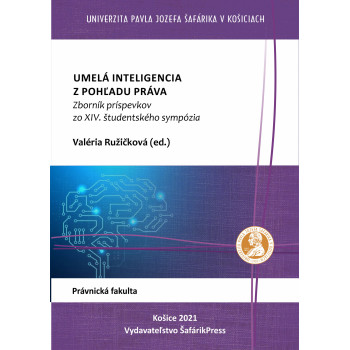
Umelá inteligencia z pohľadu práva

E-book

E-book

Valéria Ružičková (ed.)

Proceedings of the XIVth Student Symposium on International Law and European Law.

For the XIV Year of Student Symposium on International Law and European Law under the topic „Artificial Intelligence from the Perspective of Law“, students of the Faculty of Law and the Faculty of Science prepared several papers regarding current questions related to the ongoing development of the artificial intelligence. From the legal point of view, the papers regard the importance of the artificial intelligence in human activities in space, its impact on fundamental rights, development of new human rights in relation to its application in healthcare and nursing care as well as personal data protection while making use of the artificial intelligence.

Apart from the papers concerning the artificial intelligence from the legal perspective, two of the papers regard the artificial intelligence from the scientific perspective, explaining the importance of the artificial intelligence in localization in indoor environment as well as its importance in prediction of healthcare costs.

Download the e-book for free (pdf)

Právo informačných a komunikačných technológií

€19.50
Availability: 5 In Stock

Regina Hučková - Diana Treščáková - Laura Rózenfeldová

Vysokoškolská učebnica Právo informačných a komunikačných technológií je určená študentom vysokých škôl vo všeobecnosti, najmä však študentom Právnickej fakulty, ktorí majú záujem o štúdium práva v spojení s informačnými a komunikačnými technológiami. Učebnica predstavuje zdroj informácií potrebných nielen pre štúdium tejto problematiky, ale aj pre rozšírenie celkového obzoru v danej problematike.

Spotrebitelia a obchodníci online: právne a...

E-book

E-book

Renáta Bačárová, Kristián Vassay (eds.)

The proceedings Consumers and Traders Online: Legal and Economic Challenges of Digital Markets present a collection of scientific studies addressing contemporary issues of digital market functioning within the European Union. The contributions analyse legal, economic and technological dimensions of digital services, particularly in the context of the VEGA project 1/0431/23 focused on the conflict of interests between consumers and traders in the delivery of digital content and services. The studies highlight the dynamic growth of the digital economy, bringing new regulatory challenges, issues of data protection and enforcement of consumer rights. The authors examine topics such as geographical indications in the digital environment, the use of artificial intelligence in public enforcement, fintech regulation, liability for damages, and the impacts of the Digital Services Act (DSA) and the Digital Markets Act (DMA). The proceedings also expose increasing fragmentation of responsibility across digital actors and emphasise the need for a harmonised EU regulatory framework. Further attention is given to evolving consumer behaviour, cybersecurity risks, deepfake technologies, the functioning of online marketplaces and digital payment systems. A significant part of the analysis addresses the role of major online platforms, their obligations and influence on transparency in digital markets. The publication offers an interdisciplinary perspective combining law, economics and technology, representing an important contribution to the discourse on modern consumer protection in the digital era.

Download the e-book for free (pdf)

V.SLOVENSKO-ČESKÉ DNI DAŇOVÉHO PRÁVA

E-book

E-book

Miroslav Štrkolec - Filip Baláži - Natália Priateľová - Anna Vartašová

Tax Law and New Phenomena in the Economy. This collection of scientific papers presents contributions from the international scientific conference “V. SLOVAK-CZECH DAYS OF TAX LAW: Tax Law and New Phenomena in the Economy,” which took place on June 5 and 6, 2023, at the Faculty of Law of Pavol Jozef Šafárik University in Košice and was supported by the Scientific and Grant Agency within the project APVV-19-0124 “Tax Law and New Phenomena in the Economy (digital services, shared economy, virtual currencies).”

The individual contributions focus on addressing current issues of tax law in the context of new phenomena in the economy. The authors in their contributions mainly deal with digitalization and the resulting challenges for tax law, especially specific problems related to crypto-assets, digital tax, and technologies, as well as the shared economy and its tax impacts.

Attention is also given to selected extraordinary measures adopted in the financial sector in response to the COVID-19 pandemic and application problems that have arisen or may arise in their implementation in practice.

Download e-book for free (pdf)

Zákon o národnostiach a Rada vlády Slovenskej...

E-book

E-book

Jana Šutajová

From January 1, 1969, the Constitutional Act on the Status of Nationalities in the Czechoslovak Socialist Republic (ČSSR) and the Constitutional Act on the Federation came into effect. The Constitutional Act on the Status of Nationalities represented at least a formal significant step forward in the legal regulation of minority rights. However, this law was intended to serve as a foundation for further legal adjustments. It was declared that additional steps and negotiations for the adoption of implementing regulations would follow and that further laws would be enacted at both the federal and national levels. Nevertheless, no additional law or government regulation related to the constitutional act on the status of nationalities in the ČSSR was ever issued.

During the normalization period, issues concerning further legislation related to national minorities were not addressed. However, in the brief period following the adoption of the constitutional act in 1968 until the end of 1969, some institutions attempted to prepare and promote such legal norms. One of these institutions was the Government Council of the Slovak Socialist Republic (SSR) for Nationalities (hereafter referred to as the Council or the Government Council for Nationalities). The monograph provides an insight into the development of additional legal norms arising from the constitutional act on the status of nationalities in the Slovak Socialist Republic, prepared by the Government Council of SSR for Nationalities. This council was one of the institutions established in Slovakia after the formation of the Czechoslovak federation and dealt with nationality issues.

In addressing further legal norms stemming from the constitutional act on nationalities in ČSSR, it was necessary to consider prior developments. Therefore, the first part of the monograph examines the status of minorities in Czechoslovakia before adopting the constitutional act, activities of nationalities preceding its adoption, and its enactment itself. Subsequent sections focus on institutional changes in SSR following federalization, the establishment of the Government Council of SSR for Nationalities, and specific actions taken by this Council and its expert bodies in drafting proposals for laws concerning nationalities in the Slovak Socialist Republic.

The motivation for writing this monograph stemmed from the fact that this topic has so far received attention only in a few studies in Slovakia, which primarily focused on the Hungarian minority during either the Prague Spring or normalization periods.

Download the e-book for free (pdf)

LAW – COMMERCE – ECONOMY XII.

E-book

E-book

Jozef Suchoža - Ján Husár - Regina Hučková

The Proceedings of the International Scientific Symposium "LA W-BUSINESS-ECONOMICS XII" is a collection of scientific works by authors participating in the symposium of the same name. The publication focuses primarily on the area of representation in private law, related pai1ies in corporate and bankruptcy law, and current issues of legal regulation of artificial intelligence.

The authors of indivídua! contributions are erudite experts from various branches of law. The collection of scientific papers is a complete work in the form of a collection, with an overlap into private and public law sectors.

Readers are presented with scientific outputs from authors from the Slovak legal environment, as well as from foreign authors. Several authors' paper provide a European legal perspective or an international comparative perspective.

Download e-book for free (pdf)

Spravodlivosť v organizáciách verejnej správy

E-book

E-book

Eliška Župová et al.

Research into justice in public administration organizations has not yet been conducted in Slovakia, not even in the scope of respondents addressed. Therefore, we consider the project cross-sectional, current, and beneficial for deeper exploration of this area.

The project is designed as interdisciplinary, combining insights from legal perspectives in defining justice from labor law aspects, psychological and ethical evaluations of fairness levels, and knowledge from public administration management fields.

The inspiration for selecting this topic stems from its academic relevance, confirmed by both domestic and international studies, as well as its public relevance, where laypeople most intensely perceive justice/injustice in relation to remuneration and appropriate labor-law conditions – exemplified by teachers’ strikes (2003, 2006, 2016), nurses’ strikes (2003, 2006, 2012, 2016), ŽSR employees’ strikes (2003), and doctors’ strikes (2011).

Download the e-book for free  (pdf)

Novelizovaný trestný zákon 2023

€6.95
Availability: 1 In Stock

Novelizovaný Trestný zákon s aktualizovanými dôvodovými správami ZÁKON Č. 300/2005 Z. Z. TRESTNÝ ZÁKON V ZNENÍ ZÁKONA Č. 650/2005 Z. Z., ZÁKONA Č. 692/2006 Z. Z., ZÁKONA Č. 218/2007 Z. Z., ZÁKONA Č. 491/2008 Z. Z., ZÁKONA Č. 497/2008 Z. Z., ZÁKONA Č. 498/2008 Z. Z., ZÁKONA Č. 59/2009 Z. Z., ZÁKONA Č. 257/2009 Z. Z., ZÁKONA Č. 317/2009 Z. Z., ZÁKONA Č. 492/2009 Z. Z., ZÁKONA Č. 576/2009 Z. Z., ZÁKONA Č. 224/2010 Z. Z., ZÁKONA Č. 547/2010 Z. Z., ZÁKONA Č. 33/2011 Z. Z., ZÁKONA Č. 262/2011 Z. Z., ZÁKONA Č. 313/2011 Z. Z., ZÁKONA Č. 246/2012 Z. Z., ZÁKONA Č. 334/2012 Z. Z., NÁLEZU ÚSTAVNÉHO SÚDU SLOVENSKEJ REPUBLIKY Č. 428/2012 Z. Z., UZNESENIA ÚSTAVNÉHO SÚDU SLOVENSKEJ REPUBLIKY Č. 189/2013 Z. Z., ZÁKONA Č. 204/2013 Z. Z., ZÁKONA Č. 1/2014 Z. Z., NÁLEZU ÚSTAVNÉHO SÚDU SLOVENSKEJ REPUBLIKY Č. 260/2014 Z. Z., ZÁKONA Č. 73/2015 Z. Z., ZÁKONA Č. 78/2015 Z. Z., ZÁKONA Č. 87/2015 Z. Z., ZÁKONA Č. 174/2015 Z. Z., ZÁKONA Č. 397/2015 Z. Z., ZÁKONA Č. 398/2015 Z. Z., ZÁKONA Č. 440/2015 Z. Z., ZÁKONA Č. 444/2015 Z. Z., ZÁKONA Č. 91/2016 Z. Z., ZÁKONA Č. 125/2016 Z. Z., ZÁKONA Č. 316/2016 Z. Z., ZÁKONA Č. 264/2017 Z. Z., ZÁKONA Č. 274/2017 Z. Z., ZÁKONA Č. 161/2018 Z. Z., ZÁKONA Č. 321/2018 Z. Z., ZÁKONA Č. 35/2019 Z. Z., NÁLEZU ÚSTAVNÉHO SÚDU SLOVENSKEJ REPUBLIKY Č. 38/2019 Z. Z., ZÁKONA Č. 214/2019 Z. Z., ZÁKONA Č. 420/2019 Z. Z., ZÁKONA Č. 474/2019 Z. Z., ZÁKONA Č. 288/2020 Z. Z., ZÁKONA Č. 312/2020 Z. Z., ZÁKONA Č. 236/2021 Z. Z., ZÁKONA Č. 357/2021 Z. Z., ZÁKONA Č. 105/2022 Z. Z., A ZÁKONA Č. 111/2022 Z. Z. A ZÁKONA Č. 117/2023 Z.Z.

Novelizovaný trestný poriadok 2023

€8.40
Availability: 1 In Stock

Novelizovaný Trestný poriadok s aktualizovanými dôvodovými správami v úplnom znení

ZÁKON Č. 301/2005 Z. Z. TRESTNÝ PORIADOK V ZNENÍ ZÁKONA Č. 650/2005 Z. Z., ZÁKONA Č. 692/2006 Z. Z., ZÁKONA Č. 342/2007 Z. Z., ZÁKONA Č. 643/2007 Z. Z., ZÁKONA Č. 61/2008 Z. Z., ZÁKONA Č. 491/2008 Z. Z., ZÁKONA Č. 498/2008 Z. Z., ZÁKONA Č. 5/2009 Z. Z., ZÁKONA Č. 59/2009 Z. Z., ZÁKONA Č. 70/2009 Z. Z., ZÁKONA Č. 97/2009 Z. Z., NÁLEZU ÚSTAVNÉHO SÚDU SLOVENSKEJ REPUBLIKY Č. 290/2009 Z. Z., ZÁKONA Č. 291/2009 Z. Z., ZÁKONA Č. 305/2009 Z. Z., ZÁKONA Č. 576/2009 Z. Z., ZÁKONA Č. 93/2010 Z. Z., ZÁKONA Č. 224/2010 Z. Z., ZÁKONA Č. 346/2010 Z. Z., ZÁKONA Č. 547/2010 Z. Z., ZÁKONA Č. 220/2011 Z. Z., ZÁKONA Č. 262/2011 Z. Z., ZÁKONA Č. 331/2011 Z. Z., ZÁKONA Č. 236/2012 Z. Z., ZÁKONA Č. 334/2012 Z. Z., ZÁKONA Č. 345/2012 Z. Z., ZÁKONA Č. 204/2013 Z. Z., ZÁKONA Č. 305/2013 Z. Z., ZÁKONA Č. 1/2014 Z. Z., ZÁKONA Č. 195/2014 Z. Z., ZÁKON Č. 307/2014 Z. Z., ZÁKONA Č. 353/2014 Z. Z., ZÁKONA Č. 78/2015 Z. Z., NÁLEZU ÚSTAVNÉHO SÚDU SLOVENSKEJ REPUBLIKY Č. 139/2015 Z. Z., ZÁKONA Č. 174/2015 Z. Z., ZÁKONA Č. 397/2015 Z. Z., ZÁKONA Č. 398/2015 Z. Z., ZÁKONA Č. 401/2015 Z. Z., ZÁKONA Č. 440/2015 Z. Z., ZÁKONA Č. 444/2015 Z. Z., ZÁKONA Č. 91/2016 Z. Z., ZÁKONA Č. 125/2016 Z. Z., ZÁKONA Č. 316/2016 Z. Z., ZÁKONA Č. 152/2017 Z. Z., ZÁKONA Č. 236/2017 Z. Z., ZÁKONA Č. 274/2017 Z. Z., ZÁKONA Č. 161/2018 Z. Z., ZÁKONA Č. 314/2018 Z. Z., ZÁKONA Č. 321/2018 Z. Z., ZÁKONA Č. 3/2019 Z. Z., ZÁKONA Č. 6/2019 Z. Z., ZÁKONA Č. 35/2019 Z. Z., ZÁKONA Č. 54/2019 Z. Z., ZÁKONA Č. 214/2019 Z. Z., ZÁKONA Č. 231/2019 Z. Z., ZÁKONA Č. 312/2020 Z. Z., ZÁKONA Č. 423/2020 Z. Z., ZÁKONA Č. 308/2021 Z. Z., ZÁKONA Č. 432/2021 Z. Z., ZÁKONA Č. 150/2022 Z. Z., ZÁKONA Č. 340/2022 Z. Z., ZÁKONA Č. 398/2022 Z. Z. A ZÁKONA Č. 49/2023 Z. Z..

Pracovnoprávne elementy výkonu (závislej)...

E-book

E-book

Jana Žuľová (ed.)

Collection of Scientific Works

Article 35 of the Constitution of the Slovak Republic guarantees everyone the right to freely choose their profession and receive training for it, as well as the right to engage in entrepreneurial or other gainful activity. Everyone has the right to freely decide whether to secure their livelihood through self-employment—with all the associated consequences and risks—or through employment within labor-law relationships by performing dependent work.

The framework and rules for exercising these rights are primarily regulated by labor, commercial, and tax legislation, each with its own set of rights and obligations applicable specifically to entrepreneurs and employees. Constant competitive pressure, along with the effects of economic crises, pushes employers to seek ways to extract the most from workers while optimizing for the lowest possible insurance, administrative, and tax costs. As a result, employment contracts are being terminated, and under the pressure of losing their income, individuals are "voluntarily" shifting to commercial-law relationships.

This situation, along with other distortions in the labor market, confronts those entitled to work with unfair practices by employers, thereby undermining their ability to freely exercise this fundamental right.

Download the e-book for free (pdf)

Teória a prax verejnej správy (2020)

E-book

E-book

Milan DoušaTatiana GmitrováOskar TóthMatúš Vyrostko (eds.)

Peer-reviewed proceedings of contributions from the 5th year of the doctoral students' scientific conference, February 6, 2020

The dynamically evolving contemporary society creates expectations and demands among citizens for public administration to be efficient, reliable, open, professional, and fast. New theories of knowledge, in connection with constant changes, must also include practical application and reflection of these characteristics in the public administration system in practice. For this reason, it is important to pay attention to new approaches from both theoretical and practical perspectives to the application of modern public administration in the conditions of the V4 countries.

Given that public administration is an interdisciplinary scientific discipline that utilizes knowledge from a wide range of scientific fields and thus enables a comprehensive approach to solving problems of modern public administration, the peer-reviewed proceedings of contributions from the doctoral students' scientific conference are divided into three sections: socio-economic, political science, and legal. The sections eruditely respond to current public administration problems from both theoretical and practical perspectives.

PhDr. Milan Douša
Chairman of the Organizing Committee

Download the e-book for free (pdf)

Politické systémy štátov BRICS

E-book

E-book

Patrik Furik Michaela RužičkováDávid GajdoščíkPeter DubócziBarbora LinhartováLucia Grieger

The textbook entitled Political Systems of the BRICS States is published as an output of the KEGA 014UPJŠ-4/2020 Innovative Model of Education Leading to Active Citizenship as a Prevention of the Rise of Political Extremism among Students. The aim of the given publication is to present the basic principles of the political systems of the BRICS bloc states and to provide the reader with the nature and character of the bloc's functioning.

The textbook consists of an introduction and five further chapters. All sections are written in Slovak. The individual chapters focus primarily on characterizing the historical development of the BRICS states, the evolution of their constitutionalism, public administration, and on defining the legislative, executive, and judicial branches of power

The individual chapters describe the political systems of the states: Brazil, the Russian Federation, India, China, and South Africa. The introductory chapter of the textbook contains the characteristics of the development and formation of the bloc, as well as information on the cooperation among the BRICS members.

Download the e-book for free (pdf)

Ústavné právo Slovenskej republiky

€27.59
Availability: 1 In Stock

Alexander Bröstl  - Pavel  - Holländer - Patrik Príbelský a kolektív

Publikácia nie je obmedzená výlučne na ústavné právo Slovenskej republiky má oveľa širší záber. Výklad zvolený v tejto príručke vychádza z pojmu a klasifikácie ústav a pokračuje stručným a orientačným prehľadom základných línií ústavného vývoja na území Slovenskej republiky za ostatných stopäťdesiat rokov. Rozsiahla časť je venovaná základným právam a slobodám v následnosti, ktorá sa riadi systematikou Ústavy Slovenskej republiky z roku 1992. Otázky týkajúce sa jednotlivých druhov moci v kontexte modelu deľby moci sú predmetom pozornosti záverečných kapitol: po tradičných mociach je do tejto časti zaradená aj kontrolná moc spolu s prokuratúrou a verejným ochrancom práv. Sprievodným znakom publikácie sú tiež odkazy na rozhodovaciu činnosť Ústavného súdu Slovenskej republiky, najmä v spojitosti s problematikou základných práv a slobôd. Kniha je určená predovšetkým študentom magisterského štúdia v odbore právo v rámci študijných programov tam, kde sa tieto programy týkajú ústavného práva Slovenskej republiky.

Územná samospráva a tvorba práva

E-book

E-book

Michal Jesenko - Martina Kantorová(eds.)

Peer-reviewed proceedings of the scientific conference, which took place on 27.11.2015 at the Faculty of Public Administration, UPJŠ v Košice, Popradská 66, 041 32 Košice

Territorial self-government forms an integral part of a modern democratic and legal state. It is an expression of efforts to implement tasks to ensure the needs of the territorial community of citizens at the level that is closest to them.

One of the most important tools at the disposal of local self-government units in the performance of the tasks entrusted to them is the power to issue general binding regulations in matters of local self-government and to ensure the tasks arising for local self-government from the law. Law-making at the level of towns and municipalities or higher territorial units is thus an integral part of the exercise of territorial self-government and ultimately expresses its specific character as an essential part of public administration.

The aim of the scientific conference organized by the Department of Public Law Disciplines, Faculty of Public Administration, UPJŠ in Košice on 27 November 2015 was an effort to present the achieved results of scientific research activities in the field of law-making at the level of cities and municipalities, or higher territorial units. The conference provided a wide space for discussion on current issues of municipal standard-setting with the participation of representatives of the professional public, as well as representatives of local government and local self-government.

The scientific conference and the peer-reviewed proceedings of the conference were realized as a part of the solution of the VEGA grant project No. 1/0683/13 under the title "Normative Formation of Municipalities in the Matters of Local Self-Government. The present collection of papers from the scientific conference is an expression of the long-term efforts of the Department of Public Administration, Faculty of Public Administration, UPJŠ in Košice to address current issues of public administration with a special focus on the issue of local government.

Download the e-book for free (pdf)

Zelené ambície v podmienkach európskeho a...

E-book

E-book

Juraj Panigaj (ed.)

Collection of Contributions from the XVth Student Symposium on International Law and European Law, held on April 22, 2022, in a hybrid format, with the participation of students from the Faculty of Law of Pavol Jozef Šafárik University in Košice and the Faculty of Law of Trnava University in Trnava.

The jubilee XV. year of student symposium from international and European law took place at the University of Pavol Jozef Šafárik, faculty of law, on April 22, 2022, symbolically on Day Earth. This year's event was dedicated to the increasingly pressing issue of environmental protection. The topic "Green ambitions in the light of European and international law" appealed to many students, resulting in several interesting contributions, falling under both European Union law and international law. European law currently brings great challenges, but also expectations through the European Green Deal. This is also why several student contributions dealt with topics falling under the European Green Deal, either from the point of view of its individual initiatives in general, or more specifically, in the intentions of Agenda 2030, or the implementation of the so-called green diplomacy.

The other part of contributions dealt with environmental protection within international law. Students addressed issues of an environmental nature in the areas of climate change, international maritime law, atmospheric protection, or the issue of so-called climate refugees. The publication itself is an output of the APVV project APVV-20-0576 "Green ambitions for sustainable development (European Green Deal in the context of international and national law)".

Download e-book for free (pdf)

Ako správne pracovať s prameňmi práva Európskej...

E-book

E-book

Dominika BeckováRadoslav BenkoValéria Ružičková

Studies of the European Union law may hardly be possible without making use of its sources. Lots of types of legal rules, several forms of judicial decisions as well as a wide spectrum of criteria used while searching among legal acts of the European Union and case-law of its courts in search engines on the official websites of the European Union may, however, appear confusing, thereby making the work with sources of the European Union law more complicated and prolonging it.

Methodology Guide „How to Work Correctly with the Sources of the European Union Law“ aims to help students to understand the system of sources of the European Union law as well as the sources themselves, offer them tips and advice useful during their search and thus contribute to the adoption of fundamental procedures for working with them.

Download the e-book for free (pdf)

This website uses cookies to ensure you get the best experience on our website