Slovenčina


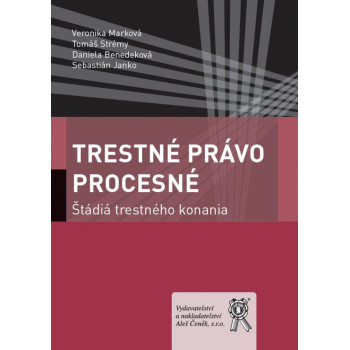
Veronika Marková a kolektív
Publikácia Trestné právo procesné. Štádiá trestného konania je učebnica trestného práva, ktorou chcú autori poskytnúť teoretické poznatky a súvislosti v časti Trestného poriadku od § 196 (postup pred začatím trestného stíhania) až po ustanovenia, ktoré sa venujú piatej a šiestej časti Trestného poriadku). Jednotlivé kapitoly obsahujú viaceré skutočnosti, ktoré sú obsahovo zamerané na štádiá trestného konania, ako aj na právny styk s cudzinou, ci trovy trestného konania. Autori sa podrobne venujú viacerým inštitútom, ktoré sú súčasťou týchto štádií v nadväznosti na prvú časť publikácie Trestné právo procesné. Všeobecná časť. Učebnica je určená ako základný a odporúčaný učebný materiál pre študentov študijného odboru právo, prípadne bezpečnostné vedy, ako aj pre poslucháčov iných študijných odborov vysokých škôl, ktorí majú vo svojom študijnom pláne zaradený predmet trestné právo procesné. Štruktúra učebnice vychádza z_ doposiaľ osvedčených publikácií a učebníc trestného práva vydávaných v Slovenskej a Českej republike.

Data sheet
Specific References
Sergej Romža a kolektív
OBSAH:
1 HISTORICKO-PRÁVNE ASPEKTY
2 KOMPARATÍVNE ASPEKTY
3 JURISTICKÉ ASPEKTY
4 KRIMINOLOGICKÉ ASPEKTY
5 PENOLOGICKÉ ASPEKTY
6 VIKTIMOLOGICKÉ ASPEKTY
7 ORGANIZAČNO TECHNICKÉ ASPEKTY
E-book
Ján Klučka et al.
The aim of the current monograph is to provide comprehensive view of the status of regional judicial organs in current conditions of regionalism. Based on selected issues examined in individual chapters research team presents the comprehensive study focused on clarification of the status and significance of regional judicial organs in terms of new regionalism.
Research of the role of regional courts in the system of peaceful settlement of disputes demonstrates the significant role of the regional courts within the promotion of the rule of law, regional integration and also significant role of regional courts to ensure legal certainty within the system of compliance with decisions of regional courts. The result of examination of possibilities of individuals to access to regional judicial organs is comparative evaluation of regional possibilities of individual to defend his/her rights within regional courts of various regions. Particular part of this area is the right to an effective remedy and to a fair trial as basic rights within the proceedings of regional judicial organs. Within the examination of preliminary rulings of international regional courts of different regions the role of regional judicial organs in the process of effective implementation of the principle of the rule of law was the subject of examination.
For the proper functioning of the regional judicial organs as well as independence of judges and legal certainty in International law, the ethical rules of international judicial organs and tribunals, which are the subject of the last chapter, are significant.
E-publication
Sergej Romža-Lukáš Michaľov-Michaela Ema Mauerová
Proceedings of scientific contributions with the main section: "Artíficíal intellígence - a challenge for crímínal law" and subsections: "Extremism from the perspective of criminology, victimology, and criminalistics" and "Creation and tools of criminal policy" is the result of a nationwide interdisciplinary scientific conference with intemational particípation, organízed by the Department of Criminal Law of the Faculty of Law at UPJŠ in Košice. The publication retlects current challenges in criminal law in the context of dynamic technological, security, and social changes. The main section, "Artificial Intelligence - A Challenge for Criminal Law," presents contributions analyzing legal, ethical, and practical issues related to the use of artificial intelligence in the field of criminal law. The authors address autonomous responsibility, algorithmic transparency, the possibilities of using Al in the prevention, detection, and prosecution of crimes, as well as the risks to the protection of fundamental rights and fair tria!.
Sergej Romža - Dávid Priščák - Matej Biroš (eds.)
Proceedings of scientific papers „ Elimination of racism, xenophobia and otherforms of intolerance by means of criminal law. Recodification of Criminal Codes - Current Challenges and Perspectives. " is the output of the national interdisciplinary scientific conference with intemational participation organized by the Department of Criminal Law ofthe Faculty ofLaw of the University of Applied Sciences in Košice. The proceedings contain contributions focused on the issues of elimination of racism, xenophobia and other forms of intolerance by means of criminal law and on the issues of recodification of criminal codes, their current challenges and perspectives, both in the field of substantíve and procedural law.
This is a highly topical issue, as the need to eliminate racism, xenophobia and other forms of intolerance by means of criminal law is an important topic with regard to the social situation. The recodification of the criminal codes in 2024 has significantly affected both the substantíve and procedural areas of criminal law, which is the means of ultima ratio. Considering the social developments and the recent amendments to the pena! codes, we consider the theme of the conference and the titlc of the proceedings to be highly topical, containing a significant scope for scientific research.
The participants of the national interdisciplinary scientific conference with international participation in their contributions also dealt with de lege ferenda considerations and at the same time offered solutions to application problems in the field.
The aim of the published proceedings is to continue to improve and develop new knowledge in the field of criminal law, while respecting human rights and freedoms, based on the existing professional knowledge.