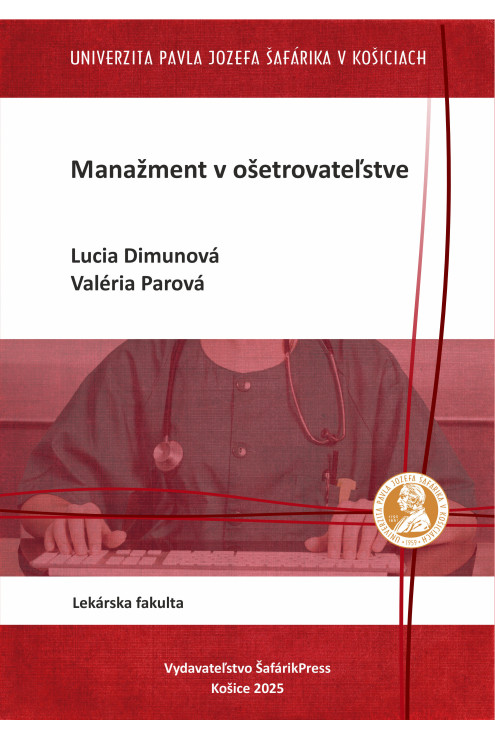
MANAŽMENT V OŠETROVATEĽSTVE

E-publication

Lucia Dimunová-Valéria Parová

The aim of this publication is to provide a comprehensive overview of the theoretical and practical foundations of management and to highlight the specific features of governance within healthcare organizations. It includes chapters on the historical development of management, major concepts, current trends, the specifics of healthcare management, and various models of healthcare delivery. Special attention is devoted to the roles and characteristics of managers, as well as to the five fundamental managerial functions—planning, decision-making, organizing, leading, and controlling. The purpose of the publication is to foster analytical and critical thinking skills in addressing problems within healthcare institutions and to contribute to improving the quality and safety of healthcare through effective management. The text incorporates numerous practical examples and review questions designed to verify knowledge and strengthen the connection between theory and practical skills. This publication is intended for nursing students and other healthcare disciplines, academic staff, and healthcare facility managers.

Download the e-book for free

Quantity

978-80-574-0470-5

Data sheet

Method of publication:
E-book (pdf)
Authors:
Lucia Dimunová-Valéria Parová
Document type:
University Textbook
Number of pages:
199
Available from:
28.11.2025
Year of publication:
2025
Edition:
1st edition
Publication language:
Slovak
Faculty:
Faculty of Medicine
Note:
Táto učebnica pre vysoké školy vznikla v rámci riešenia projektu KEGA 003UPJŠ-4/2023„Inováciavýučbového procesu v lekárskych a nelekárskych študijných programoch s využitím medicínskych simulačných nástrojov a virtuálnej reality“.
License:
CC BY NC ND (Uveďte autora - Nepoužívajte komerčne - Nespracovávajte)
DOI:
https://doi.org/10.33542/MVO-0470-5

4 other products in the same category:

Liekové formy a aplikačné cesty podávania liekov so zameraním na ich význam v humánnej medicíne

Liekové formy a aplikačné cesty podávania...

E-book

E-book

Martina ČižmárikováPeter Takáč 

It is known that pharmacology is a rapidly evolving medical field, with information about drug forms and their routes of administration constantly changing. In addition to the emergence of new drug forms, new trends are also observed in the routes of administration suitable for delivering drugs. Despite being significant factors influencing the efficacy and safety of pharmacotherapy – an indispensable component of comprehensive patient care – to our knowledge, there has been a lack of comprehensive and detailed textual material focused on this issue on the market. This fact is related to the broader scope of the professional text we are presenting, as rare drug forms or less commonly used routes of administration are only marginally mentioned or not mentioned at all in available pharmacology textbooks.

Our main goal was therefore to provide sufficient information about existing drug forms, their routes of administration, as well as their methods of delivery, which should serve to enhance the quality of pharmacotherapy in the context of so-called "tailored treatment," whose main effort is to individualize treatment for a specific patient. Although the work focuses on drug application methods, a detailed description of the technical implementation of algorithms and other related procedures is the subject of interest for other fields (nursing, surgical propaedeutics, etc.). Overall, it is a supplementary educational text provided in electronic form, which is extremely popular in today's modern informatized era. Thanks to this, the work can be used at any time at home or in a school environment, comprehensively or progressively, partially. We have also tried to enhance its quality by appropriate content organization, inclusion of practical experiences, as well as the inclusion of colorful images or photographs, overview tables, and appendices.

The textbook is supplemented by test quizzes serving to verify acquired selected knowledge, which are published on the website of the Department of Pharmacology at the Medical Faculty of UPJŠ in Košice (under "Teaching" → "Taught subjects"), and which will be continuously supplemented and updated (http://www.lf.upjs.sk/farmakologia/TEST%201.htm; http://www.lf.upjs.sk/farmakologia/TEST%202.htm).

Although the work is primarily intended for medical students, or students of pharmacy and other healthcare fields, we firmly believe that enriching information will be found in it by beginning graduates of these fields, as well as their teachers.

Download the e-book for free (pdf)

Etické aspekty komunikácie v medicíne

Etické aspekty komunikácie v medicíne

E-book

E-kniha

Silvia Farkašová Iannaccone a kol.

The history of ethics represents the search for a fundamental principle that would enable a person to distinguish between moral and immoral, good and evil, or right and wrong. The main issues are the motives, methods, and consequences of human actions.

The integrity of the medical profession emphasizes lifelong study and practice according to professional competence, and, last but not least, adherence to ethical principles and standards of medical ethics. Medical ethics and the related communication in the process of providing healthcare are becoming increasingly relevant topics. Communication between doctor and patient itself constitutes a very important part of the diagnostic process and treatment; it significantly contributes to the creation of a mutual relationship and, to a considerable extent, ensures patient cooperation.

The development of various information and network technologies allows for rapid communication even in medicine; however, a kind word and real contact with the patient, with an appropriate choice of verbal and nonverbal communication tools in personal contact, cannot be replaced by modern technology. The present era places demands on certain communication skills of the physician. Another ethical and legal issue is informed consent, which brings the patient’s active participation in the process of providing healthcare.

The presented publication provides basic information about medical ethics, communication in medicine in general, and communication skills in medical practice. Further chapters are devoted to the issue of informed consent, ethics, and the specifics of communication with selected groups of patients. We believe that this publication will clarify for the reader the basic ethical pillars and will be helpful for basic orientation in the issues of medical communication.

Download the e-book for free (pdf)

Autonómny nervový systém v klinickej praxi

Autonómny nervový systém v klinickej praxi

E-book

E-book

Ladislav Kočan-Dušan Rybár-Róbert Rapčan

The autonomic nervous system is a vital component of the peripheral nervous system, responsible for maintaining homeostasis and regulating internal processes within the body. Unlike the voluntary control exerted by the central nervous system, the autonomic nervous system operates involuntarily, innervating smooth organs, vessels, skin glands, and even exerting some influence over skeletal muscles in connection with vegetative functions such as breathing, digestion, and the urinary and gonadal systems. Its impact extends crucially to the cardiac muscles of the heart and plays a significant role in endocrine and metabolic functions, thermoregulation, as well as emotional and behavioral responses, including adaptive reactions to stressors. The aim of this publication is to provide a comprehensive and objective exploration of the anatomical and physiological intricacies of the autonomic nervous system, offering insights into its clinical applications. Within these pages, we meticulously delineate various interventional therapeutic procedures tailored to specific diagnoses related to the autonomic nervous system, aligning each intervention with the anatomical framework of the autonomic system. The efficacy of these procedures is evaluated based on the level of evidence, as per the current recommendations of Evidence-Based Medicine. This publication is primarily crafted for fifth and sixth-year medical students and medical professionals specializing in anesthesiology, intensive care, and pain medicine. It serves as a valuable resource for gaining a deeper understanding of autonomic nervous system function and its clinical implications, facilitating informed decision-making in clinical practice.

Download e-book for free (pdf)

Medical Biophysics: Practical Exercises

Medical Biophysics: Practical Exercises

€10.70
Availability: 19 In Stock

Michal Legiňa kol.

Progress in biology and medicine has always been significantly related to advances in physics. Not only has physics supplied instruments and methods of measurement that have led to many discoveries in physiology and medicine, but methods of physical research have changed many of the older approaches to the biologic sciences. Such circumstances have even led to development of a new scientific field: biophysics, which uses to a great extent physical instrumentation procedures applied to an experimental system. Because any instrument is an additional factor in any experimental system, it may affect the data. To interpret physical data on biological material correctly then, it is necessary to consider the characteristics of instrument response.

A practical course enables a student to acquire some skills, experience and methodological knowledge for performance of experiments and evaluation of measured data. Due to the fast development of instrumentation technology, it is not possible to teach every operation and procedure upon instruments we may use in a future. Besides the basic physical principles, the aim of a practical course is to point out some general rules and skills for instrument operation and for the interpretation of the measured values derived from such operation.

There are two kinds of lessons in practical courses. The first one focuses on laboratory measurements of some important physical quantities and the evaluation of the measured data. These measured quantities are components of the subject “medical biophysics” or of the phenomena studied. Experience provided in managing various scales and tables, as well as in the construction of tables and graphs is substantial. Lessons also enable students to repeat and to strengthen their knowledge of secondary school physics, which is useful for understanding of many phenomena studied in medical biophysics. The second kind of lesson provides experience with some of the diagnostic and therapeutic medical instruments, which can be seen in practical medicine.

The understanding of basic physical principles of corresponding instruments is both recommended and demanded. Theoretical preparation is not only an appropriate condition for the practical managing of the whole lesson, but also helps to avoid injury. This textbook, therefore, intends to help students in preparing for both the practical lessons and the final exam.

Authors

This website uses cookies to ensure you get the best experience on our website