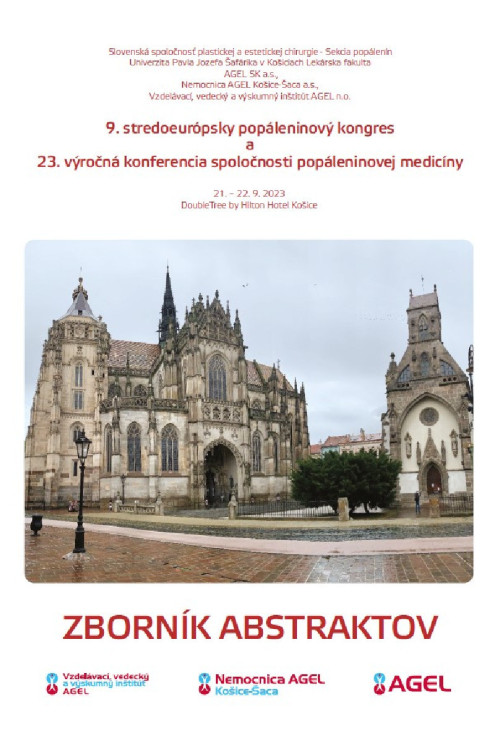
9. stredoeurópsky popáleninový kongres a 23. výročná konferencia spoločnosti popáleninovej medicíny

E-book

Peter Lengyel - Eugen Frišman (eds.)

Book of Abstracts

CONGRESS TOPICS:

Medical section

  • Surgical Treatment of Burns
  • Electrical Burns
  • Thermal Injuries in Children
  • Military Thermal Injuries
  • Scalds
  • Poster Section

    Nursing Section

  • Care of Pediatric Patients with Thermal Injuries

  • Care of Adult Patients with Extensive Burns

  • The Importance of Nurses’ Work in Operating Rooms

  • Treatment of Patients in a Hyperbaric Chamber

Download the e-book for free (pdf)

Quantity

978-80-89496-24-2

Data sheet

Method of publication:
E-book (pdf)
Editors:
Peter Lengyel - Eugen Frišman
Document type:
Book of abstracts
Number of pages:
88
Available from:
15.09.2023
Year of publication:
2023
Edition:
1st edition
Publication language:
slovenčina, angličtina
Faculty:
Faculty of Medicine
- Free for download

4 other products in the same category:

Dve úrovne vedomia: bazálne a rozvinuté vedomie

Dve úrovne vedomia: bazálne a rozvinuté vedomie

€19.10
Availability: 2 In Stock

Jozef Kafka

Význam vedomia pre každého človeka ale aj pre pozná­vanie je taký rozhodujúci, že by bolo nesprávne hovoriť o ňom iba pri psychických procesoch, lebo je jadrom ľudskej individuality a práve vedomím sa človek odlišuje od ostat­ných živých tvorov.

Je potešujúce, že nová oblasť poznávania označovaná ako veda o mysli začína sa vedomím zaoberať podrobnejšie a vylučuje tvrdenia, že vedomie nejestvuje hoci zatiaľ hovorí podľa mojej mienky iba o bazálnom vedomí a jej inter­pretácie prekračujú zistené fakty.

V svojej odbornej činnosti a aj v učebniciach som rozlišoval dve cesty poznávania vedomia a  iba postupne som si uvedomil, že mám pred sebou dva úrovne vedomia. V tejto práci  rozlišujem tieto dve úrovne:

  • bazálne vedomie,
  • rozvinuté vedomie.

Ak bazálne vedomie vyjadruje bdenie a spánok, tiež po­zornosť a gnostické rozpoznávanie, teda  idiognózia a somatognózia, rozvinuté vedomie predpokladá reč a vytvára také prejavy, ktoré označujeme ako duševné, teda identita, sebareali­záciu, čo vyjadruje schopnosť uvedomovania si seba, okolia, spoločnosti ale aj všetkého čo sme schopní poznať.

Také chápanie je blízke výkladu fyziológa Pavlova o dvoch signálnych sústavách a chápaniu Poppera o treťom sve­te ale aj ďalšie náhľady, nikto však neurobil určitejšie závery a nedošiel k náhľadu, že naše vedomie má dvojvrstevnú podobu, dve úrovne.

Napriek rozsiahlej a takmer neprehľadnej literatúre vieme o vedomí málo, okrem toho, že je to schopnosť uvedomo­vania, teda schopnosť uvedomiť si, že jestvujem, že som, že jest­vujú aj iní ľudia, že jestvuje niečo čo označujeme ako svet ako nepredstaviteľný vesmír. Uvedomujem si, že som individua­litou jedinečnou, ale limitovanou narodením a smrťou a že mám aj zmysel svojho bytia. Toto uvedomovanie, akokoľvek spo­chybňované je pre človeka prítomné v jeho poznávaní, hoci nemáme zmysly, ktorými by sme vedeli lokalizovať jeho prí­tomnosť v mozgu, ale svojou charakteristikou s dynamikou a integráciou má však duševný charakter, odlišný od    ostatných preja­vov mozgovej činnosti.

Práca sa pokúša v deviatich kapitolách osvetliť, čo sa chápe pojmom bazálne a rozvinuté vedomie    a možno ju rozdeliť do troch okruhov:

V prvých šiestich kapitolách diela hovorí o vedomí ako o doméne bytia človeka, podáva sa preto výklad vedomia a jeho rozlíšenie, potom sa hovorí o kolobehu života a rozvoji ve­domia, kladie sa otázka vedomia u stavovcov, potom náhľady filozofické a metodológia skúmania vedomia. Nasledujú ďalšie kapitoly, ktoré analyzujú podrobnejšie dve formy, úrovne vedomia, sú to kapitoly 7-9, začínajú ana­lýzou individuality človeka, lebo to je báza vedomia aj je­ho foriem, ďalej kapitoly o bazálnom vedomí a rozvinu­tom vedomí, čo považujem za jadro predkladanej práce. Napokon sa opisujú niektoré poruchy vedomia, ktoré dokladajú realitu vedomia v podobe  jej porúch ale aj možnosti rozlí­šenia dvoch úrovní, ktoré sa dajú zistiť pri starostlivom štúdiu a pri práci s chorými.

Medical Ethics

Medical Ethics

E-book

E-book

Nikita Bobrov et al.

History of ethics represents a search for basic principle, which would enable a distinction between moral and immoral, good and bad, right and wrong. The main problem lies in motives, methods and consequences of human conduct. The integrity of medical profession puts emphasis on life-long study and practice according to the professional competence, and last but not least on ethical principles and rules of medical ethics.
Medical ethics, as a part of bioethics, is currently taking on a huge importance in everyday clinical practice and must face many serious ethical issues regarding the whole system of health care. On general level the decision-making in medical practice is quite easy, based on the requirement to always act in the patient's best interest. However, it is often difficult to know exactly what is best for the patient, in a certain situation, for this particular patient. Also with each progress in medicine and its globalization, the more aspects of human lives are being affected.

Biomedical research, and the new treatment and diagnostic methods it provides are viewed differently in each country, therefore various cultural, religious, social and legal aspects must be considered in their assessment, as well as the basic principles of medical ethics. Worldwide effort on unifying ethical regulations on certain aspects of health care led to the establishment of many legally recognized documents the doctors must be familiar with.

Teaching ethics to students of medical school aims to educate the future doctors towards ethical decision-making, behaviour and professional conduct according to the basic principles of medical ethics.
This textbook provides the basic information on medical ethics for students of medical faculties and serves as a practical introduction to the most common ethical problems of health care provision for their future professional practise.

Authors

Download the e-book for free (pdf)

Výskum v medicíne a etika

Výskum v medicíne a etika

E-book

E-book

Iveta Cimbolákováa kol.

The premise “today’s research shapes the healthcare of tomorrow” expresses the importance of medical research and the reason for its pursuit. Scientific research and advances in biomedical sciences, as well as their application in medical practice and in the process of delivering healthcare, nevertheless bring new problems in the area of ethics.

Biomedical research itself requires the precise definition of hypotheses, which are tested both under laboratory conditions and on experimental animals. Although clinical studies on human subjects are expected to benefit individual participants and to advance fundamental biomedical knowledge, they also entail certain risks depending on the nature of the research. These risks must be minimized, and the experiment should be conducted freely while also taking place within specific measures to protect all involved-not only the test subjects, but also the researchers themselves.

The presented publication provides an overview of the general conditions and ethical principles of research involving laboratory animals and human subjects, the issue of professional and ethical assessment of projects, as well as fraud and the publication of results. At present, we are witnessing tremendous progress in molecular biological sciences, which brings ethical dilemmas also in the field of genetics. For this reason, one of the chapters is devoted to the latest findings in this area.

Download the e-book for free (pdf)

Etické aspekty komunikácie v medicíne

Etické aspekty komunikácie v medicíne

E-book

E-kniha

Silvia Farkašová Iannaccone a kol.

The history of ethics represents the search for a fundamental principle that would enable a person to distinguish between moral and immoral, good and evil, or right and wrong. The main issues are the motives, methods, and consequences of human actions.

The integrity of the medical profession emphasizes lifelong study and practice according to professional competence, and, last but not least, adherence to ethical principles and standards of medical ethics. Medical ethics and the related communication in the process of providing healthcare are becoming increasingly relevant topics. Communication between doctor and patient itself constitutes a very important part of the diagnostic process and treatment; it significantly contributes to the creation of a mutual relationship and, to a considerable extent, ensures patient cooperation.

The development of various information and network technologies allows for rapid communication even in medicine; however, a kind word and real contact with the patient, with an appropriate choice of verbal and nonverbal communication tools in personal contact, cannot be replaced by modern technology. The present era places demands on certain communication skills of the physician. Another ethical and legal issue is informed consent, which brings the patient’s active participation in the process of providing healthcare.

The presented publication provides basic information about medical ethics, communication in medicine in general, and communication skills in medical practice. Further chapters are devoted to the issue of informed consent, ethics, and the specifics of communication with selected groups of patients. We believe that this publication will clarify for the reader the basic ethical pillars and will be helpful for basic orientation in the issues of medical communication.

Download the e-book for free (pdf)

This website uses cookies to ensure you get the best experience on our website