Slovenčina


E-journal
Michal Jesenko (editor) - Eva Mihalíková - Darina Koreňová
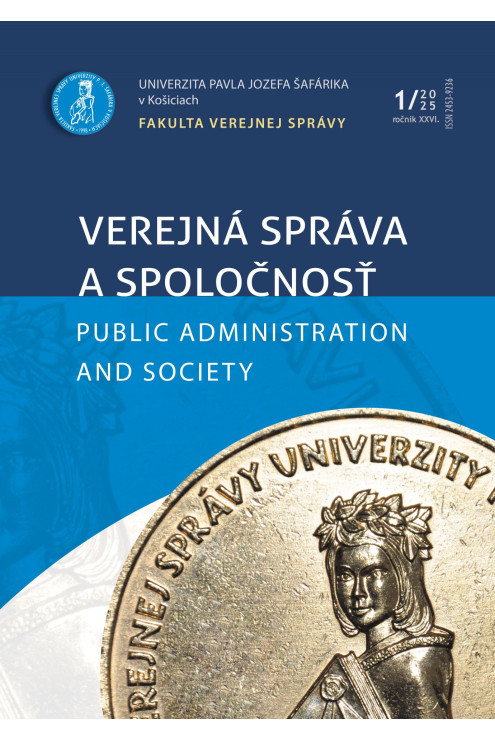
Public Administration and Society is a scientific journal publishing scientific academic articles, contributions to discussion and reviews having the content orientation on the theory and practice of Public Administration. The mission of the Journal is to publish significant results of the scientific scholarly researches regarding the area of public administration and related disciplines which are connected with the study profile and scientific bias of our Faculty. The Scientific Journal is issued in electronic version.

Data sheet
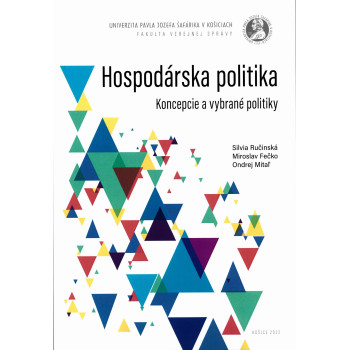
Silvia Ručinská - Miroslav Fečko - Ondrej Mitaľ
Vysokoškolská učebnica poskytuje ucelený prehľad teoretických východísk, základných myšlienok, koncepcií a súvislostí v problematike cieľov a nástrojov hospodárskej politiky. Učebnica sa zameriava na kombináciu teórie a praxe hospodárskej politiky a sumarizuje reálie v rámci cieľov hospodárskej politiky a jednotlivých druhov politík ako súčasti cyklu verejnej politiky v súčasných demokratických a právnych štátoch. Hospodársku politiku autori vnímajú ako verejnú politiku, ktorá je praktickou činnosťou vlád štátov, a zároveň aj etablovanou teoretickou vednou disciplínou, ktorá má svoje teoretické východiská a koncepcie. Autori hospodársku politiku sledujú aj v jej praktických implikáciách, ktoré sa prejavujú v jednotlivých parciálnych politikách. Vzhľadom na celospoločenskú významnosť a schopnosti ovplyvniť správanie ekonomických subjektov, štátu a verejnej správy, autori upriamujú pozornosť na menovú politiku, fiškálnu politiku, zahranično-obchodnú politiku, stabilizačnú politiku, politiku hospodárskej súťaže a štruktúrnu politiku a na celkové hodnotenie účinnosti hospodárskej politiky. Jednotlivé hospodárske politiky autori rozpracovávajú samostatne, a následne aj v ich vzájomných súvislostiach. Vysokoškolská učebnica je súhrnnou publikáciou približujúcou čitateľovi teóriu a prax hospodárskej politiky v Slovenskej republike a v širšom európskom priestore.
E-book
Ondrej Mitaľ - Veronika Nováková(eds.)
Reviewed Proceedings of the Doctoral Students' Scientific Conference
The proceedings contain contributions from the participants of the conference Theory and Practice of Public Administration: Doctoral Students' Scientific Conference, held on February 17, 2016, at the Faculty of Public Administration of Pavol Jozef Šafárik University in Košice.
The publication includes 29 contributions, thematically divided into political science, legal, and socio-economic sections. Participants presented diverse and current professional topics, enriching the contemporary theory and practice of public administration. Authors incorporated significant insights, opinions, experiences, and knowledge into their conference papers. All published contributions provide space for deeper, qualified discussion.
E-book
Gabriela Kravčáková a kol.
University Exercise Book Organizational Behavior adds content as University Textbook with the same name and completes the overall view of the behavior of people in organizations with respect to the classical approaches and new trends on a subject.
The authors are university teachers, scientific researchers of two Slovak universities and two Czech universities and their texts formed the basis of analysis and comparison of theoretical knowledge of both home and foreign resources, research results, as well as monitoring requirements of practice imposed on the behavior of employees organizations. Submitted publication has 26 separate chapters focusing on work, personality, work groups and teams, team roles, communication organization, social, communication and management skills, social audit, job satisfaction and motivation, loyalty to the organization, organizational culture, social responsibility organization, talent management, performance management, learning and learning organization, negative phenomena at work, unemployment as a social problem, acceptance of risk in the organization, system of strategic tuning of organization and empirical social research. Each chapter contains a brief summary of the information on the chosen theme, theses and questions to replicate the tasks and activities in which there are used innovative and creative teaching methods (case studies, role playing, mental mapping, etc.)
With a view to increase the active participation of students or other participants, actors in addressing current issues and problems in practice. University Exercise Book may therefore serve not only as a teaching material for higher education, but also as a useful tool in various outdoor and indoor training activities in the process of learning in organizations, or. the interaction of academic theory and economic reality.
Download the e-book for free (pdf)
Attachments (zip)
E-book
The textbook Citizenship in the Context of the Ethics of Care seeks to introduce students of the humanities and social sciences to current issues of citizenship from the perspective of a specific moral-philosophical theory—namely, feminist moral philosophy, specifically the feminist ethics of care. Traditionally, the topic of citizenship and its related questions have been perceived and studied primarily as subjects of political thought and political theory.
We predominantly consider citizenship as a political category, which is mainly the domain of political science or, at most, other social science disciplines. However, both the past and the present urge us to reflect on citizenship in connection with humanity and solidarity, and thus from a moral perspective. Understanding citizenship solely as a political category and political institution is insufficient. The conceptual separation of politics from morality and ethics results in difficulties in grasping citizenship as a morally relevant category and as an ethical value. This, in turn, prevents us from critically analyzing the assumptions underlying our understanding of citizenship and, ultimately, from identifying the causes and factors that contribute to the failures of civil society, as well as the shortcomings and deficits in the realization of citizenship as a vision based on freedom, equality, and solidarity.
Thus, the textbook clarifies the values associated with democratic citizenship, while also highlighting the potential of the feminist ethics of care as an analytical, evaluative-critical, and applicative tool for understanding and examining the concept of citizenship and the practice of citizenship as a caring practice, and as the practice of caring for a good life in civil society.