• New
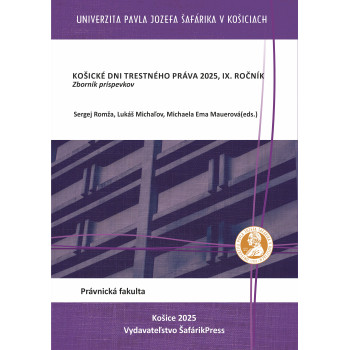
    KOŠICKÉ DNI TRESTNÉHO PRÁVA 2025, IX. ročník (2025)

KOŠICKÉ DNI TRESTNÉHO PRÁVA 2025, IX. ročník (2025)

E-publication

Sergej Romža-Lukáš Michaľov-Michaela Ema Mauerová
Proceedings of scientific contributions with the main section: "Artíficíal intellígence - a challenge for crímínal law" and subsections: "Extremism from the perspective of criminology, victimology, and criminalistics" and "Creation and tools of criminal policy" is the result of a nationwide interdisciplinary scientific conference with intemational particípation, organízed by the Department of Criminal Law of the Faculty of Law at UPJŠ in Košice. The publication retlects current challenges in criminal law in the context of dynamic technological, security, and social changes. The main section, "Artificial Intelligence - A Challenge for Criminal Law," presents contributions analyzing legal, ethical, and practical issues related to the use of artificial intelligence in the field of criminal law. The authors address autonomous responsibility, algorithmic transparency, the possibilities of using Al in the prevention, detection, and prosecution of crimes, as well as the risks to the protection of fundamental rights and fair tria!. The subsection "Extremism from the perspective of criminology, victimology, and criminalistics" provides an overview of current fonns of extremism, mechanisms of radicalization, risk factors, impacts on victims, and criminalistic aspects of its detection. Its interdisciplinary nature allows for the interconnection of legal, sociological, and psychological contexts. In the subsection "Criminal Policy Creation and Tools," the authors focus on the fonnation of modem criminal policy in the context of changing crime, the evaluation of thc effectiveness of criminal law tools, and the challenges posed by new technological and social phenomena. Legislatíve trends, comparativc findings, and practical implications for legal practice are discussed. The aim is to provide a comprehensive view of selected issues in contemporary criminal law theory and practice and to contribute to the professional dialogue on the future of criminal law and its ability to respond to the challengcs of the 21st century.
Download the e-book for free

Quantity

978-80-574-0479-8

Data sheet

Method of publication:
E-book (pdf)
Editors:
Sergej Romža-Lukáš Michaľov-Michaela Ema Mauerová
Document type:
Proceedings
Number of pages:
561
Available from:
17.12.2025
Year of publication:
2025
Edition:
1st edition
Publication language:
Slovak
Faculty:
Faculty of Law
Note:
Táto publikácia vznikla s podporou a je výstupom riešenia výskumného projektu VEGA č. 1/0333/23 Eliminácia rasizmu, xenofóbie a ostatných foriem intolerancie prostriedkami trestného práva a VEGA č. 1/0498/24 Tvorba a nástroje trestnej politiky.
License:
CC BY NC ND (Uveďte autora - Nepoužívajte komerčne - Nespracovávajte)
DOI:
https://doi.org/10.33542/KDT-0479-8

16 other products in the same category:

Medzinárodné a európske právo v kinematografii II.

E-book

E-book

Dominika Becková (ed.)

Proceedings of Contributions from the XIII. Year of the Student Symposium on International and European Law held on March 6, 2020, at the Faculty of Law of UPJŠ in Košice

The Student Symposium on International and European Law has its traditional place in the calendar of events at the Faculty of Law of Pavol Jozef Šafárik University in Košice. In the academic year 2019/2020, the Institute of International Law and European Law decided to continue this tradition and offer students an opportunity to present their professional opinions on selected topics and problematic issues of international and European law.

The XIII. edition of the student symposium continued from its previous year and once again focused students' attention on the institutions of international and European law depicted in films. The films processed by the participants of the symposium offer a wide range of institutions of international and European law.

In their contributions, participants addressed issues related to diplomatic law, terrorism, armed conflicts, the use of robots, environmental protection, and questions regarding the legal regime of outer space.

Download the e-book for free  (pdf)

Environmentálny rozmer medzinárodných územných...

E-book

E-book

Lucia Bakošová (ed.)

Proceedings from the XVII Annual Student Symposium on International and European Law held on October 27, 2023.

The presented proceedings from the student symposium are part of a long-standing tradition of student symposia organized by the Institute of International Law and European Law of the Faculty of Law at Pavol Jozef Šafárik University in Košice. This seventeenth edition of the symposium, entitled "The Environmental Dimension of International Territorial Regimes," took place on October 27, 2023.

The symposium was thematically dedicated to the current and dynamically developing issue of the environmental dimension of international territorial regimes.

Download e-book for free (pdf)

Právne postavenie spoločníka v obchodnej...

E-book

E-book

Žofia Šuleková (ed.)

Proceedings of the Contributions from the IV. Student Symposium on Corporate Law held on November 24-25, 2016, at the Training Facility of Pavol Jozef Šafárik University in Danišovce.

The Department of Commercial Law and Economic Law at the Faculty of Law of Pavol Jozef Šafárik University in Košice organized the fourth edition of the student symposium, this time focusing on corporate law.

The event took place on November 24-25, 2016, at the training facility of Pavol Jozef Šafárik University in Danišovce. The aim of the annually organized symposiums is to create a discussion platform for students with the participation of mentors from the department, including teachers, researchers, and doctoral students. This year’s symposium focused on problematic issues related to the legal status of a partner in a commercial company. The topics were assigned to allow students to demonstrate and develop their analytical and argumentative skills while improving their ability to present and formulate their own views and perspectives.

The presented proceedings are the outcome of the students' work from this event.

Download the e-book for free (pdf)

Antické paradigmy a Trianonská zmluva

E-book

E-book

Ľuboš Dobrovič - Vladimír Vrana

The world of diplomacy, whether ancient or modern, is naturally prone to problems associated with cultural clashes and often serves as an “unarmed battlefield” of cultural concepts. International diplomacy, however, stands on the assumption of war, as misunderstandings and cultural discrepancies lead to confusion. Cultural encounters also provide many opportunities for the choice of misunderstanding: the choice to perceive an act as an insult, even if unintended, or the choice to ignore the most blatant intentional insult, all according to momentary expediency.

The Roman historian Livy recounts an anecdote about the gates of the Temple of Janus, which, when open, signified that Rome was at war. However, the doors of the ancient Temple of Janus were closed only twice from the beginning of the 7th century BC to the end of the 1st century BC. One might ask, how many times and for how long after the signing of the Treaty of Trianon were the metaphorical gates of the European (or global) Temple of Janus closed?

The publication that the reader holds in their hands does not attempt to exhaustively answer all questions of ancient and modern international diplomacy. That is neither possible nor the goal of this scientific monograph. Authors seeking intersections between diplomacy of antiquity, the Middle Ages, and the early 20th century encountered some thought-provoking ideas and controversial debates. Indeed, what other conclusions can the topic of the Treaty of Trianon and the perpetual clash of cultures in the Mediterranean antiquity and medieval Europe bring?

We believe that the topic of ancient and modern diplomacy will inspire the reader and stimulate the professional public to new ideas, reflections, and scholarly activity.

The scientific monograph was prepared as an output of the project of the Agency for the Support of Research and Development No. APVV-19-0419: "100 years of the Treaty of Trianon."

Download the e-book for free (pdf)

Informačná spoločnosť a medzinárodné právo

E-book

E-book

Adam Giertl - Ľubica Gregová Širicová (eds.)

Proceedings from the 5th Student Symposium held on April 21-22, 2013

The French delegate to the Commission on Human Rights, while discussing the inclusion of the term "media" in the article on freedom of expression in the draft of the International Covenant on Civil and Political Rights, wisely urged other members of the commission to be forward-looking regarding the information media of the future.

The discussion took place in 1950, when delegates could not yet foresee the impact of the internet on social relations. Given that it is now clear that information technologies significantly influence law, including international law, the organizers of the student symposium decided to dedicate its sixth edition to the theme "Information Society and International Law."

Students of the Faculty of Law, after registering for the symposium, first focused on preparing their contributions, with each participant having access to a consultant if needed. This year, the list of consultants, in addition to members of the Institute of European Law and the Department of International Law, was expanded to include an expert in intellectual property law, Mgr. Martin Husovec, a graduate of our Faculty of Law and currently an IMPRS-CI doctoral student at the Max Planck Institute for Intellectual Property and Competition Law. We also take this opportunity to thank him for dedicating his time to the students and providing them with valuable advice in preparing their contributions. After the preparatory phase, the symposium itself took place, with the aim of presenting the prepared contributions and discussing them.

The presented contributions reflected a wide range of intersections between international law and the information society.

Download the e-book for free (pdf)

The loan or usury? Compulsory enforcement of...

E-book

E-book

Terézia HišemováDarina Kmecová (eds.)

Reviewed proceedings of scientific papers of Conference of Slovak and Czech law romanists, which take place at May, 10.-11.5.2018, at Faculty of Law, UPJŠ in Košice.

The submitted reviewed proceeding of scientific papers on „The loan or usury? Compulsory enforcement of roman - law basics and problems of application practice.”  is prepared within the solution of the grant project VEGA on: „The loan or usury? Compulsory enforcement of historical - law basics and problems of application practice.”, no. p. 1/0198/17.

The authors of papers are important personalities of Roman law working in the Slovak and Czech Republic, as well as PhD students and young scientists from Slovak and foreign universities who are active in the academic environment as well as in legal practice. The main goal of the editors is to help improve the current legal situation, which is assessed as unsatisfactory, and through a historical excursion of the development of the loan institute and then the forced execution of the decision, to create de lege ferenda proposals considering all areas of research.

The Proceedings trace the interrelationships between the substantive law institute in terms of the Roman law of contractus unilaterales - mutuum in its various types, often realized by the attachment of high interest rates, which bordered on the insurrection and the procedural law of individual lawsuits enforced in the legislative, formular and cognitive process. If there was no possibility to impose certain behaviour on the obligated person (the debtor, the sentenced person), then the declared general obligation to enforce the legal norms was only a legal term. It has always been the case that every internally well-organized state, whether antique or present, has to use power tools - often with the use of gross violence - but within the limits of the law, to promote what it has declared valid law. It must protect creditors on the one hand, but it must also prevent self-help and the use of illegal, unjustified and disproportionate violence.

The loan contract as a real contract has often become an integral part and relatively the most frequent reason leading to the compulsory enforcement, especially when contracting parties often agree on the connection of interest - sometimes within the legal limit, sometimes exceeding the legal framework - and in this way the potential future creditor (the plaintiff) significantly increased the insolvency risk of the debtor (the defendant, the sentenced) and of the subsequent execution. The pronounced and deepening social stratification of the Roman population and the secondary depreciation effort, the cancellation of the debts of the poor part of the population logically culminated in social unrest and revolt against the enforcement of the enforcement law.

The proceedings capture not only the rich scientific discussion of Slovak and Czech legal Romanists, but also the opinions, experience and knowledge of experts on contemporary law dealing with this type of issues. As a result, it provides a unique interdisciplinary view of the subject and raises many stimulus points for future research. This work proves that the problems encountered by the various representatives of the Roman jurisprudence and their legal and theoretical bases and solutions are undoubtedly useful and serve as a guideline also for solving legal issues in the field of modern enforcement proceedings.

Download the e-book for free (pdf)

Učíme právo zážitkovo

E-book

E-book

Daniela Lamačková-Renáta Orosová- Beáta Sakalová- Diana Repiščáková

Methodological guide for teachers for classroom lessons and civics Teaching law experientially? Is it even possible? The answers to these questions are provided by a methodological guide that uniquely links experiential learning methods with legal content. This methodological guide is a set of techniques based on the use of interactive and participatory learning methods, focusing on selected human rights and value-oriented topics, which also have the potential to develop other key competences of students, such as their communication skills, their ability to learn and educate independently, their ability to think critically, their ability to work with and analyse texts, their ability to discuss and express their opinions, and their ability to listen to each other. The methodological guide consists of a set of training activities - techniques, while each technique contains a precise description of the procedure for conducting a specific activity, the expected duration of the activity, aids, discussion topics and also a short pedagogical and legal commentary, precisely "tailored" to the specific legal topic. The legal topics are chosen to be generally applicable to both classroom and civics lessons, to raise questions about the functioning of rules and the need to respect them, mutual respect and tolerance, and to encourage reflection on the limits of individual rights and on responsibility in exercising one's rights. The techniques use training methods such as group work, brainstorming, role-playing, dealing with model situations, as well as a simulated court process. The methodological guide is intended for classroom teachers in the implementation of classroom lessons, and also for the purposes of the subject of civics, as well as for students of pedagogy at the Pavol Jozef Šafárik University in Košice.

Download e-book for free (pdf)

Liber Amicorum Ján Klučka

E-book

E-book

Dominika Becková (ed.)

This Liber Amicorum presents a collection of contributions in Honour of Professor Ján Klučka. This Liber Amicorum was written by his colleagues from universities, collaborators from the judiciary, former colleagues from the Constitutional Court of the Slovak republic and the Court of Justice of the European Union, current colleagues from the Faculty of Law and his former PhD. students. Their contributions elaborate the knowledge their gained from the work they conducted together with Professor Ján Klučka and are interspersed with references to memories associated with Professor Ján Klučka.

Download e-book for free (pdf)

LAW - COMMERCE - ECONOMY IX.

E-book

E-book

Jozef SuchožaJán HusárRegina Hučková (eds.)

Collection of papers presented at an international scientific symposium LAW - COMMERCE - ECONOMY held from 23rd. – 25th. of October 2019 in High Tatras

This year's conference program and the proposed collection reflect current topics not only in domestic legal science (recodification of private law in the conditions of the Slovak legal order) but also in European and international legal science (legal and ethical aspects of artificial intelligence). The conference program is enriched this year by a section, which the organizers have prepared in cooperation with the International Arbitration Court at the Czech-Moravian Commodity Exchange and the Arbitration Court at the Chamber of Commerce of the Czech Republic and the Agrarian Chamber of the Czech Republic.

Download the e-book for free  (pdf)

Obchodná spoločnosť ako právnická osoba

E-book

E-book

Ján Husár - Kristián Csach (eds.)

The collection contains contributions presented at the international conference held on April 1st - 3rd 2014 in Smolenice, organized by Pavol Jozef Šafárik University in Košice in cooperation with the Institute of State and Law of the Slovak Academy of Sciences and the Institute of State and Law of the Czech Academy of Sciences. Authors are high-profile Slovak and Czech scholars in the field of private law and company law, as well as representatives of new generation of young researchers. Contributions focus on contemporary issues in the field of company law, in particular theoretical basis of corporations, groups of companies, doctrine of abuse of rights, reflective loss and new tendencies in corporate law in foreign legal orders. The first part of the contributions presented at the conference have been already published in the special issue of the theoretical magazine Právny Obzor n. 4/2014. 

Download the e-book for free (pdf)

Ownership rights protection in Polish and...

E-book

E-book

Milan Sudzina, Renata Świrgoń-Skok, Wojciech J. Kosior

Given the importance of the ownership right, the aim of this monograph is to provide an analysis, a clear systematic interpretation and an evaluation of the above issue, not only from the theoretical point of view, but also from the point of view of legal practice. The protection of ownership relations is ensured in various ways. It is judicial protection, protection provided by local self-government authorities, self-help, public registration of real property and other instruments of administrative and criminal law. In connection with the transformation of legislation in Slovakia and Poland after the fall of the socialist regime, there have been many changes in the legislation of both countries concerning the protection of ownership rights. A number of private law institutions related to the ownership of real property, the use of which was impossible or limited during the socialist period, have been restored. Legislation has also been adopted to alleviate the consequences of certain property and other injustices caused by the deprivation of ownership of real property during the socialist period. The adoption of restitution legislation was the basis for restoring the ownership rights of the original owners, who were allowed to get back their real property that had been used by socialist organisations. After the end of the socialist regime, the various forms of ownership, which until then had favoured the state ownership, were abolished. Changes were made to ensure that the ownership rights of all owners had the same content and enjoyed the same legal protection. The monograph is structured in such a way as to enable a comparison of individual institutions of rights in rem under Polish and Slovak law. The monograph also analyses the relevant decision-making practice of the supreme judicial authorities. The scientific methods applied enabled the authors not only to analyse and evaluate the historical context and the current legal regulation of ownership rights in Poland and Slovakia, but also to point out possible gaps and shortcomings and to elaborate de lege ferenda proposals that can be used in future legislative activity.

Download e-book for free (pdf)

Hranice Československej republiky optikou...

E-book

E-book

Dominika Kováčová- Lucia Pištejová- Ivan Vaňa

The present monograph deals with the post-war settlement of relations and peace negotiations related to the settlement of the borders of the newly established Czechoslovak Republic. The work discusses in detail the negotiation processes related to the preparation and signing of the Versailles and Saint-Germain Peace Treaties. Similarly, it then discusses in detail the peripeties related to the drafting of the Treaty of Trianon dealing with the border with Hungary and its subsequent delineation in the field. Last but not least, the thesis captures the settling of Czechoslovakia's international relations with Poland and their common border, with a particular focus on the arbitration settlement on the territory of Orava and Spiš.

Download e-book for free (pdf)

Iniciatívy EÚ pri predchádzaní daňovým únikom a...

E-book

E-book

Adrián Popovič a kol.

The possibility of solving the grant project VVGS-2016-284 has provided a unique opportunity for members of the author´s team in the interdisciplinary composition to examine the issue not only from a tax-law point of view, but also from a political point of viewIn the presented monograph, the authors focused on the characterization of different aspects of the EU in order to allow the reader correctly understand its position in relation to the outside world and to its inward relations within its Member States in the context of the creation and implementation of the EU tax policy.

Particular attention is paid to the definition of the relationship between national tax legislation and EU law, the impact of the EU's tax policy on the national laws of its Member States, with reference to the identification of the harmonized areas with the approximation of their current stage of development and the final objective. This definition can be seen as a prerequisite for a correct and comprehensive understanding of the application and implementation of EU institutions' initiatives to prevent tax evasion and tax fraud and their implementation into the national legal order of the Slovak Republic. In the last part of the monograph, the authors focused on defining individual EU initiatives to combat tax evasion and tax fraud as a means of implementing its tax policy, in the area of ​​indirect taxation, in particular in the field of value added tax and in the field of direct taxation, especially with regard to corporate taxation, and to evaluate their projection into the national tax legislation of the Slovak Republic. At the same time, in these chapters, they assessed the real impact and effect of the measures admitted on the basis of the initiatives in practice.

The presented work is intended for a university student studying in the field of Tax Law and European Law, as well as the broader legal and economic community. However, in view of the scope and recency of the subject under consideration, the authors believe that the publication will find its application not only in the theoretical field but also in the practical field.

 JUDr. Adrián Popovič

Download the e-book for free (pdf)

Ochrana súkromia zamestnanca

E-book

E-book

Jana Žuľová(ed.)

Proceedings from the 1st Annual Student Symposium on Labor Law held on April 8–9, 2016 in Danišovce

Discussions on the topic of privacy are currently very topical and interesting. The advancement and progress of technology have added a new dimension to individual privacy. With the use of modern electronic devices, terms such as precious commodity, chimera, or illusion are increasingly associated with privacy. Workplaces have not remained immune to modernization either. Machines are replacing human labor, programming and planning the production process, but also controlling, monitoring, and recording the fulfillment of assigned work tasks.

The availability of technology and its implementation in employers’ operations intrude upon the personal and private sphere of employees, which is an inherent part of every person’s life and does not remain left behind the doors of the workplace. Proper and correct use of monitoring mechanisms by employers means not only mastering their technical installation at the workplace and covering the associated financial costs, but also respecting the privacy of employees.

It cannot be overlooked that the right to privacy is among the fundamental human rights and freedoms, enjoying the corresponding characteristics (inalienability, non-transferability, irrevocability, etc.) and appropriate legal protection. And even though it is not absolute and may be suspended in favor of another right (especially the employer’s right to protect their property), every intervention—such as comprehensive camera surveillance, monitoring of phone calls, email correspondence, blocking certain websites, etc.—always has adverse consequences for the privacy of the employee.

Download the e-book for free (pdf)

100 rokov Trianonskej zmluvy - diplomacia, štát...

E-book

E-book

Erik ŠtenpienIvan Svatuška (eds.)

The Collection of scientific Contributions of the International scientific conference: 100 Years of Treaty of Trianon – Diplomacy, State and Law on the Turn of the Century.

The presented publication is the first of a series of proceedings published within the solution of the grant APVV-19-0419. The conference took place from 14 to 15 October 2021 with the participation of experts from Slovakia, Hungary and Poland. The ambition of the research team, composed of legal historians and positive lawyers from three countries, is to provide a comprehensive, unbiased view of the peace negotiations that resulted in the Treaty of Trianon with Hungary. The conference, the result of which is the presented collection, was devoted to the causes of possible disputes in Europe - focusing on diplomacy and constitutional development of Central European countries at the turn of the 19th and 20th centuries, ie in the period immediately preceding the outbreak of World War I.

Download the e-book for free  (pdf)

This website uses cookies to ensure you get the best experience on our website