Zavolajte nám:
+421 55 234 1635E-publication
Mária Vilková-Zuzana Kudličková-Ján Elečko
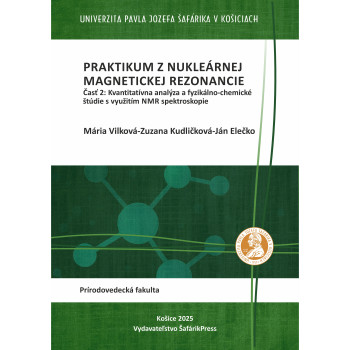
This study material is intended for students of chemistry and related disciplines interested in applied nuclear magnetic resonance (NMR) and physical chemistry. It offers practice-oriented tasks designed to develop skills in NMR spectroscopy, quantitative analysis, and data interpretation. Students learn modern approaches to determining physicochemical parameters (e.g., partition coefficients, pKa values, keto–enol equilibria, or enantiomeric excess) and gain experience with software tools for spectrum processing.
Download the e-book for free (pdf)
Data sheet
E-book
Erik Sedlák - Rastislav Varhač - Patrik Danko - Helena Paulíková - Dušan Podhradský
The presented scripts were created in an effort to update and especially clarify the tasks that are solved in the basic practical exercises in biochemistry students of the 2nd and 3rd year of the bachelor's degree in chemistry, biology and their combinations with other disciplines. Most of the tasks come from the original scripts "Podhradský, Mihalovová: Praktické cvičenia z biochémie, Košice 1989".
Some of them have been modified to a greater or lesser extent and adapted to current conditions in the laboratory. New tasks were also added, such as those dedicated to nucleic acids. The scripts are thematically divided into six separate units, each of which consists of several tasks. The names of the units correspond to the nature of the biomacromolecules, which form their central theme. Theoretical introductions at the beginning of the unit are newly constructed and their main goal is to provide a brief overview of the basic biochemical methods used in the study of biomacromolecules.
These scripts are intentionally only available in electronic form. The reason is the effort to continuously update and modernize individual tasks according to the changing possibilities of our laboratory. We hope that the scripts will fulfill their role and that students will have sufficient theoretical knowledge and practical skills in the field of basic biochemical methods after completing these laboratory exercises.
Download e-book for free (pdf)
E-book
This electronic material provides the basic principles of creating a systematic nomenclature of organic compounds, from the simplest hydrocarbons to the more complicated nomenclature of carbohydrates. For some groups of derivatives, alternative ways of generating system names are also mentioned, as well as the most common trivial names that are still in use in the literature and in practice, in some cases being the characteristic (dominant) ones. In the introductory section, the basic rules to be respected when writing names of organic compounds are discussed. This document is intended primarily for interdisciplinary undergraduate and graduate students as support material for the courses Organic Chemistry and Selected Chapters in Organic Chemistry and Biochemistry. In the final section of this document, solved examples are given so that the student can check how the rules for forming the names of organic compounds have been understood.
Download e-book for free (pdf)
E-publication
Mária Ganajová-Ivana Sotáková-Petra Letošníková
The conference proceedings FORMATIVE 2025 – Implementing Formative Assessment in Schools Together constitute the output of an online conference organised by the Institute of Chemical Sciences, Faculty of Science, Pavol Jozef Šafárik University in Košice, in cooperation with the National Institute of Education and Youth in Bratislava, within the framework of the KEGA project No. 001UPJŠ-4/2023. These proceedings present current knowledge, experience, and examples of good practice in implementing formative assessment in primary, secondary, and university teaching, with an emphasis on the use of digital tools. The papers address the foundations of formative assessment in the context of curricular changes and the ongoing educational reform, as well as specific didactic procedures for its implementation in the teaching of science and social science subjects, including mathematics, Slovak language, and foreign languages. Particular attention is paid to the development of professional teaching competences, formative assessment strategies, providing targeted feedback, and promoting students’ active participation in the assessment process. These proceedings also present the Digilib digital library, a tool developed to support the creation and management of formative assessment processes within the school environment. This publication is intended for experts in pedagogy and didactics, teachers at all levels of education, student teachers, digital coordinators, and all those interested in educational innovation and in improving the quality of teaching through formative assessment.
E-book
Cell Biophysics II is the one semester comprehensive course textbook for PhD students. It encompasses basic principles and mechanisms underlying cell physiology and biophysics with aims:
• General knowledge of the principles of cellular function, including membrane, cytoplasmic and nuclear roles in normal and abnormal conditions.
• In-depth understanding of the mechanisms underlying the cell functions at the molecular and subcellular level.
• Awareness of cell pathologies that lead to specific disease symptoms and phenotypes.
• The ability to apply learned principles to solve new problems (analysis & synthesis).
E-book
Jana Shepa (ed.)
The book of abstracts from 8th International Conference on Novel Materials: Fundamentals and Applications, NFA 2023 is composed of contributions from the participants of this international conference. The conference consisted of 6 invited lecture and 38 abstracts of participants. The conference is focused on novel materials and its application in various research areas. All contributions are professionally processed and inspiring.
E-book
Zuzana Kudličková(ed.)
Proceedings of Abstracts from the Scientific Conference with International Participation Organized on the Occasion of the 50th Anniversary of the Establishment of the Department of Organic Chemistry, Faculty of Science, Pavol Jozef Šafárik University in Košice, held on June 8–10, 2016 in Košice.
The Department of Organic Chemistry was established on February 1, 1966. From its inception, the department’s development prospects have been linked to high-quality scientific research focused on the synthesis of isothiocyanates and the products of their nucleophilic additions. In addition, studies were conducted on the use of cycloaddition, cyclocondensation, and photocyclization reactions of heterocumulenes in the synthesis of heterocycles.
Currently, research at the Department of Organic Chemistry is concentrated on stereoselective syntheses of iminosugars and γ-lactam-β-lactone antibiotics, total synthesis of natural compounds and their analogues possessing a sphingoid structure, research into the synthesis of indole alkaloids from the phytoalexin group, and the synthesis of acetylcholinesterase inhibitors based on acridine and coumarin derivatives.
Download the e-book for free (pdf)
E-book
The current teaching of chemistry has its specific problems. On one hand, due to the shift of the focus of chemistry curriculum towards theoretical content, the difficulty of chemistry material has increased, and in connection with this, students' interest in chemistry has decreased.
The lack of student interest in chemistry is mostly supported by the opinion that it is precisely chemistry that significantly contributes to the deterioration of environmental quality. On the other hand, we live in an era where we encounter chemical products practically everywhere. It is necessary to learn the basics of chemistry as well as possible, which makes the question of increasing interest in chemistry education and improving its effectiveness very relevant. State educational programs have been introduced into Slovak schools as a foundation for the creation of school educational programs. These emphasize not only acquiring a certain amount of knowledge but also the development and enhancement of key and specific competencies of students, preparing them for lifelong learning and their application in life.
Therefore, increasing attention is being paid to one of the fundamental didactic tools for raising student activity in teaching, and thus improving the effectiveness of chemistry education – learning tasks. From both theory and practice of chemistry teaching, we know that learning tasks, questions, examples, exercises, etc., are among the important components of every teaching lesson. Learning tasks are applied in all phases of teaching – in the motivational phase, the phase of acquiring knowledge, the phase of consolidating knowledge, and the phase of checking the acquired knowledge. It is therefore clear that every teacher will sooner or later find themselves in a situation where they will have to select learning tasks from textbooks, workbooks, collections of problems and examples, or create them themselves.
This scientific monograph is intended for educational specialists and chemistry teachers, aiming to familiarize them with examples of various types and forms of learning tasks and the basics of their creation in chemistry. It can also be helpful for them in preparing certification works focused on test creation and their statistical evaluation.
E-book
Peter Fedoročko (ed.)
Proceedings of the 7th Annual Doctoral Spring School 2020
From November 10 to November 11, 2020, the 7th annual Spring School for Doctoral Students at Pavol Jozef Šafárik University in Košice will take place in Košice in a modified mode in the on-line space. The scientific program of the spring school will comprise 2 plenary lectures by leading scientific experts of Pavol Jozef Šafárik University in Košice. Doctoral students will present their research papers in two sections: 24 doctoral students of Faculty of Public Administration, Faculty of Law and Faculty of Arts, and 22 doctoral students of Faculty of Medicine and Faculty of Science.
The scientific programme of the spring school will also include a panel discussion with the management of Pavol Jozef Šafárik University in Košice.
E-book
Adela Kravčáková - Stanislav Vokál - Janka Vrláková
The presented “General Physics IV, Part 1: Atomic Physics” is intended as a basic study material for lectures from General Physics IV in the second year of bachelor-level study of physics and interdisciplinary study in combination with physics at the Faculty of Science, P. J. Šafárik University in Košice. The content covers the first part of the given course of physics, devoted to atomic physics.
The aim of the course is to obtain basic information about the structure of the atom and the electron shell of the atom.
E-book
These "Exercise Manuals" present a concise overview of commonly used methodologies as well as progressive techniques, such as the use of liquid chromatography and fluorescence microscopy. Individual tasks were selected based on the research focus of the Department of Botany at the Faculty of Science, Pavol Jozef Šafárik University in Košice, particularly in the context of "stress physiology."
Some tasks can also be utilized within the subject "Plant Ecology." Chamomile (Matricaria chamomilla) is typically used as a model plant for individual tasks due to its long-standing history of research at the Department of Botany and its ease of cultivation under laboratory conditions. The chapters also briefly discuss the significance of monitored parameters, principles of their determination, and metabolism (formation or degradation), aiming to indicate their mutual context.
This approach highlights that determining an individual parameter cannot provide a general explanation for the overall causes and impacts of observed changes; however, it can serve as a basis for testing hypotheses at the level of other parameters.
For deeper study of specific issues, there is an abundance of high-quality international monographs and review articles available.
E-book
The present textbook deals with exactly solved models and their diverse applications in several branches of physics such as mathematical physics, statistical physics, condensed matter physics and so on. Exactly soluble models are currently considered as an inspiring research field in its own right, which regrettably requires a considerable knowledge of sophisticated mathematics. Accordingly, my primary ambition was to provide an intro- ductory course for undergraduate students that would cover the simplest exactly solved models, whose rigorous solutions are available even after modest calculation. The present textbook should be therefore regarded as an auxiliary graduate-level textbook, which should serve as the student’s guide on this beautiful but surely intricate subject.
E-book
This textbook is intended for master's degree students and is a follow-up to the Computational Physics I course studied at the bachelor's level. The content of the textbook Computational Physics II focuses on stochastic methods of solving physical problems, mainly on Monte Carlo (MC) simulation of many-particle systems.
The focus on this computationally intensive approach is motivated by the gradual increase in the computing capacities of ordinary computers as well as the introduction of high-performance computing clusters. This has led to significant progress in the development of new simulation techniques, thanks to which MC simulations have found application in various areas of research and application practice. Considering the main research focus of the department, this text is particularly devoted to the presentation of basic and more advanced MC simulation techniques applied to a simple Ising spin model in order to investigate its magnetic, thermodynamic and critical properties.
The next part is devoted to MC simulations of random processes. It focuses on the simplest but also the most basic random walk process and demonstrates its applications in financial analysis and the solution of a quantum system described by the time-dependent Schrödinger equation. The last part is dedicated to the basics of molecular dynamics, applied to simulating the classical movement of atoms in a given force field. By mastering the problems addressed in this course, students will obtain a potential tool for working out of their diploma theses, or a methodology useful for their further scientific and research practice in the field of investigating of complex systems.
The lectured topic is subsequently exercised in the form of preparing projects implemented in the freely distributable software Octave, which is easy on the user's programming skills and which students have the opportunity to familiarize themselves with in the previous study.
Download e-book for free (pdf)
E-publication
Beáta Valkay ed.
Ivana Slepáková-Monika Balogová a kol.
EFFUSE - Scientific Education for Advanced is an educational material designed for university students interested in ecological sciences, biology and environmental protection. The publication was developed as part of the EFFUSE project and focuses on the scientific investigation of living organisms in the river ecosystem, with an emphasis on their ecological role and importance as bioindicators. The river ecosystem is a dynamic environment where a wide range of organisms can be studied, from algae and phytoplankton to aquatic invertebrates, fish, amphibians and reptiles. This publication presents a detailed study of their adaptations, life cycles, reproductive strategies and their importance for ecological balance. Particular attention is paid to fish and amphibians, whose environmental demands and sensitivity to pollution make them important indicators of water quality and environmental status. The publication also provides guidance on how to integrate their study into university education in the form of practical research. It also includes a chapter on science education in the context of sustainable development, which is often absent from university curricula in Slovakia and Ukraine. This material promotes the link between theory and practice and develops students' scientific thinking in order to prepare them to meet the environmental challenges of the future.
E-book
An enormous progress in computer technology, closely linked with advances in computational chemistry, has enabled the user to exploit the principles of quantum chemistry to elucidate the chemical phenomena.
Computational chemistry is the branch of science that requires, except an academic knowledge, software skills to fully exploit a potential of theoretical methods. The aim of this textbook is to help the user take the legendary first step in the field of computational chemistry to opening a new horizon of knowledge.
E-book
This university textbook is intended for students of the Faculty of Science of the University of Applied Sciences in Košice who have enrolled in practical exercises in Biotechnology, but also for all other students who are interested in learning about the practical applications of biotechnology.
The aim of the practical course is to familiarize students with basic biotechnological methods and their applications. The students will verify in practice the theoretical knowledge acquired in the Biotechnology lectures such as the course of fermentation processes, wine production, preparation of fermented milk products and cheese, preparation of culture media, inoculation and cultivation of microorganisms, etc. The practical exercises also include the use of analytical and spectral methods, which are an integral part of biochemistry.
The scripts are published only in electronic form and are available on the University's website: http://kosice.upjs.sk/~kbch/sk, for the reason that it will always be possible to update and modernize the content of the laboratory exercises.
This website uses cookies to ensure you get the best experience on our website