• New
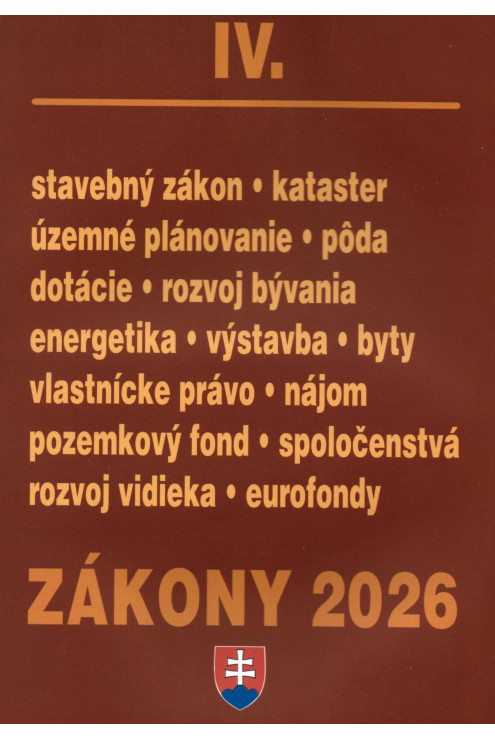
    Zákony IV. 2026

Zákony IV. 2026

€17.24
Tax included

Kolektív autorov

Titul Stavebný zákon a územné plánovanie obsahuje úplné znenie novelizovaných zákonov, vyhlášok a opatrení z oblastí stavebníctva a rozvoja bývania. V publikácií sú zákony venované územnému plánovaniu, vlastníctvu bytov a nebytových priestorov, výstavbe, štátnej podpore nájomného bývania, energetike, pozemkovým spoločenstvám, vlastníctvu k pozemkom a iné. Všetky právne predpisy obsahujú zmeny k 1. 1. 2026. Zmeny v zákonoch sú v texte prehľadne vyznačené.

Stavebný zákon a územné plánovanie obsahuje témy:
1. Stavebný zákon a súvisiace predpisy
ZÁKON č. 25/2025 Z. z. Stavebný zákon
VYHLÁŠKA č. 59/2025 Z. z. o členení stavieb
VYHLÁŠKA č. 60/2025 Z. z. o štruktúre a prevádzke infor. systému územ. plánovania a výstavby
ZÁKON č. 200/2022 Z. z. o územnom plánovaní
ZÁKON č.  182/1993 Z. z. o vlastníctve bytov a nebytových priestorov
ZÁKON č. 608/2003 Z. z. o štátnej správe pre územné plánovanie, stav.poriadok a bývanie
ZÁKON č. 162/1995 Z. z. o katastri nehnuteľností (katastrálny zákon)
2. Energetika
ZÁKON č. 251/2012 Z. z. o energetike
ZÁKON č. 555/2005 Z. z. o energetickej hospodárnosti budov
ZÁKON č. 260/2025 Z. z. o adresnej energopomoci
3. Stavebné výrobky
ZÁKON č. 133/2013 z. z. o stavebných výrobkoch
VYHLÁŠKA č. 323/2010 Z. z., ktorou sa vykonáva Štatistická klasifikácia stavieb
4. Bývanie
ZÁKON č. 150/2013 Z. z. o Štátnom fonde rozvoja bývania
ZÁKON č. 222/2022 Z. z. o štátnej podpore nájomného bývania
ZÁKON č. 443/2010 Z. z. o dotáciách na rozvoj bývania a o sociálnom bývaní
ZÁKON č. 310/1992 Zb. o stavebnom sporení
OPATRENIE č. 238/2025 Z. z. o výške štátnej prémie na stavebné sporenie na rok 2026
PREHĽAD OPATRENÍ o výške štátnej prémie na stavebné sporenie
5. Pôda
ZÁKON č. 229/1991 Zb. o úprave vlastníckych vzťahov k pôde a inému poľn. majetku
ZÁKON č. 97/2013 Z. z. o pozemkových spoločenstvách
ZÁKON č. 330/1991 Zb. o pozem. úpravách, usporiadaní pozem. vlastníctva...
ZÁKON č. 180/1995 Z. z. o niektorých opatr. na usporiadanie vlastníctva k pozemkom
ZÁKON č. 503/2003 Z. z. o navrátení vlastníctva k pozemkom
ZÁKON č. 504/2003 Z. z. o nájme poľ. pozemkov, poľ. podniku a lesných pozemkov
ZÁKON č. 280/2017 Z. z. o poskytovaní podpory a dotácie v pôdohosp. a rozvoji vidieka
ZÁKON č. 282/2015 Z. z. o vyvlastňovaní pozemkov a stavieb

Quantity
Last items in stock

Poradca
978-80-8162-303-5

Data sheet

Method of publication:
Printed publication
Authors:
Kolektív autorov
Document type:
Legislation
Number of pages:
712
Year of publication:
2026
Publication language:
Slovak
License:
Copyright

Specific References

MPN
303555

16 other products in the same category:

Ochrana zamestnanca perspektívou priemyselnej...

E-book

E-book

Milena Barinková (ed.)

Proceedings from the IV Annual Student Symposium on Labor Law held on April 5–6, 2019, in Danišovce

The term "Industrial Revolution 4.0" is currently widely used, yet remains mysterious and its content unfamiliar to many. While we do not claim omniscience, through the educational process at the Faculty of Law of Pavol Jozef Šafárik University in Košice and the scientific research of the Department of Labor Law and Social Security Law, we have delved into examining the accompanying features and anticipated phenomena of this modern industrial revolution.

It can be stated with great certainty that this revolution already affects—and will continue to affect—production processes, including radical changes in their structure, the emergence of groundbreaking technological and communication tools, and, undoubtedly, labor relations. The rise of new forms and methods of work based on automation and digitalization, applied within new models of labor relations, is beginning to threaten jobs in certain sectors of the economy. There is an increasing demand for specialized qualifications and skills, particularly in information technology, with an emphasis on process digitalization, data processing, and the creation of communication networks connecting objects and people. This intelligent industry inevitably disqualifies many existing jobs from their current structures, leading to job losses for numerous employees. Analysts openly predict that by 2030, robots will replace up to 20 million industrial jobs worldwide.

The vision of which occupations or working conditions will be impacted is becoming increasingly concrete. Radical changes will require radical solutions as well as previously unknown movements and new elements or measures in the labor market.

Download the e-book for free  (pdf)

Ochrana práv veriteľov v obchodných záväzkových...

E-book

E-book

Žofia Mrázová (ed.)

Proceedings of Contributions from the V. Student Symposium on Commercial Law

The proceedings are the result of student works presented at the fifth annual student symposium organized by the Department of Commercial Law and Economic Law, Faculty of Law, UPJŠ in Košice, which took place on November 30 – December 1, 2017, at the UPJŠ educational and training facility in Danišovce.

This year’s symposium focused on problematic issues related to creditor rights protection in commercial contractual relationships.

The purpose of these annually organized symposia is to provide students with a platform to present their own opinions and improve their analytical and argumentation skills.

Download the e-book for free (pdf)

Zákon o národnostiach a Rada vlády Slovenskej...

E-book

E-book

Jana Šutajová

From January 1, 1969, the Constitutional Act on the Status of Nationalities in the Czechoslovak Socialist Republic (ČSSR) and the Constitutional Act on the Federation came into effect. The Constitutional Act on the Status of Nationalities represented at least a formal significant step forward in the legal regulation of minority rights. However, this law was intended to serve as a foundation for further legal adjustments. It was declared that additional steps and negotiations for the adoption of implementing regulations would follow and that further laws would be enacted at both the federal and national levels. Nevertheless, no additional law or government regulation related to the constitutional act on the status of nationalities in the ČSSR was ever issued.

During the normalization period, issues concerning further legislation related to national minorities were not addressed. However, in the brief period following the adoption of the constitutional act in 1968 until the end of 1969, some institutions attempted to prepare and promote such legal norms. One of these institutions was the Government Council of the Slovak Socialist Republic (SSR) for Nationalities (hereafter referred to as the Council or the Government Council for Nationalities). The monograph provides an insight into the development of additional legal norms arising from the constitutional act on the status of nationalities in the Slovak Socialist Republic, prepared by the Government Council of SSR for Nationalities. This council was one of the institutions established in Slovakia after the formation of the Czechoslovak federation and dealt with nationality issues.

In addressing further legal norms stemming from the constitutional act on nationalities in ČSSR, it was necessary to consider prior developments. Therefore, the first part of the monograph examines the status of minorities in Czechoslovakia before adopting the constitutional act, activities of nationalities preceding its adoption, and its enactment itself. Subsequent sections focus on institutional changes in SSR following federalization, the establishment of the Government Council of SSR for Nationalities, and specific actions taken by this Council and its expert bodies in drafting proposals for laws concerning nationalities in the Slovak Socialist Republic.

The motivation for writing this monograph stemmed from the fact that this topic has so far received attention only in a few studies in Slovakia, which primarily focused on the Hungarian minority during either the Prague Spring or normalization periods.

Download the e-book for free (pdf)

Algoritmy a inklúzia: Pracovné právo v ére...

E-book

E-book

Marek Švec, Jana Žuľová

The collection of scientific contributions offers an interdisciplinary analysis of the challenges labour law faces due to digitalization and social change. Its main goal is to highlight potential synergies between the technological management of work processes and the promotion of diversity and inclusion in the workplace, with a focus on legal mechanisms that ensure equal opportunities and protect employees. The collection includes studies on various aspects of labour law protection, such as the prohibition of discrimination, transparency in algorithmic management, protection of individuals with diverse needs, and legislative challenges related to GDPR. It also features contributions to innovative remuneration systems and the protection of socially and health-disadvantaged groups, with special attention to employees of different sexual orientations and pregnant women. A significant portion of the work is dedicated to issues surrounding the use of artificial intelligence and algorithmic management in decision-making within labour relations. This publication serves as an insightful resource for academics, lawyers, students, and practitioners addressing modern employment law challenges, and it encourages further discussion on innovative approaches to contemporary labour law topics.

Download the e-book for free (pdf.)

Návrh metodického postupu medzinárodných...

E-book

E-book

Lucia BakošováĽudmila ElbertĽubica Gregová Širicová 

Disasters, whether natural or industrial, have a serious impact on the functioning of society and are a negative phenomenon which, with the increasing impact of climate change, is increasingly affecting the sustainable development and prosperity of States. Their increasing regularity and intensity affect the current evolution not only of social life, but also of legal debates on the necessity of responding to international and national disaster response, eliminating their negative consequences and protecting affected persons. No State is immune to the occurrence of disasters, and this also applies to the Slovak Republic, which is mostly affected by sudden natural disasters, namely floods, landslides, droughts, fires, windstorms and snow calamities.

The subject of this publication is the proposal of the methodological guidelines regulating the activities of NGOs in case of disaster, as well as cooperation with the state affected by the disaster, and the glossary of legal terms which need to be clear and unified in case of disaster. Slovak and English version of the proposal is basic precondition of its usability not only for the state organs of the Slovak republic and Slovak NGOs, but also for foreign NGOs.The Proposal of the methodological guidelines is the result of the research project VVGS-PCOV 2018-459: Návrh metodického postupu mimovládnych organizácií v prípade katastrofy v podmienkach Slovenskej republiky (The Proposal of the methodological guidelines for the non-governmental organisations in case of disaster in conditions of the Slovak republic).

Download the e-book for free  (pdf)

Demokracia, dôstojnosť, diverzita: Zborník z...

E-book

E-book

Alexander BröstlMarta Breichová Lapčáková (eds.)

Under the auspices of the Institute of Legal Theory of Gustav Radbruch and the Slovak Section of the International Association for Philosophy of Law and Social Philosophy (IVR), a 3D flash conference was held on May 16, 2019, at the Faculty of Law of UPJŠ in Košice. This event was primarily dedicated to the upcoming 29th World Congress of IVR in Lucerne, Switzerland. In line with the main theme of the congress, the conference focused on "Dignity, Democracy, Diversity." At the time of the conference, it was clear that the number of participants at the world congress would significantly exceed 1,000, with discussions taking place in 151 special workshops and 28 working groups.

During the congress, a round table was also announced featuring Professor Brian Tamanaha, recipient of the IVR award for best book for "Realistic Theory of Law" (Cambridge 2017), a meeting regarding the IVR Encyclopedia, a panel on academic freedom issues, and a gathering of chairs from national sections of IVR.

Download the e-book for free (pdf)

Spracúvanie osobných údajov zamestnanca podľa GDPR

E-book

E-book

Jana Žuľová a kol.

The presented publication is intended for employers, managers, and HR professionals who process employees' personal data for various employment-related purposes and need to conduct an audit of their processing in compliance with the GDPR and the new Personal Data Protection Act. The publication will also be useful for new employers who are encountering data protection for the first time and need to establish internal data protection rules, essentially starting from scratch.

The reader has the opportunity to gain a comprehensive understanding of the data protection rules applicable in the employment sector, the obligations of the employer, and the rights of the data subject, i.e., job applicants, employees, and former employees.

Download the e-book for free (pdf)

Condition and perspectives of financial law and...

E-book

E-book

Adrián PopovičJozef SáboAnna Vartašová (eds.)

The International Scientific Conference on the topic Condition and perspectives of public finances in the EU was held 2nd – 3rd June 2022in Košice focused on the topics of the EU Budget and Real Estate in taxation. On this occasion, a student symposium on the topic: "Condition and perspectives of financial law and tax law" was organized for students of the Pavol Jozef Šafárik University Faculty of Law in Košice on 1st June 2022. The focus of the symposium was chosen due to the content of the grant project VEGA no. 1/0485/21: „Simultaneity and possibilities of reforming the system of own resources of the EU budget (legal and economic aspects also in the context of the consequences of the COVID-19 pandemic)“, of the grant project VEGA no. 1/0214/21: „Taxation of real property – legal status and potential“ and of the grant project APVV-19-0124 entitled "Tax law and new phenomena in the economy (digital services, shared economy, virtual currencies)", which are currently being addressed at the Department of Financial Law, Tax Law and Economy, Faculty of Law, Pavol Jozef Šafárik University in Košice.

The output of this symposium is a reviewed proceeding of papers, in which students focus on examining the current challenges of financial law and tax law. In this context, students examine not only the issue of current challenges in the field of real estate tax and the introduction of taxation based on their market value of real estate and the institute of remedies in tax procedural law, but also the current issue of EU budget law with a focus on the revenue side of the EU budget.

The authors also assess in detail the current situation in the research area, and they also present de lege ferenda proposals that could contribute to the development and improvement of several aspects of taxation, which is a benefit not only for legal science but also for application practice.

Download the e-book for free  (pdf)

Slovensko - Európa - Svet

E-book

E-book

Tomáš DvorskýLucia LaczkóKatarína Lörincová (eds.)

The collection of articles from the VIII. International Scientific Conference for Students and Young Scientists, organized by the Department of Political Science of the Faculty of Arts of the Pavol Jozef Šafárik University in Košice, in cooperation with the Res Publica Civic Association the Faculty of Social Sciences of the University of Saints Cyril and Methodius in Trnava, held on 16 May 2019 in Košice.

The aim of this publication, entitled Slovakia-Europe-World, is to point out a complex of diverse topics that are actual in the world, in Europe and in the Slovak republic.

The publication consists of 15 articles, which are primarily written in Slovak. The individual contributions deal with selected topics and aspects of national and foreign policy.

The topics of the articles are human rights, freedom of expression, the rise of religiously motivated nationalism, the issue of unemployment, parliamentary elections and election research. The publication also contains contributions focused on topics in the field of environmental policy, cultural policy or migration policy.

Download the e-book for free  (pdf)

Slovenské právne dejiny I., 2.vydanie

€15.00
Availability: 1 In Stock

Miroslav Lysý

Vychádza 2. vydanie úspešnnej učebnice, ktorá vypĺňa medzeru v právnohistorických skriptách. Osobitne treba oceniť, že spracované obdobie sa nekončí rokom 1945, ale historickú matériu spracováva až do súčasných dejín. Novú, modernú koncepciu učebnice vidieť v štruktúrovaní textu podľa jednotlivých právnych inštitútov, resp. inštitúcii a nielen výlučne na základe chronologického kritéria.
Autor sa úspešne zhostil náročnej úlohy uchopiť rozsiahlu problematiku právnych dejín Slovenska v kompaktnej, logickej a prehľadnej štruktúre. Odborný text je napísaný živým štýlom, na ktorom sa odzrkadľuje autorova odborná erudícia v oblasti histórie a práva i dlhoročná pedagogická skúsenosť.

Informačná spoločnosť a medzinárodné právo

E-book

E-book

Adam Giertl - Ľubica Gregová Širicová (eds.)

Proceedings from the 5th Student Symposium held on April 21-22, 2013

The French delegate to the Commission on Human Rights, while discussing the inclusion of the term "media" in the article on freedom of expression in the draft of the International Covenant on Civil and Political Rights, wisely urged other members of the commission to be forward-looking regarding the information media of the future.

The discussion took place in 1950, when delegates could not yet foresee the impact of the internet on social relations. Given that it is now clear that information technologies significantly influence law, including international law, the organizers of the student symposium decided to dedicate its sixth edition to the theme "Information Society and International Law."

Students of the Faculty of Law, after registering for the symposium, first focused on preparing their contributions, with each participant having access to a consultant if needed. This year, the list of consultants, in addition to members of the Institute of European Law and the Department of International Law, was expanded to include an expert in intellectual property law, Mgr. Martin Husovec, a graduate of our Faculty of Law and currently an IMPRS-CI doctoral student at the Max Planck Institute for Intellectual Property and Competition Law. We also take this opportunity to thank him for dedicating his time to the students and providing them with valuable advice in preparing their contributions. After the preparatory phase, the symposium itself took place, with the aim of presenting the prepared contributions and discussing them.

The presented contributions reflected a wide range of intersections between international law and the information society.

Download the e-book for free (pdf)

STAV A PERSPEKTÍVY VEREJNÝCH FINANCIÍ V EÚ

E-book

E-book

Elena LazoríkováAdrián PopovičAnna Románová

Reviewed proceedings of scientific papers

The Proceedings presents papers from international scientific conference “The Condition of Public Finances in the EU and their Future Perspectives” held on June 2 – 3, 2022 in Košice, Slovakia and is published as a partial outcome of the implementation of the VEGA project No. 1/0485/21: "Simultaneity and possibilities of reforming the system of own resources of the EU budget (legal and economic aspects also in the context of the consequences of the COVID-19 pandemic)" and VEGA project No. 1/0214/21: "Real Property Tax - Legal Status and Potential".

The proceedings consist of contributions from conference participants divided into two thematic sections: “The EU Budget” and “Real Estate in Taxation.” While the first section addresses both the revenue side of the EU budget (particularly in the context of the own resources system), as well as its expenditure side and its relationship to other budgets, the second section focuses on real estate as the subject of specific regulations under various taxes, including those that directly tax real estate through a tax of the same name.

Download e-book for free (pdf)

Zákon o policajnom zbore

€27.86
Availability: 1 In Stock

Marián PeťovskýMiriam Odlerová - Tomáš Škrinár

Publikácia je komplexným zhrnutím doterajších teoretických poznatkov a praktických skúseností z oblasti činností Policajného zboru. Súčasná policajná prax pociťuje absenciu publikácie, ktorá by vo svojom obsahu vysvetlila postupy pri výkone policajných činností v rozsahu súčasného znenia zákona o Policajnom zbore. Publikácia sa preto sústreďuje najmä na praktickú činnosť policajta pri výkone služby, vykonávanie služobných zákrokov, používanie donucovacích prostriedkov, ale aj povinnosti a oprávnenia príslušníkov Policajného zboru. Okrem toho rozoberá úlohy, organizáciu a riadenie Policajného zboru, informačno-technické prostriedky a operatívno-pátraciu činnosť, spracúvanie informácií Policajným zborom, spôsoby a formy kooperácie Policajného zboru s inými subjektmi a náhradu škody. Publikácia má byť praktickou pomôckou policajta vo vzťahu ku kvalitnému a efektívnemu plneniu jeho úloh, povinností a oprávnení v priamom výkone služby. Autori chcú predmetnou publikáciou osloviť čitateľov z odbornej verejnosti, najmä príslušníkov Policajného zboru, zložiek Ministerstva vnútra Slovenskej republiky, bezpečnostných mimorezortných služieb, ale tiež aj laickej verejnosti, ktorá mnohokrát dochádza do bezprostredného kontaktu so zásahmi polície do ich práv a slobôd.

Medzinárodné právo súkromné

€19.80
Availability: 1 In Stock

Natália Štefanková - Mária Sumková

Medzinárodné právo súkromné už neodmysliteľne patrí k právnym odvetviam, ktorých znalosť je nevyhnutným predpokladom pre plnohodnotné profesionálne vzdelanie právnika v modernej dobe. Táto publikácia je prejavom snahy o sprístupnenie kompletného obrazu slovenského medzinárodného práva súkromného s ohľadom na aktuálny právny stav nielen na úrovni slovenského právneho poriadku, ale aj na úrovni európskeho a medzinárodného práva. Otvára priestor pre objasnenie všetkých relevantných teoretických a praktických otázok, ktoré sa objavujú pri riešení súkromnoprávnych vzťahov s cudzím prvkom. Snahou autoriek bolo pripraviť odborný materiál, ktorý by bol adekvátnym sprievodcom určeným nielen študentom právnických fakúlt, ale aj odborníkom a profesionálom zaoberajúcim sa širokým spektrom otázok medzinárodnej súkromnoprávnej povahy v praxi. Publikácia vychádza z tradičného členenia slovenského medzinárodného práva súkromného na časť všeobecnú a osobitnú. Kniha ako prvá na Slovensku spracováva európske normy aplikovateľné od roku 2017.

Ako správne pracovať s prameňmi práva Európskej...

E-book

E-book

Dominika BeckováRadoslav BenkoValéria Ružičková

Studies of the European Union law may hardly be possible without making use of its sources. Lots of types of legal rules, several forms of judicial decisions as well as a wide spectrum of criteria used while searching among legal acts of the European Union and case-law of its courts in search engines on the official websites of the European Union may, however, appear confusing, thereby making the work with sources of the European Union law more complicated and prolonging it.

Methodology Guide „How to Work Correctly with the Sources of the European Union Law“ aims to help students to understand the system of sources of the European Union law as well as the sources themselves, offer them tips and advice useful during their search and thus contribute to the adoption of fundamental procedures for working with them.

Download the e-book for free (pdf)

Aktuálne otázky migrácie z pohľadu...

E-book

E-book

Adam Giertl (ed.)

Collection of Papers from the 9th Annual Student Symposium on International and European Law held on April 22, 2016 at the Faculty of Law, Pavol Jozef Šafárik University in Košice

As indicated by the very title of the 9th Annual Student Symposium on International and European Law, “Current Issues of Migration from the Perspective of International Law with Special Regard to the Charter of Fundamental Rights of the European Union,” the participants focused on the highly topical subject of European migration, which they examined from various aspects of both international and Union law (a total of 9 contributions).

In assessing the role of individual actors primarily involved in addressing the problems arising from migration to Europe, particular emphasis was placed on the role of international specialized organizations, which often provide direct assistance to migrants “in the field” through humanitarian or medical aid. However, this is not the only response of the international community, as it is complemented by the activities of the concerned states as well as various non-governmental organizations and volunteers. Regarding the evaluation of the European Union’s activities, the symposium participants agreed that the mass migration wave caught the EU relatively unprepared—institutionally, legislatively, and technically—accompanied by a lack of clarity in adopting a fundamental approach to this reality.

It was also emphasized that these shortcomings occurred despite the fact that developments in the preceding period clearly signaled the possibility of gradual migration to the European Union escalating into a mass phenomenon. According to the participants, additional ex post and sometimes delayed measures adopted in response to the ongoing migration process contributed to an overall increase in political tension within the EU and divided its member states into opposing camps.

Download the e-book for free (pdf)

This website uses cookies to ensure you get the best experience on our website