Slovenčina


Kolektív autorov
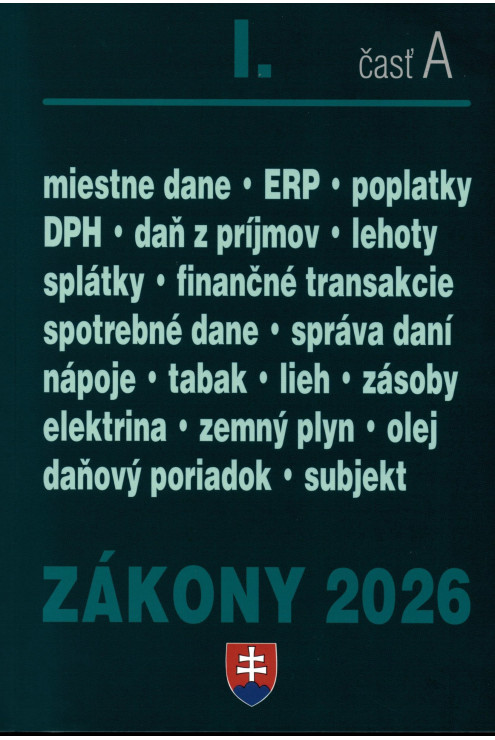
Titul obsahuje úplné znenie zákonov z oblasti dane z príjmov, DPH, správy daní, miestnych a spotrebných daní po novelách k 1. 1. 2026. Zmeny zákonov sú v publikácií vyznačené tučným písmom. Publikácia obsahuje témy: finančné transakcie, daň z príjmov, daň z pridanej hodnoty, spotrebné a miestne dane a iné.

Data sheet
Specific References
E-journal
Michal Jesenko (editor) - Eva Mihalíková - Darina Koreňová
Public Administration and Society is a scientific journal publishing scientific academic articles, contributions to discussion and reviews having the content orientation on the theory and practice of Public Administration. The mission of the Journal is to publish significant results of the scientific scholarly researches regarding the area of public administration and related disciplines which are connected with the study profile and scientific bias of our Faculty. The Scientific Journal is issued in electronic version.
E-book
Marcel Dolobáč - Monika Seilerová
The Industrial Revolution cannot be avoided or hidden from, but it is equally wrong to see it only in gray tones. Let us be optimistic. The Information Age can also mean a reduction in working hours, perhaps more time for family and interpersonal relationships, or an overall increase in individual economic luxury. The Information Age will take away many job opportunities but will put many others on the table, though mostly for the educated. Science and research will become even more important for overall economic development than they are today. Let us be prepared.
The ambition of this monograph is not, and cannot be, to provide an exhaustive answer to the above-outlined debates. Its goal is to stimulate broader scientific discussion, particularly on the issue of mental health protection in correlation with the advent of the Information Age. The subject of study is the protection of the individual—the employee—who must adapt to a new technological environment and its associated demands.
The monograph represents a comprehensive output by authors who, over the past two years, have published on similar topics within the APVV-16-0002 grant "Mental Health in the Workplace and Assessment of Employee Health Capability." The authors believe that thanks to this APVV grant, they will continue to build on this topic in the coming years. Most importantly, they hope that its content will engage you, the readers.
Marcel Dolobáč
E-book
Monika Minčičová - Marcel Dolobáč - Jana Žuľová (eds.)
Peer-reviewed proceedings of the scientific conference
Health determines an individual's life in all activities and interests, including the possibility and ability to work. Work and health are in the mutual interaction. Work leads to social inclusion, financial self-sufficiency, finding confirmation of one's own usefulness or achieving personal ambitions. Work can have therapeutic effects, but at the same time it can have an adverse effect on health.
Overlapping factors of work environment, alone or in combination with non-work influences, can lead to illnesses that temporarily or permanently exclude an employee from his or her profession. For these reasons, health enjoys fundamental legal protection as one of the most important values, not only in labour relations.
E-book
Patrik Furik - Michaela Ružičková - Dávid Gajdoščík - Peter Dubóczi - Barbora Linhartová - Lucia Grieger
The textbook entitled Political Systems of the BRICS States is published as an output of the KEGA 014UPJŠ-4/2020 Innovative Model of Education Leading to Active Citizenship as a Prevention of the Rise of Political Extremism among Students. The aim of the given publication is to present the basic principles of the political systems of the BRICS bloc states and to provide the reader with the nature and character of the bloc's functioning.
The textbook consists of an introduction and five further chapters. All sections are written in Slovak. The individual chapters focus primarily on characterizing the historical development of the BRICS states, the evolution of their constitutionalism, public administration, and on defining the legislative, executive, and judicial branches of power
The individual chapters describe the political systems of the states: Brazil, the Russian Federation, India, China, and South Africa. The introductory chapter of the textbook contains the characteristics of the development and formation of the bloc, as well as information on the cooperation among the BRICS members.