Slovenčina


Kolektív autorov
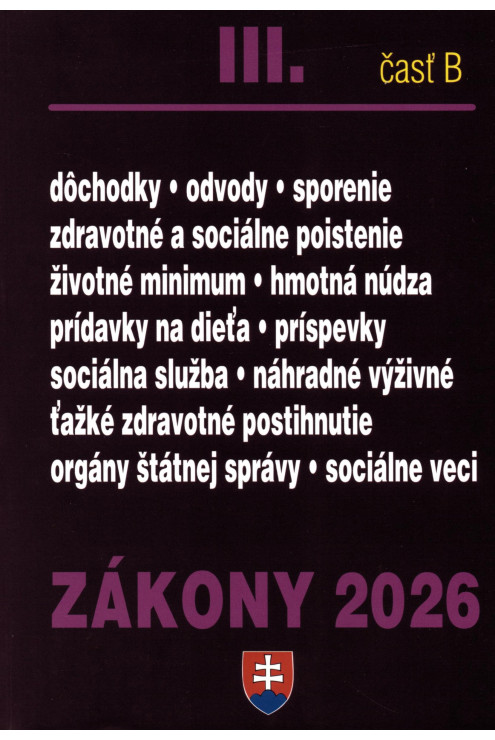
Publikácia obsahujúca právne predpisy týkajúce sa sociálneho poistenia, zdravotného poistenia, starobného dôchodkového sporenia, doplnkového dôchodkového sporenia, príspevkov a sociálnych služieb. Všetky právne predpisy obsahujú zmeny k 1. 1. 2026. Zmeny v zákonoch sú v texte prehľadne vyznačené. Hlavné témy: Sociálne poistenie, Starobné a doplnkové dôchodkové sporenie, Zdravotné poistenie, Sociálne služby
Titul obsahuje úplné znenie zákonov a súvisiacich predpisov:
Sociálne, dôchodkové, zdravotné a nemocenské poistenie (1. kapitola)
Zákon č. 461/2003 Z. z. o sociálnom poistení
Zákon č. 43/2004 Z. z. o starobnom dôchodkovom sporení
Zákon č. 650/2004 Z. z. o doplnkovom dôchodkovom sporení
Zdravotné poistenie (2. kapitola)
Zákon č. 580/2004 Z. z. o zdravotnom poistení
Sociálne zákony (2. kapitola)
Zákon č. 417/2013 Z. z. o pomoci v hmotnej núdzi
Opatrenie MPSVaR SR č. 365/2025 Z. z. o úprave súm pomoci v hmotnej núdzi
Zákon č. 601/2003 Z. z. o životnom minime s prehľadom opatrení MPSVaR SR
Opatrenie MPSVaR SR č. 168/2025 Z. z. o úprave súm životného minima
Zákon č. 453/2003 Z. z. o orgánoch štátnej správy v oblasti sociálnych vecí, rodiny a služieb zamestnanosti
Zákon č. 600/2003 Z. z. o prídavku na dieťa
Opatrenie MPSVaR SR č. 497/2021 Z. z. o úprave súm prídavku na dieťa a príplatku k prídavku na dieťa
Zákon č. 571/2009 Z. z. o rodičovskom príspevku
Opatrenie MPSVaR SR č. 366/2025 Z. z. o ustanovení sumy rodičovského príspevku
Zákon č. 561/2008 Z. z. o príspevku na starostlivosť o dieťa
Zákon č. 383/2013 Z. z. o príspevku pri narodení dieťaťa a príspevku na viac súčasne narodených detí
Zákon č. 201/2008 Z. z. o náhradnom výživnom
Zákon č. 627/2005 Z. z. o príspevkoch na podporu náhradnej starostlivosti o dieťa
Zákon č. 238/1998 Z. z. o príspevku na pohreb
Sociálne služby (2. kapitola)
Zákon č. 448/2008 Z. z. o sociálnych službách
Zákon č. 447/2008 Z. z. o peňažných príspevkoch na kompenzáciu ťažkého zdravotného postihnutia
Zákon o sociálnom poistení vymedzuje sociálne poistenie, upravuje rozsah sociálneho poistenia, právne vzťahy pri vykonávaní sociálneho poistenia, organizáciu sociálneho poistenia, financovanie sociálneho poistenia, dozor štátu nad vykonávaním sociálneho poistenia, konanie vo veciach sociálneho poistenia a konanie vo veciach vymáhania pohľadávok. na základe sociálneho poistenia odvádza podnikateľ či zamestnávateľ odvody do Sociálnej poisťovne na účely dôchodku, PN, alebo invalidného dôchodku. Okrem zákona o sociálnom poistení sú dôležitými právnymi predpismi zákon o starobnom dôchodkovom sporení, zákon o doplnkovom dôchodkovom sporení a zákon o 13. dôchodku.
Zdravotným poistením je povinné verejné zdravotné poistenie, na základe ktorého sa poskytuje poistencom verejného zdravotného poistenia za podmienok ustanovených týmto zákonom zdravotná starostlivosť a služby súvisiace s poskytovaním zdravotnej starostlivosti alebo individuálne zdravotné poistenie, na základe ktorého sa poskytuje poistencom individuálneho zdravotného poistenia zdravotná starostlivosť v rozsahu určenom v zmluve podľa osobitného predpisu.

Data sheet
Specific References
E-book
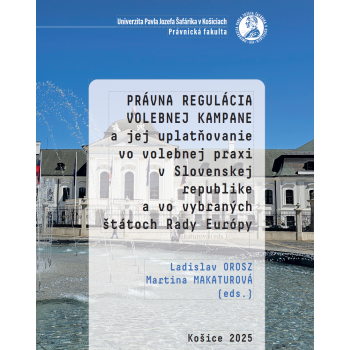
Ladislav Orosz, Martina Makaturová
This scientific volume has been published as an output of the VEGA grant project No. 1/0474/24 Audit of Slovak Electoral and Referendum Legislation. Thematically, it focuses on the issue of the legal regulation of election campaigns and a critical analysis of the experience of its application in electoral practice. On this basis, the authors also formulate proposals for improving the current legal framework of election campaigns.
The proceedings include contributions presented at the scientific conference of the same name held in May 2025. The volume contains papers not only from domestic but also from foreign authors, who present the legal regulation of election campaigns in their respective home countries. Contributions from academics are complemented and enriched by those of representatives of non-governmental organizations engaged in election and campaign monitoring, as well as by contributions from authors working in public authorities responsible for the administration of elections and for overseeing the constitutionality and legality of elections.
E-book
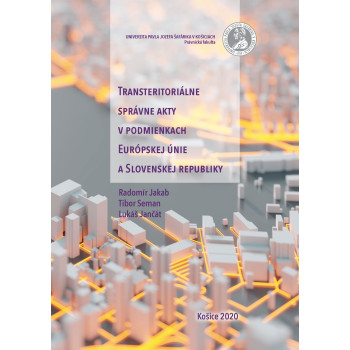
Radomír Jakab - Tibor Seman - Lukáš Jančát
The concept of a transterritorial administrative act is relatively new in administrative law, especially in the conditions of the Slovak Republic. It has practical applicability to the application of European Union law (including international law). Its essence lies in the fact that the effects of such an administrative act issued within one Member State exceed the territory of that Member State, have effects in other Member States, in all Member States of the European Union without being subject to the recognition process.
The purpose of the monograph is to present outputs of the scientific examination of this type of administrative acts, the definition of its characteristics and its effects, the examination of the possibilities of procedural defense against its effects by the State concerned, and possibly the possibility of unifying the action of the Member States of the European Union in case of procedural defense against the effects of transterritorial administrative acts. The monograph also contains analysis of certain types of transterrritorial administrative acts that are commonly used in the conditions of the European union and Slovak republic; they are also categorized under specific criteria.,
E-book
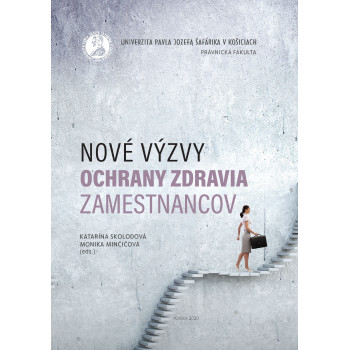
Katarína Skolodová - Monika Minčičová (eds.)
Proceedings of the 5th Year of the Student Symposium of Labour Law
New trends in the digital age around the world do not avoid the labour market and the labour law relations. Do labour law standards and employers' practices correspond to the actual factors that influence an individual's physical or mental condition? Does digitization, including artificial intelligence, bring improvements or threats? Is the protection of employees' mental health paid equal attention that to the protection of physical health? The Department of Labour Law and Social Security Law of the Pavol Jozef Šafárik University in Košice examines and analyzes legal aspects of new risks that threaten and affect individual health in the work environment within the researching of the project APVV-16-0002 - Mental Health in the Workplace and Employee Health Assessment.
The members of the department, with the theme of the 5th year of the student symposium "New Challenges of Employees´ Health Protection" created an opportunity for students to search deeper current legal issues and reflect the results of their creative work in the submitted papers. The proceedings of papers of the student symposium is rich in content and offers the reader the space to get acquainted with interesting questions and application problems accompanying them.
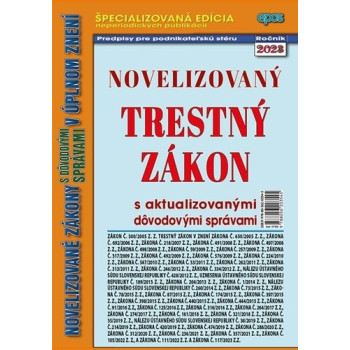
Novelizovaný Trestný zákon s aktualizovanými dôvodovými správami ZÁKON Č. 300/2005 Z. Z. TRESTNÝ ZÁKON V ZNENÍ ZÁKONA Č. 650/2005 Z. Z., ZÁKONA Č. 692/2006 Z. Z., ZÁKONA Č. 218/2007 Z. Z., ZÁKONA Č. 491/2008 Z. Z., ZÁKONA Č. 497/2008 Z. Z., ZÁKONA Č. 498/2008 Z. Z., ZÁKONA Č. 59/2009 Z. Z., ZÁKONA Č. 257/2009 Z. Z., ZÁKONA Č. 317/2009 Z. Z., ZÁKONA Č. 492/2009 Z. Z., ZÁKONA Č. 576/2009 Z. Z., ZÁKONA Č. 224/2010 Z. Z., ZÁKONA Č. 547/2010 Z. Z., ZÁKONA Č. 33/2011 Z. Z., ZÁKONA Č. 262/2011 Z. Z., ZÁKONA Č. 313/2011 Z. Z., ZÁKONA Č. 246/2012 Z. Z., ZÁKONA Č. 334/2012 Z. Z., NÁLEZU ÚSTAVNÉHO SÚDU SLOVENSKEJ REPUBLIKY Č. 428/2012 Z. Z., UZNESENIA ÚSTAVNÉHO SÚDU SLOVENSKEJ REPUBLIKY Č. 189/2013 Z. Z., ZÁKONA Č. 204/2013 Z. Z., ZÁKONA Č. 1/2014 Z. Z., NÁLEZU ÚSTAVNÉHO SÚDU SLOVENSKEJ REPUBLIKY Č. 260/2014 Z. Z., ZÁKONA Č. 73/2015 Z. Z., ZÁKONA Č. 78/2015 Z. Z., ZÁKONA Č. 87/2015 Z. Z., ZÁKONA Č. 174/2015 Z. Z., ZÁKONA Č. 397/2015 Z. Z., ZÁKONA Č. 398/2015 Z. Z., ZÁKONA Č. 440/2015 Z. Z., ZÁKONA Č. 444/2015 Z. Z., ZÁKONA Č. 91/2016 Z. Z., ZÁKONA Č. 125/2016 Z. Z., ZÁKONA Č. 316/2016 Z. Z., ZÁKONA Č. 264/2017 Z. Z., ZÁKONA Č. 274/2017 Z. Z., ZÁKONA Č. 161/2018 Z. Z., ZÁKONA Č. 321/2018 Z. Z., ZÁKONA Č. 35/2019 Z. Z., NÁLEZU ÚSTAVNÉHO SÚDU SLOVENSKEJ REPUBLIKY Č. 38/2019 Z. Z., ZÁKONA Č. 214/2019 Z. Z., ZÁKONA Č. 420/2019 Z. Z., ZÁKONA Č. 474/2019 Z. Z., ZÁKONA Č. 288/2020 Z. Z., ZÁKONA Č. 312/2020 Z. Z., ZÁKONA Č. 236/2021 Z. Z., ZÁKONA Č. 357/2021 Z. Z., ZÁKONA Č. 105/2022 Z. Z., A ZÁKONA Č. 111/2022 Z. Z. A ZÁKONA Č. 117/2023 Z.Z.