 English
 Slovenčina


Katalóg
Subcategories
There are 50 products.
Active filters
- Categories: Law
- Categories: Social sciences
- Year of publication:: 2012
- Year of publication:: 2012
- Year of publication:: 2014
- Year of publication:: 2014
- Year of publication:: 2014
- Year of publication:: 2014
- Year of publication:: 2014
- Year of publication:: 2016
- Year of publication:: 2016
- Year of publication:: 2016
- Year of publication:: 2016
Sociálne a politické analýzy 1-2016
E-book
E-journal
Juraj Schenk et al.
The scientific journal Sociálne a politické analýzy (Social and Political Analyses) serves as an interactive electronic platform for communication and the presentation (publication) of experts and their work in the fields of basic and applied research and analyses within sociological, psychological, political, and methodological contexts. It is a medium focused on intensively supporting research activities and analyses within an interdisciplinary framework, facilitating the exchange of experiences, fostering collaboration, and revitalizing the production of scientific work in this area.
The publication section of the journal offers space for works such as:
- Original sociological, psychological, and political studies and analyses in any areas of social life
- Methodological studies
- Research reports
- Studies from qualification theses Research and analysis projects
- Reviews
Sociálne a politické analýzy 1-2014
E-book
E-journal
Juraj Schenk et al.
The scientific journal Sociálne a politické analýzy (Social and Political Analyses) serves as an interactive electronic platform for communication and the presentation (publication) of experts and their work in the fields of basic and applied research and analyses within sociological, psychological, political, and methodological contexts. It is a medium focused on intensively supporting research activities and analyses within an interdisciplinary framework, facilitating the exchange of experiences, fostering collaboration, and revitalizing the production of scientific work in this area.
The publication section of the journal offers space for works such as:
- Original sociological, psychological, and political studies and analyses in any areas of social life
- Methodological studies
- Research reports
- Studies from qualification theses Research and analysis projects
- Reviews
Sociálne a politické analýzy 2-2012
E-book
E-journal
Juraj Schenk a kol.
The scientific journal Sociálne a politické analýzy (Social and Political Analyses) serves as an interactive electronic platform for communication and the presentation (publication) of experts and their work in the fields of basic and applied research and analyses within sociological, psychological, political, and methodological contexts. It is a medium focused on intensively supporting research activities and analyses within an interdisciplinary framework, facilitating the exchange of experiences, fostering collaboration, and revitalizing the production of scientific work in this area.
The publication section of the journal offers space for works such as:
- Original sociological, psychological, and political studies and analyses in any areas of social life
- Methodological studies
- Research reports
- Studies from qualification theses Research and analysis projects
- Reviews
Sociálne a politické analýzy 1-2012
E-book
E-journal
Juraj Schenk et al.
The scientific journal Sociálne a politické analýzy (Social and Political Analyses) serves as an interactive electronic platform for communication and the presentation (publication) of experts and their work in the fields of basic and applied research and analyses within sociological, psychological, political, and methodological contexts. It is a medium focused on intensively supporting research activities and analyses within an interdisciplinary framework, facilitating the exchange of experiences, fostering collaboration, and revitalizing the production of scientific work in this area.
The publication section of the journal offers space for works such as:
- Original sociological, psychological, and political studies and analyses in any areas of social life
- Methodological studies
- Research reports
- Studies from qualification theses Research and analysis projects
- Reviews

Leibniz a Heidegger – veta o (dostatočnom) dôvode
E-book
E-book
Philosophy is interwoven throughout its history with several principles that bring light and order to this kind of thinking, whether it is a systematic or a non-systematic form of philosophizing.
Each of the principles represents in its own way the origin (ἀρχή) of all deductive reasoning, but not all philosophical statements and conceptions are obliged to proceed in the same way, for not all philosophical statements and conceptions are calculus. Actually, such a form of rationalist philosophizing is really a minority in the history of philosophy. But in spite of its minority presence, it will always attract attention to some extent, whether by becoming a pillar of thought itself and finding a permanent place in its foundations, or by becoming an indispensable mainstay of philosophical reasoning. In fact, there are not many principles in the history of philosophical thought.
The state of affairs is primarily due to the heterogeneous and in many cases irrationalist nature of philosophical thinking.
Úvod do psychológie rozhodovania
E-book
E-book
Decision-making is an everyday activity for us, whether it involves decisions about routine matters such as what to have for breakfast or more significant choices like selecting a career after finishing school. Due to the far-reaching consequences that a single decision can have on our entire lives, this area has received considerable attention in psychology. After all, the classic goals of psychology—describing, explaining, and predicting human behavior—are essentially attempts to understand decision-making and identify and describe the factors influencing it. Fundamental psychological disciplines such as the psychology of emotions and motivation, cognitive psychology, social psychology, and personality psychology all strive to achieve this understanding.
The presented text primarily adopts a cognitive approach, focusing on the processes of information processing and utilization. Since there are very few events in the future we can be completely certain about, key concepts include terms expressing uncertainty about the future, such as uncertainty, risk, objective probability, and subjective probability.
The central question thus lies in processing information from the environment and utilizing it in the decision-making process.
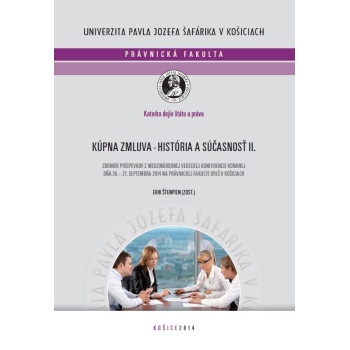
Kúpna zmluva – história a súčasnosť II.
E-book
E-book
Erik Štenpien (ed.)
Proceedings from the international scientific conference held on September 26-27, 2014 at the Faculty of Law, UPJŠ in Košice
Nowadays, in the modern 21st century, we have a much more complex society than the ancient one. It requires legal regulation of various types of purchase contracts, where although the basic feature remains, it needs to be specified further, and the simple sentence 'I sell, you buy' needs to be supplemented with conditions 'how, where, when, under what conditions?' This is the task of modern civil law. The current recodification of civil law has already taken place in some European countries, and it is currently underway in our country. Therefore, it is important to meet at conferences with colleagues from these countries and exchange knowledge, to discuss their experiences, avoid the bad, and accept or adjust the good according to our conditions.
This proceedings is the output publication from the conference held on September 26-27, 2014 in Košice. It was the second conference with the participation of the most prominent legal Romanists, legal historians, and civilists from home and abroad. The proceedings is the result of unique cooperation among experts from various fields of legal science. I believe that the published outputs will help to understand the institute of purchase contracts from all its aspects and will become an inspiration for both experts and laypeople.
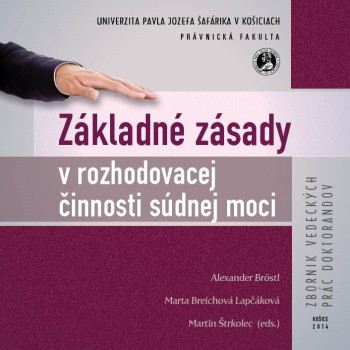
Základné zásady v rozhodovacej činnosti súdnej...
E-book
E-book
Alexander Bröstl - Marta Breichová Lapčáková - Martin Štrkolec (eds.)
Collection of scientific papers by doctoral students.
Thematically, the contributions are diverse: they feature fundamental principles in public law (basic principles of criminal proceedings, the principle of contradiction, basic principles of constitutional court proceedings, basic principles in private law and procedural law (superficies solo cedit), the principle of civil court proceedings in deciding labor disputes, equality of participants and the duty to instruct, objection of bias in light of the right to an impartial court, the principle of speed and the principle of economy in the decision-making activities of general courts, basic principles in legal theory and international law (general legal principles recognized by civilized nations), coexistence of the principle of equality and the principle of non-discrimination in the legal order of the European Union, argumentation through the principle of rule of law in the decision-making activities of courts, the impact of fundamental principles on the interpretation of legal norms.
It is important that the authors, i.e., doctoral students from law faculties in the Czech Republic and the Slovak Republic, almost unanimously examine these principles in the process of application (interpretation) of law, from the perspective of how legal (primarily judicial) practice deals with them. This should be fundamentally welcomed and appreciated.
Obchodná spoločnosť ako právnická osoba
E-book
E-book
Ján Husár - Kristián Csach (eds.)
The collection contains contributions presented at the international conference held on April 1st - 3rd 2014 in Smolenice, organized by Pavol Jozef Šafárik University in Košice in cooperation with the Institute of State and Law of the Slovak Academy of Sciences and the Institute of State and Law of the Czech Academy of Sciences. Authors are high-profile Slovak and Czech scholars in the field of private law and company law, as well as representatives of new generation of young researchers. Contributions focus on contemporary issues in the field of company law, in particular theoretical basis of corporations, groups of companies, doctrine of abuse of rights, reflective loss and new tendencies in corporate law in foreign legal orders. The first part of the contributions presented at the conference have been already published in the special issue of the theoretical magazine Právny Obzor n. 4/2014.
Aktuálne problémy medzinárodného leteckého a...
E-book
E-book
Adam Giertl (ed.)
Proceedings from the VII. annual student symposium on international law held on April 11-12, 2014 at the UPJŠ training facility in Danišovce
Despite this, flying and space travel are now a common part of human civilization. What is the role of law in this process? This is the question posed by the organizers of the VII. annual student symposium on international law, aiming to evaluate the contribution of international law in the field of aviation and space flights, especially in light of current developments.
The individual topics were tackled by second, third, and higher-year students of the Faculty of Law at UPJŠ in Košice. The result of their work on the assigned topics, which the authors could consult with members of the Institute of European Law and the Department of International Law, is the presented work.
The proceedings are thematically divided into two parts. The first part acquaints the reader with selected topics related to aviation law, and the second part is dedicated to international space law.
With its focus, the proceedings also have a broader impact, as in some aspects it fits into the broader context of research conducted at the Institute of European Law and the Department of International Law, which focuses on examining the influence of regionalism on general international law and vice versa. This issue is also reflected in the topics of the individual contributions.
Ľudský kapitál a spoločnosť 2014
E-book
E-book
Iveta Jeleňová - Gabriela Kravčáková (eds.)
Proceedings of the International Scientific Conference, October 16, 2014, Košice
In mid-October 2014, the second annual conference "Human Capital and Society" was held, organized by the Department of Social Studies of the Faculty of Public Administration at P. J. Šafárik University in Košice, in collaboration with another department of the faculty, the Department of Economics and Management of Public Administration. Today, you have before you the proceedings encompassing contributions presented by participants of this conference. In preparing it, the editors had to deal with the diversity of the participants' profiles, which was reflected in the authors' approaches to the issues they addressed, and subsequently had the contributions reviewed by experts from various fields. The individual contributions address traditional topics, as well as newer and emerging themes, reflecting current problems and questions related to human capital, organizational behavior, and primarily, public administration.
At the conference, researchers specializing in management, psychology, political science, social work, sociology, anthropology, linguistics, as well as individuals who do not belong to just one scientific discipline, came together. It was interesting to see how people from different disciplines view the same phenomenon. The conference demonstrated that an interdisciplinary approach can highlight the shortcomings in identifying and understanding problems from the perspective of just one discipline.
Ako nájsť zmysel života v sociálnej práci s...
E-book
E-book
Eva Žiaková (ed.)
Proceedings of the Scientific Conference with International Participation within the VEGA Project No. 1/0282/12 Interdisciplinary Analysis of the Meaning of Life and Its Components in Socially Significant Groups of Adolescents in Terms of Its Formation and Possible Intervention.
The introductory word is a very good opportunity for us to jointly evaluate what we have managed to achieve in addressing our common scientific research task focused on the study of the meaning of life in socially at-risk groups of adolescents. First and foremost, we asked ourselves what we have discovered about the meaning of life so far, that is, what we know about it.
The second question we asked was: what surprised us about the results we have obtained so far. The third question was about what we want to do to resolve the discrepancy between what we have discovered and what we want to achieve.
The final question in evaluating the solution of the scientific research task was: what do we (not) know about the meaning of life of adolescents and want to know in the future, or what should we focus on to develop the most effective logotherapeutic and sociotherapeutic methods for social workers working with socially at-risk groups of adolescents.

THE FUNCTION OF METAPHOR IN MEDIEVAL NEOPLATONISM
E-book
E-book
Mária Mičaninová - Ivica Hajdučeková (eds.)
In the framework of the project VEGA of the Ministry of Education, Science, Research and Sport of the Slovak Republic 1/0330/12 The Function of Metaphor in the Philosophy of Shlomo ben Yehuda ibn Gabirol and Shihab al-Din Yahya al-Suhrawardi, project leader Assoc. Prof. Mária Mičaninová, CSc., under the patronage of the rector of Pavol Jozef Šafárik University in Košice, The Slovak Republic, Prof. MUDr. Ladislav Mirossay, DrSc., and of The Department of Philosophy and History of Philosophy of the Faculty of Arts of the same University, took place on 4th – 5th October 2013 an International conference on The Function of Metaphor in Medieval Neoplatonism. Two days´conference was opened by Dean of the Faculty of Arts of P. J. Šafárik University, Prof. PhDr. Ján Gbúr, CSc.,in the presence of Prof. PhDr. Vladimír Leško, CSc., Head of The Department of Philosophy and History of Philosophy, and of foreign guests and students of the University.
Rizikové správanie v teórii a praxi sociálnej...
E-book
E-book
Soňa Lovašová (ed.)
Proceedings of the Scientific Conference with International Participation held on November 28, 2014, in Košice
Social work is among the helping professions that can be considered highly risky from various perspectives. The clientele utilizing social services is very diverse, often consisting of individuals in extreme life situations. It is typical for help to be sought only when the client is at rock bottom. Along with other factors, this can lead to the emergence of various risky situations. The proceedings were created within the framework of the VEGA task No. 1/0332/12 titled Analysis of Selected Risk Factors of Client Violence in Social Work with an Emphasis on Prevention of Client Violence and Preparation of Social Workers - National Mapping of the Occurrence of Client Violence Against Social Workers in Slovakia. The thematic focus of the proceedings is broader, as client violence is only one of many risks in social work. In the proceedings, the reader will find 52 articles that address the riskiness of social work from many perspectives. They offer an interesting overview of theoretical foundations as well as research findings. The numerous thematic contributions indicate that the issue of risk in social work is highly relevant and that attention is paid to it in both theory and practice.
Analýza vybraných faktorov klientskeho násilia...
E-book
E-book
Soňa Lovašová a kol.
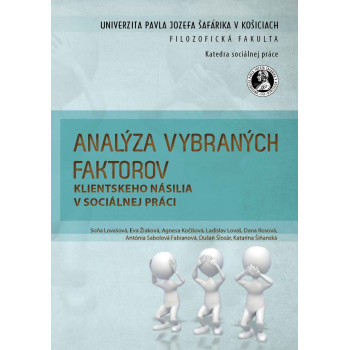
Violence in the workplace has been a problem that has received attention for fifty years. Client violence is one of its forms. These are cases where the aggressor is a person coming to an institution to use its services. Client violence affects all helping professions. This monograph deals with the specifics of client violence in social work.
In addition to theoretical outputs, it also offers research results conducted on a sample of 1170 respondents, frontline workers in selected entities providing services in the social field in Slovakia. The monograph represents a summary of three years of work by eight experts. Each author contributed within their area of expertise and brought a different perspective to the issue. The main aim was to bring a variety of views on the issue and attempt to combine them into a cohesive whole. Thus, a monograph was created that contains interesting theoretical foundations included in six theoretical chapters, starting with the introductory chapter on the position of client violence in the area of workplace violence.
The following chapters address the risk and riskiness of social work, ethical aspects, the personality of the social worker, and risk areas of social work. The research chapter presents the research project to the reader and three subchapters of findings processed in tables and described in detail.
The final part of the monograph deals with prevention and group work. An important part is also the appendices, which include a questionnaire battery, a program implemented for social work students, and a proposed program for workers in the social field.
Výchova a vzdelávanie 2014: Kontexty...
E-book
E-book
Ján Juščák - Renáta Orosová - Zuzana Nováková
Proceedings of the International Scientific Conference February 5 -február 2014 6, 2014
Conference proceedings of abstracts is one of the outputs of the international scientific conference entitled Education 2014: Contexts of education in the current perspective held 5 to 6 Feb 2014 at University of Pavol Jozef Šafárika in Kosice. This conference focused on the issues of education and emphasizes the current state and prospects of educational practice, topical aspects of undergraduate teacher training, health psychology in educational practice, as well as pedagogical and psychological aspects of education in primary educational institutions in view of the broad educational community. It was aimed for scientists, young university teachers, PhD students as well as experts and teachers, to present trends in education and to stimulate discussion on topical issues presented in the field of education.
K problému dichotómií v dejinách politického...
E-book
E-book
The work deals with the evolution in theory and practice of democracy, open society and humanism which is marked by dichotomy of its own progressive and regressive features. Civilization trajectory of human reality, the implementation strategy thought overlaps through a reality in the form of freedom, solidarity and human rights, formulation of normative ideas of man and his/her nature, rationalistic universalism and voluntaristic individualism created preconditions for the political background of modern societies which established democratic order with rules allowing to dispose with freedom to which the individual, as a rational being, is authorized. Moreover, the perspective of awareness of ambiguity and paradoxical content of individual parameters of democracy, open society and humanism, ideologically shaped and fixed by worldviews of economic and political elites, from our point of view, is a mirror image of how those conditions differ from the standard assumptions formulated in theory.
DEMOKRACIA • Stav – Kontexty – Perspektívy
E-book
E-book
Gabriel Eštok - Mária Hrehová - Renáta Bzdilová (eds.)
Collection of contributions from II. year of the Student Scientific Conference held on May 17, 2013 by the Department of Political Science of the Faculty of Arts of the University of Pavel Jozef Šafárik in Košice
The collection was created on the basis of an event with a thematically defined and political science, perhaps the most frequently discussed issue of democracy. I would add that the event was also attended by doctoral students of other fields of study, who analyzed the topic of democracy from positions other than political science. I very much welcomed the fact that a contribution from the legal issues of the European Union appeared in the proceedings. Enriching the collection is also a contribution from international political issues, which sheds light on democratic rules applied in territory other than European. Other contributions focus on various aspects of the creation of a democratic political environment in Slovakia and the European Union, while several sympathetic attempts at non-traditional perspectives on the development of civil society, public and party politics appear in them.
10 rokov v EÚ: Vzťahy, otázky, problémy
E-book
E-book
Ján Klučka(ed.)
Collection of Papers from the International Scientific Conference Held on May 29–30, 2014 at the Faculty of Law, Pavol Jozef Šafárik University in Košice.
In the first half of this year, a scientific conference entitled “10 Years in the EU: Relations, Questions, Issues” was held in Košice, and the contributions from this event constitute the content of the present collection bearing the same name.
The aim of the organizers—namely, the Slovak Association of European Law, the Representation of the European Commission in the Slovak Republic, and the Institute of European Law together with the Department of International Law of the Faculty of Law at Pavol Jozef Šafárik University—was not only (even if loosely) to follow up on the previous 2009 conference “Community Law in Slovakia – Five Years ‘After’”, but, after another five years, to continue its main objective: to provide participants from both the academic and non-academic community with a space for further analysis and exchange of views on legal issues related to the membership of the Slovak Republic in the European Union and various current issues of the Union’s legal order.
From this perspective, a shift in the overall focus of the conference contributions in 2009 and 2014 can be observed. While the contributions from the first conference focused primarily on various aspects of the application of Union law in the Slovak legal system and related application problems, especially before courts and other authorities, the basic orientation of the contributions from the second conference is already different. The present collection also confirms that the contributions focus primarily on current issues of the European legal order and on certain aspects of the Union’s external policy, while the relationship of Union law to the Slovak legal system is no longer given primary attention.
Several contributions focus on areas characterized by a certain overlap or “cohabitation” of Union law with public international law, private international law, or, more broadly, international relations.
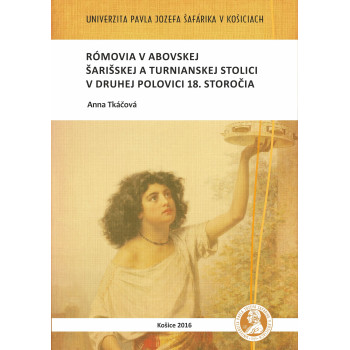
Rómovia v Abovskej, Šarišskej a Turnianskej...
E-book
E-book
The main topic of this publication is the Roma, their status, and life in Hungary, specifically in the Abov, Šariš, and Turnia counties in the second half of the 18th century, particularly according to the censuses conducted during the reign of Maria Theresa and Joseph II.
The work is divided into six chapters and fourteen subchapters. It contains three images, twenty-eight tables, and twenty-nine graphs. The introductory chapter deals with the state of research on the subject (i.e., the Roma in the second half of the 18th century) from 18th-century authors to contemporary authors who have dealt with or are still dealing with it.
In the first chapter, the author briefly mentions the Indian origin of the Roma, the social affiliation of the Roma ancestors, their departure from India, their migration until their arrival in Hungary, as well as the names given to the Roma by the surrounding world. It also mentions the first reports on the Roma in Hungary and in the territory of today's eastern Slovakia, as well as their status in Hungary until the first half of the 18th century.
In the second chapter, the author touches on the life of the Roma in the Abov, Šariš, and Turnia counties in the light of archival materials from the second half of the 18th century and presents the administrative division of these counties during this period.
The third chapter discusses the royal decrees of the Enlightenment rulers Maria Theresa and Joseph II concerning the Roma and briefly describes the political situation and the resolution of socio-economic issues in Hungary in the second half of the 18th century.
The fourth chapter is devoted in detail to the censuses of the Roma in the Abov, Šariš, and Turnia counties during the reign of Maria Theresa and Joseph II, their objectives, characteristics, contributions, as well as their shortcomings, and presents the methodology of numerical and graphical processing of these censuses.
The fifth chapter contains a comprehensive graphical comparison and evaluation of the Roma censuses from all three counties. The overall findings about the life of the Roma in the Abov, Šariš, and Turnia counties are presented in the sixth, concluding chapter.
The main finding of this research is that the regulation of the Roma was carried out with only minimally successful (from the rulers' perspective) results, as the affected Roma families continued to roam both during and after the regulation. They practiced so-called "hidden roaming."
Aktuálne otázky migrácie z pohľadu...
E-book
E-book
Adam Giertl (ed.)
Collection of Papers from the 9th Annual Student Symposium on International and European Law held on April 22, 2016 at the Faculty of Law, Pavol Jozef Šafárik University in Košice
As indicated by the very title of the 9th Annual Student Symposium on International and European Law, “Current Issues of Migration from the Perspective of International Law with Special Regard to the Charter of Fundamental Rights of the European Union,” the participants focused on the highly topical subject of European migration, which they examined from various aspects of both international and Union law (a total of 9 contributions).
In assessing the role of individual actors primarily involved in addressing the problems arising from migration to Europe, particular emphasis was placed on the role of international specialized organizations, which often provide direct assistance to migrants “in the field” through humanitarian or medical aid. However, this is not the only response of the international community, as it is complemented by the activities of the concerned states as well as various non-governmental organizations and volunteers. Regarding the evaluation of the European Union’s activities, the symposium participants agreed that the mass migration wave caught the EU relatively unprepared—institutionally, legislatively, and technically—accompanied by a lack of clarity in adopting a fundamental approach to this reality.
It was also emphasized that these shortcomings occurred despite the fact that developments in the preceding period clearly signaled the possibility of gradual migration to the European Union escalating into a mass phenomenon. According to the participants, additional ex post and sometimes delayed measures adopted in response to the ongoing migration process contributed to an overall increase in political tension within the EU and divided its member states into opposing camps.
Európska únia a jej vplyv na organizáciu a...
E-book
E-book
Alena Krunková (ed.)
Proceedings of the Scientific Conference Held on June 28, 2016 at the Faculty of Law of Pavol Jozef Šafárik University in Košice in connection with the implementation of the project “The European Union and Its Impact on the Organization and Functioning of Public Administration in the Slovak Republic” – approved under number MVZP – SK PRES/2016/134
The Slovak Republic, as a member state of the European Union, is undertaking a historic role associated with the Presidency of the Council of the European Union within the presidency trio. At the beginning of 2016, the Ministry of Foreign and European Affairs of the Slovak Republic announced a call for applications for grants for 2016 in the field of international relations and foreign policy, specifically focused on the Slovak Republic’s Presidency of the Council of the European Union. The Faculty of Law of Pavol Jozef Šafárik University in Košice responded to this call and obtained a project aimed at carrying out research activities through a series of events focused on regional self-government in the Slovak Republic in the context of its role within the European Union. The Faculty has long been engaged with issues of European Union law both in its teaching and in the scientific research activities of its individual faculty members. The project aims to enrich this portfolio with special activities targeting not only professionals, but also students and the general public.
The first activity of the project was a conference entitled “The European Union and Its Impact on the Organization and Functioning of Public Administration in the Slovak Republic – Development So Far, Current State, and Perspectives.” The conference was attended by invited public officials, representatives of academia, and representatives of local government, as one of the main goals of the project is to connect the academic community with the practical sphere and thus involve practitioners in the planned activities within the project.
Ochrana súkromia zamestnanca
E-book
E-book
Jana Žuľová(ed.)
Proceedings from the 1st Annual Student Symposium on Labor Law held on April 8–9, 2016 in Danišovce
Discussions on the topic of privacy are currently very topical and interesting. The advancement and progress of technology have added a new dimension to individual privacy. With the use of modern electronic devices, terms such as precious commodity, chimera, or illusion are increasingly associated with privacy. Workplaces have not remained immune to modernization either. Machines are replacing human labor, programming and planning the production process, but also controlling, monitoring, and recording the fulfillment of assigned work tasks.
The availability of technology and its implementation in employers’ operations intrude upon the personal and private sphere of employees, which is an inherent part of every person’s life and does not remain left behind the doors of the workplace. Proper and correct use of monitoring mechanisms by employers means not only mastering their technical installation at the workplace and covering the associated financial costs, but also respecting the privacy of employees.
It cannot be overlooked that the right to privacy is among the fundamental human rights and freedoms, enjoying the corresponding characteristics (inalienability, non-transferability, irrevocability, etc.) and appropriate legal protection. And even though it is not absolute and may be suspended in favor of another right (especially the employer’s right to protect their property), every intervention—such as comprehensive camera surveillance, monitoring of phone calls, email correspondence, blocking certain websites, etc.—always has adverse consequences for the privacy of the employee.
Obchodné záväzky: Všeobecná časť
E-book
E-book
Dominika Zavadová(ed.)
Proceedings from the 3rd Student Symposium on Commercial Law
In November 2015, the third annual Student Symposium on Commercial Law took place at the university facility in Danišovce.
After two years of symposia focused on company law, the main topic of the third edition was the general part of commercial obligations law. This year as well, the goal of the student symposium remained to provide more space for students to formulate their own perspectives on current legal issues and to present the results of their own work.
The overarching topic made it possible to assign several current issues, allowing students to tackle problems they are likely to encounter in their future practice. The selected topics are not among those unanimously accepted by legal doctrine or established case law. On the contrary, the topics were deliberately chosen for the lack of sufficient domestic literary sources. As a result, processing the individual topics required more than just standard textbook or commentary knowledge.
The participating members of the department, both teachers and doctoral candidates, acted this year primarily as contact persons, rather than as consultants or supervisors of the students’ work. The primary purpose of the symposium at the faculty is to enable students interested in commercial law to develop their analytical and argumentative skills, as well as to express their personalities. We aim for students to develop not only professional knowledge but also personal skills-so-called soft skills-the art of presenting their own opinions and arguing persuasively.
Medzinárodné daňové úniky a metódy ich...
E-book
E-book
Peter Huba - Jozef Sábo - Martin Štrkolec
The presented monograph aims to provide an in-depth overview of the issue of international tax evasion, both in terms of its conceptual foundations and with regard to specific methods and schemes used to carry out tax evasion.
The members of the authorial team have also addressed questions of tax evasion in their previous works: "International Tax Evasion and Tax Havens" (JUDr. Jozef Sábo) and "Legal Aspects of the Elimination of Double Taxation and Prevention of Tax Evasion" (JUDr. Peter Huba).
This monograph represents a synthesis of the relevant research activities of the authorial team, enriched by the interdisciplinary dimension of the tax evasion problem. At the same time, it highlights those shortcomings that appear to be the most serious from the perspective of the risk of international tax evasion and base erosion in Slovakia. In this respect, a comparative perspective on the issue is presented, drawing extensively from American sources, mainly due to the high quality and long-standing research on international tax evasion in the United States.
The authorial team believes that this monograph will help to bring the issue of corporate income tax evasion closer to the professional public, and that it will receive attention equal to that given to VAT fraud and other pressing issues of current tax legislation.
Výskum v medicíne a etika
E-book
E-book
Iveta Cimbolákováa kol.
The premise “today’s research shapes the healthcare of tomorrow” expresses the importance of medical research and the reason for its pursuit. Scientific research and advances in biomedical sciences, as well as their application in medical practice and in the process of delivering healthcare, nevertheless bring new problems in the area of ethics.
Biomedical research itself requires the precise definition of hypotheses, which are tested both under laboratory conditions and on experimental animals. Although clinical studies on human subjects are expected to benefit individual participants and to advance fundamental biomedical knowledge, they also entail certain risks depending on the nature of the research. These risks must be minimized, and the experiment should be conducted freely while also taking place within specific measures to protect all involved-not only the test subjects, but also the researchers themselves.
The presented publication provides an overview of the general conditions and ethical principles of research involving laboratory animals and human subjects, the issue of professional and ethical assessment of projects, as well as fraud and the publication of results. At present, we are witnessing tremendous progress in molecular biological sciences, which brings ethical dilemmas also in the field of genetics. For this reason, one of the chapters is devoted to the latest findings in this area.
Tanatológia a humánna tafonómia - etické a...
E-book
E-book
Nikita Bobrova kol.
The concept of medical ethics is interpreted as both applied and professional ethics. As a bioethical discipline, it consists of three normative parts: biogenesis, biotherapy, and thanatology. From an ethical perspective, medicine is part of clinical bioethics; however, at the current stage, “evidence-based ethics” is still lacking.
In the context of standardizing health care, there is an excessive development of certain components of bioethics (such as ethical codes and the concept of patient autonomy), but also a reduction, especially of its clinical component (such as communication, thanatology, euthanasia, dysthanasia, and futile treatment). Current legislative efforts are leading to a reduction in the rights of health care workers, particularly in terms of corporate autonomy.
The fundamental task of medical ethics is the cultivation of medical professionalism, which is defined as the professional alignment of expert, ethical, and legal reasoning, and as a starting point for thinking in terms of values, with reflection on the bioethical space in clinical and professional practice.
Since society declares health as its priority, this priority should positively influence the entire health care system, and its basic idea should be a health care system based on a humanistic ethical paradigm with social and professional application.
Download the e-book for free (pdf)
Etické aspekty komunikácie v medicíne
E-book
E-kniha
Silvia Farkašová Iannaccone a kol.
The history of ethics represents the search for a fundamental principle that would enable a person to distinguish between moral and immoral, good and evil, or right and wrong. The main issues are the motives, methods, and consequences of human actions.
The integrity of the medical profession emphasizes lifelong study and practice according to professional competence, and, last but not least, adherence to ethical principles and standards of medical ethics. Medical ethics and the related communication in the process of providing healthcare are becoming increasingly relevant topics. Communication between doctor and patient itself constitutes a very important part of the diagnostic process and treatment; it significantly contributes to the creation of a mutual relationship and, to a considerable extent, ensures patient cooperation.
The development of various information and network technologies allows for rapid communication even in medicine; however, a kind word and real contact with the patient, with an appropriate choice of verbal and nonverbal communication tools in personal contact, cannot be replaced by modern technology. The present era places demands on certain communication skills of the physician. Another ethical and legal issue is informed consent, which brings the patient’s active participation in the process of providing healthcare.
The presented publication provides basic information about medical ethics, communication in medicine in general, and communication skills in medical practice. Further chapters are devoted to the issue of informed consent, ethics, and the specifics of communication with selected groups of patients. We believe that this publication will clarify for the reader the basic ethical pillars and will be helpful for basic orientation in the issues of medical communication.
Environment a jeho etické aspekty
E-book
E-book
Tatiana Kimáková a kol.
Ethics, as the science of the proper realization of human potential in various areas of life, also extends into the environment. For understanding the ethical aspects in this field, a thorough knowledge of the individual components of the environment, as well as their impact not only on humans but on all living nature, is very important. Therefore, questions concerning the influence of the environment are increasingly at the forefront of interest from an ethical perspective, also in connection with existing legal norms.
The modern process of civilization is characterized by rapid development of science and technology. However, this development, while raising the standard of living on one hand, also brings negative side effects on the other. The result is the disruption of ecological, biological, and natural life conditions, especially in the areas of industrial centers. The development of individual branches of industry leads to the production of liquid, gaseous, and solid wastes, the emergence of harmful risk factors threatening various components of living nature, including humans. There may be increased bioaccumulation of hazardous chemical elements in organisms, which, through their effects, represent a potential risk also in terms of carcinogenesis and mutagenesis.
For this reason, an important role of society is to create conditions to prevent the release of emissions and to reduce their concentration to the lowest possible, socially and biologically acceptable level. The assessment of the biological effects of harmful substances is based on experimental and epidemiological studies. Knowledge of concentration and duration of exposure is crucial for applying dose-effect relationships and for determining the highest permissible concentrations of pollutants. The health of the population, as a universal value and a primary human right, represents a fundamental economic resource not only for the individual, but also for society as a whole.
Úvod do dejín stredovekej židovskej filozofie
E-book
E-book
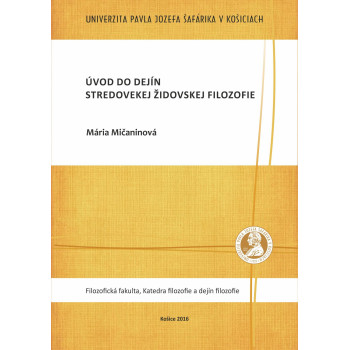
Scholars whose works constitute medieval philosophy were active as theologians, jurists, physicians, and sometimes even poets. Among them, there is hardly anyone who could be described exclusively as a philosopher.
For theologians and (religious) jurists, the primary source of their philosophical reflection was the Bible or the Qur’an. The second source was the philosophical heritage of the preceding antiquity, in which the figure of Aristotle and his commentators dominated. The Peripatetic legacy was complemented by followers of Plato in the long line of so-called Neoplatonic philosophy (e.g., Plotinus, Iamblichus, and Proclus), which in its beginnings developed within the environment of Hellenistic schools.
It is therefore not surprising that the main philosophical problem for medieval scholars was the relationship between theology and philosophy, or faith and reason, and, consequently, the relationship between theology and metaphysics. In the context of Christian thought, this was already discussed in the 2nd century, when some Church Fathers questioned the value of secular learning for those to whom the truth had been revealed by God.
Etika starostlivosti
E-book
E-book
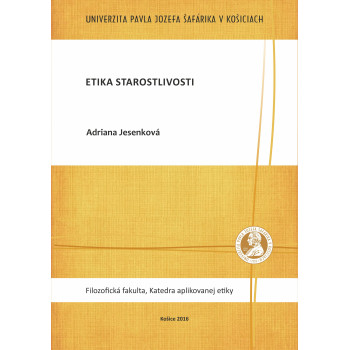
The ethics of care offers inspiring ways to think about the relationships and connections we are part of. It provides a new and unconventional reading and understanding of human relationships, thereby enabling us to respond in new and appropriate ways to certain empirical challenges (Pettersen 2011, p. 51).
Just twenty-five years ago, thinking about care was associated with women’s decisions in the private sphere concerning their personal dilemmas and problems. Over the last two decades, advocates of the ethics of care have demonstrated that the ideal of care has the potential to regulate not only private behavior but also human interactions in general.
Today, ideas about care have the power to change how we evaluate personal relationships, professional conduct, public policy, international relations, and global issues. The relevance of the ethics of care in such a wide range of areas of life, many of which are characterized by mutual incompatibilities and conflicting interests, is conditioned by several factors. However, one of the most significant is the creativity and fruitfulness of the thinking of the representatives of the ethics of care, who develop ethical concepts, models, and methods capable of grasping and analyzing human relationships in all their diversity (Pettersen 2011, p. 52).
Compared to traditional ethical concepts and theories in moral philosophy, the ethics of care introduces radically different sets of models and normative concepts. Today, it is precisely feminist ethics of care that offers a critical reflection on care within the realm of moral philosophy, ethics, and social philosophy. The aim of this publication is to identify the concept, subject, approach, philosophical foundations and starting points, as well as the possibilities for applying the ethics of care as a specific moral approach and, at the same time, as a specific moral theory in the field of social science and humanities research.